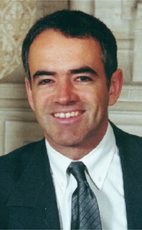
House of Commons photo

Crucial Fact

  • His favourite word was quebec.

Last in Parliament March 2003, as Independent MP for Témiscamingue (Québec)

Won his last election, in 2000, with 50% of the vote.

Statements in the House

Ethics Counsellor March 28th, 2001

Mr. Speaker, the ethics counsellor said that the documents for the period from 1993 to 1999 were not released because they were not relevant.

Yet, there must be documents from those years that would tell us why the Prime Minister got involved in the 1999 transaction, when he claims to have sold his shares in 1993.

I am asking the Prime Minister how the ethics counsellor can justify his decision not to release the documents for the 1993-1999 period, when it is precisely during that time that the Prime Minister put himself in a conflict of interest.

Prime Minister March 26th, 2001

Mr. Speaker, will the Minister of Industry confirm that before the changes recently made to the books of the golf club, one of the names on the shareholders' register was that of the Prime Minister?

Prime Minister March 26th, 2001

Mr. Speaker, referring to the 1996-97 period, the Prime Minister said in the House on Wednesday, regarding the golf club that, and I quote, “The Minister of Industry has stated that I did not own shares”.

However, officials of the Grand-Mère golf course stated that the Prime Minister's name was on the shareholders' register until 1999. Moreover, Radio-Canada learned that Industry Canada asked that the register be changed.

Could the Minister of Industry tell us whether it is the Prime Minister who asked that this change be made, the office of the Prime Minister or the minister himself?

Who asked that this change be made?

International Child Abduction March 26th, 2001

Mr. Speaker, it is with pleasure that I support the motion moved by the member for Rosemont—Petite-Patrie. This is something that I would have preferred we not have to do but, in the past five years almost 300 children in Canada have been abducted by a foreigner, which also shows that we have considerable difficulty recovering these children.

I listened closely to the debate and followed the issue, since my colleague brought it to the public's attention. Often refuge is taken behind the fact that there are agreements, conventions and so forth. It is all very fine and well to sign agreements and conventions, but some means of enforcing them is also necessary. That is the problem we are facing. There is little that can actually be done to get these children back.

The member for Rosemont—Petite-Patrie knows whereof he speaks because his spouse went through such a situation. I believe he is probably the member of this House who knows the most about this sort of situation.

It is unfortunate that the Liberal Party member seems more inclined to recite his briefing notes. Furthermore, I wish to point out to him that this is not a Bloc Quebecois motion but a motion by a member which is being debated under private members' business.

I am sure all Bloc Quebecois members and most, if not all, other members of the House will be pleased to support the member for Rosemont—Petite-Patrie, so that measures are much more effective than they are right now.

I listened carefully to my colleague earlier when he said that from the outset people often have to wait too long before action is taken. Not only must the federal government take action but the police must also review the way they operate and there must be co-operation in the exchange of information. Customs officials must also play a key role and their authority should be increased.

For example, we talked about measures as simple as issuing passports to children. There are very concrete actions. The rules could be tightened so that we would have an increased intervention capability that would help us prevent such incredible human tragedy where a parent is separated from his or her child. I do not need to make a long speech on this issue because everyone is aware of the negative and disruptive consequences that has on the child, on the parents and on the community. It is a human tragedy.

If only we could take measures limiting such tragedies because when we hear about a case in particular, we feel that it is very exceptional. I was very surprised to learn that there were around 60 cases a year, on average. When I said that there were close to 300 cases in the last five years, it was way too much.

I do not have enough time to speak in detail to each of the measures. My colleague has done a much better job dealing with the issue. I invite all members to unanimously support the motion. I invite the government to go beyond statements of principle and to take measures that have more teeth than what we now have.

I congratulate my colleague from Rosemont—Petite-Patrie and I assure him of my support, as no doubt all members of parliament will. Not everyone will get to speak but everyone will get the opportunity to vote and show his or her support for such an important motion.

Supply March 15th, 2001

Mr. Speaker, I will begin by answering the question, and then I will make comments. The answer is simple. What we are asking the federal government is nothing complicated: true free trade and nothing else. It is the basis for the best solution.

I will pick up on some of the points raised by the Canadian Alliance member. The lumber industry is a highly productive industry, both in Quebec and in British Columbia. I am pleased to be able to repeat this. There has been much talk of the new economy over the past 10 years or so, but our traditional resource sectors are now consumers of new technologies. These are highly productive sectors and perhaps among the best adapted to the integration of these modern new development concepts.

These are, therefore, highly productive sectors. It is not our problem that the Americans cannot compete with us. In the case of Quebec, we know that the figure was, if I remember correctly, 0.01%, the last time we checked the industry subsidy. We are talking of something that is marginal to say the least.

If our prices are lower, it is not because of a subsidy but because of our efficiency. The federal government needs to tell the American government now that there will be no more foolishness of signing agreements right and left, and thus hindering trade in this area.

I remember how the Minister of Industry took pride in announcing, in connection with a trade dispute with Brazil, that it was high time that Canada stopped acting like a Boy Scout in the conflict between Bombardier and Embraer.

It is the same in this case also. It is time for Canada to start acting like a true partner to the industry, to move to true free trade once and for all, and not to bow to the pressures exerted by the Americans during the period of turbulence that is coming when there will be but one objective: for free trade to start up on April 1 and just keep on going and going.

Supply March 15th, 2001

Mr. Speaker, I am pleased to speak today on an issue that is extremely important of course for a region like mine, the Abitibi-Témiscamingue region, but also for the whole province of Quebec and for a number of regions across Canada.

Canada is a major exporter of lumber. Lumber ranks among our greatest resources. We have been engaged in a trade dispute with the United States for some 20 years. Given the escalation in the means used, we should clarify this whole issue once and for all and support our industry to the end, so that this sector like many others is covered by a true free trade policy.

The Bloc Quebecois is proposing the motion today to show solidarity with an industry that has succeeded in building a very strong coalition, which shows that people are prepared for comprehensive and global free trade. These people are prepared to begin to play, on April 1, by rules that should have been in place for quite some time.

I will not review the whole history of this issue, but since 1982 the Americans have challenged on a number of occasions the fact that the Canadian industry was subsidized, using all kinds of recourses in the process. This situation was primarily due to a different approach, since in Canada large areas of forest and land are publicly owned, while in the United States they are privately owned. The Americans have always felt that stumpage fees were perhaps too low and they have used that argument to claim that our industry was thus being subsidized.

They have made that claim wherever they could, including in the United States, but not exclusively. They won a number of cases internally, but when the time came to clarify the matter before organizations other than those pressured by the American lobby or by the U.S. industry, their claims were never validated.

For a variety of reasons, this led the Government of Canada to sign agreements on two occasions with the American government, the protocols of which included acceptance of a system limiting our ability to sell our products freely on the U.S. market. The first of these was in 1991 and the second in 1996. It was to run for five years, terminating on March 31.

For the past five years, the current system has included quotas. Of course, even if the government wanted to recognize past production, a quota system creates problems for us in that it is too discretionary as to who has or does not have the right of production. Some benefit from the quotas on what we are entitled to produce, without falling victim to the drastic American measures.

I do not know how many members have had this experience, but I and many others have heard complaints from people in our regions that they did not have a big enough quota or were not given any at all. This creates problems for new players in the market. Lacking quotas, they are at a disadvantage compared to those who do have one.

As a result, we end up with an economic system in which highly arbitrary choices influence the capacity of certain industries to develop and prevent others from developing.

The time has come for the government to stand up and vigorously defend Canadian and Quebec producers. Just to remind the House briefly, so we understand what we are talking about, the industry in Quebec produces about 25% of Canada's output. I am giving figures for Quebec, but you will no doubt hear members from other areas during the day telling you how important this industry is for their region.

The industry in Quebec produces seven billion board feet. Production is measured in board feet. There are over 30,000 jobs linked to the lumber industry in Quebec. The sawmill industry accounts for 20,000 jobs and the forestry industry, 10,000. This industry is important in a number of municipalities, as we can see from the figures given this morning.

There are 250 municipalities in Quebec where all of the manufacturing sector jobs are related to this sector. There are 250 municipalities. We are therefore talking about something really important to many communities throughout Quebec, and I am sure that this is true in many other regions in Canada. It is very common to have a lumber business as the major activity in a village with, of course, a few other economic activities about. But the manufacturing sector is where we have to keep improving.

Our ability to export lumber does not excuse us from other issues, such as better processing our products, producing more value added products or better using our natural resource. All of this is an extremely important issue we must not lose sight of. But trade rules must be the same for everyone.

I remember that, when I was first elected in 1993, I had the opportunity to have discussions with Tembec Inc., a major player in that industry back home. On the general topic of free trade, officials from that company said “Yes, this is one way free trade. The Americans really like having access to our market, while it is very difficult for us to have access to theirs”. They were referring to all these problems they were experiencing in their industry or foreseeing because of the complex situation and the numerous challenges by the Americans.

Americans are very good at extolling the virtues of free trade. They will do exactly that at the Summit of the Americas. They will make great speeches in support of a market covering all the Americas. But it is another story when they are confronted to realities like the one where part of their industrial sector could be threatened by the very productive companies we have here.

Incidentally, we always talk about productivity gaps between Canadians and Americans, but there are sectors, like mining and logging, where our productivity rates are excellent. We too often forget to mention that. Whatever we may think and despite the fact that traditional economy has been run down and called “old economy”, there have been massive investments in the natural resources sector. Such sectors are often among the most productive in the Quebec and Canadian economy.

People in these sectors want access to the U.S. market just as much as the Americans want free access to ours. That is what free trade is all about. But we are familiar with this tendency of the Americans to say one thing and, in practice, to block free trade. This is one area where the Government of Canada will have to stand behind an industry. There are major legal battles on the horizon.

Certain provinces are being accused of dumping. There is again talk of challenges because this industry is subsidized. The government must not abdicate its responsibilities towards the industry in this battle. It must not negotiate any sort of transitional agreement whatsoever. This is one thing that worries us.

The government clarified its position, but there was a suggestion of hesitation when it said there would be a transition towards free trade. No transition is necessary. On April 1, we will be in a free trade position. This means that businesses will be in a new phase; admittedly, some will have a transition to make, but we do not want a transitional agreement. We want full free trade and we want the government to mount a strong defence of our industry in these battles, to be there for us and to take the lead, so that we do not find ourselves in the situation we have been in for several years now. The result of arbitrary decisions has been that some companies have been able to grow while others have not, and some have been limited in what they could do.

This is an excellent test of the effectiveness of the Minister for International Trade. We will see whether or not he is up to the task. He has everything he needs to succeed. The industry is strong and parliament will be very solidly behind him, I am sure, with the Bloc Quebecois motion moved today. He has a responsibility to succeed. The Government of Canada must succeed because this industry is extremely important to our economy.

Of course things will be heated for a while, because the Americans will make all sorts of threats, but we must follow through so that we do not find ourselves having to make this same argument every five years. We must resolve this once and for all, clarify the situation, and enter fully into free trade.

We have every confidence that our industry will do well in these circumstances and that our economy will be able to grow further.

Gasoline Pricing February 23rd, 2001

Mr. Speaker, the conclusions of the Conference Board have been known since October, but the government waited until February 22 to release them.

Finally, it seems clear that the conclusions were probably known ahead of time, since the start of committee deliberations, even.

Could we not say the Minister of Industry or the Minister of Natural Resources is mocking the public, since we know full well that Shell, Petro-Canada and Imperial Oil influenced this work, and the conclusions could be only favourable to the major oil companies and unfavourable to consumers? Who are the minister and the government protecting: the consumers or the petroleum industry?

Gasoline Pricing February 23rd, 2001

Mr. Speaker, rather than assume its responsibilities and calm consumers in the face of the high cost of gasoline, the federal government was satisfied with a study by the conference board at a cost of over $500,000, whose conclusions were favourable to the industry and supported government inaction. It was released yesterday. However a document dated last October contains word for word the same conclusions as yesterday's report.

Why did the government wait until after the election to release this study? Why did it not have the courage to make it public during the elections when it had the conclusions of the report in hand?

Gasoline Pricing February 22nd, 2001

Mr. Speaker, how does the Minister of Industry explain the conference board's astonishing conclusion that all is well in the petroleum industry, when the introduction to the same report says, and I quote: “Some issues, such as taxation and competition policy in Canada, are beyond the purview of the study”.

Gasoline Pricing February 22nd, 2001

Mr. Speaker, for months now, the price of gas has been approaching record highs. Prices sometimes fluctuate by seven to ten cents a litre on the same day. All companies post the same price at any given time.

But we can rest easy. Today, we read in a study done for the government by the conference board that “Consumers across the country are well served by the current market system that determines gasoline prices”.

My question is for the Minister of Industry. How can we trust this study, when some of the conference board's influential members include corporations such as Shell, Petro-Canada and Esso Imperial?