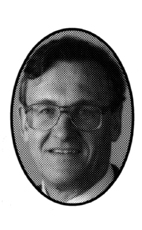
House of Commons photo

Crucial Fact

  • His favourite word was billion.

Last in Parliament April 1997, as Reform MP for Capilano—Howe Sound (B.C.)

Won his last election, in 1993, with 42% of the vote.

Statements in the House

Budget Implementation Act, 1995 June 6th, 1995

Madam Speaker, I appreciate the hon. member's remarks, but I must take him up on the fact that the day after the Reform Party issued its alternative budget we were together on a radio program in Vancouver, at which point he hammered me because in that budget we had similarly proposed the maintenance of standards through co-operative agreements among provinces. This is very

consistent with Reform Party policy that we should have less power at the centre.

I will never forget the hon. member saying that as an expert in constitutional law he would tell me that it will not be possible for the central government to either create or enforce such arrangements because there is no leverage. I am now very pleasantly surprised to hear that he has come around to the policy the Reform Party had pronounced before this budget came out and which he now feels is doable.

I have a practical question for him. Even though the Reform Party says that it would support this kind of an effort, does the hon. member really believe that a maverick province like Alberta would slow down its efforts to privatize and rationalize medicare by for example allowing more of the services to be provided by the private sector? Does he believe he could get from Alberta agreement of the nature he thinks is necessary if even at the present time, when there is a threat of withholding funds, this province, according to the minister, apparently is doing all those nasty things?

Budget Implementation Act, 1995 June 6th, 1995

Madam Speaker, I have a very quick question for my colleague.

Budget Implementation Act, 1995 June 5th, 1995

Mr. Speaker, before I turn to the main contents of my remarks, I would like to remind members of the House that in the last 24 hours the debt of the Government of Canada rose by $100 million. It now has reached a total of $556 billion. This is a very severe indictment of the budget, of which Bill C-76 is merely a method for implementing its contents.

We should periodically recall that Canada is in severe difficulties. We have to do more to eliminate the deficit, especially now that the economy seems to be slowing down and there are some indications of inflation raising its ugly head. I had hoped and wished that the government had cut spending more but obviously it was not to be.

Bill C-76 implements the budget. I am here to discuss the amendments which the Reform Party has proposed with respect to the maintenance of national standards of social programs.

The Government of Canada has a severe problem because it has switched from the traditional granting of cash to the provinces to a system which ultimately will lead to the elimination of all cash transfers. The reason is that along with the cash transfers used to come the opportunity to impose national standards on welfare and health and other programs which were financed. When this is eliminated the government will have difficulties because it will not have leverage over the provinces.

How has the government attempted to resolve the problem? The problem has been resolved by having the opportunity, without consent from the provinces, to impose standards. This is an interpretation we have put on what is in the bill. The government is acting without the consent of the provinces to impose standards. The Reform Party believes this is a very serious matter.

It is a pulling of power toward the centre that is unprecedented in Canada and we wish to oppose it. We have proposed some amendments which would clarify the point. No minister, no agent of the crown, can simply impose standards. They can be imposed only with the mutual consent of all of the provinces.

The second method which is very disturbing to Reformers is the decision whether certain standards have been violated by any province can be decided by cabinet in a closed session. We believe it is a similarly usurpation of power which is not suitable for the federal state. Third, there is a clause which we find unfortunate in that the power to withhold finances will not just be limited to the program, the standards of which were alleged to have been violated, but the ability to withhold money applies to other transfer payments. That is also an unfortunate development.

All of these approaches to try to maintain standards from the centre under the new Canada health and social transfers program are fundamentally against the current trend in Canadian society. What we have seen during the election campaign is the desire for devolution of power, to have smaller government.

I find it ironic that the parliamentary secretary a minute ago was praising that his government's program would lead to devolution.

At the same time there is this attempt to grab it back by trying to have clauses which restore and maintain the ability to set national standards.

I find it interesting to consider how we got those national standards. I remind the House that many years ago there was the obligation of individuals to look after themselves and if they could not do it families did.

We know when this is the case, cheating and excesses are not possible the way they are today. The closer programs are in their administration and design to the people they serve and who pay for them in the end, the more efficient and better they are.

The family alone historically was not able to maintain those services. When society became more complex churches, fraternal associations and all kinds of decentralized but slightly collective organizations took very good care of society.

How did it all happen? It happened in the post-war years when an intellectual, political and media elite imposed itself on Canada. It had a love affair with socialism, if not communism. The people who opposed these things thought the socialist experiment that had been undertaken in some of the industrial countries, especially the Soviet union, were a great success and that we should emulate them. This is how it came about. The initiation of those standards had their roots in a fundamental distrust in the wisdom of the people. They thought the people could not be trusted, that it took a political media elite to establish the kind of standards it thought were appropriate.

To me the most unbelievable thing was that this elite was able to persuade the media and others of the merit of its program. It introduced in a major public relations coup the idea that national standards are needed for national identity.

In the finance committee we heard a concerted effort of the political left discussing continuously on how a removal of these national standards means a destruction of Canadian national identity.

I am appalled by the ease with which this idea is still accepted. There is not one person questioning it. Is anyone saying that before we had national standards there was no Canada? Would anyone wish to ask the Prime Ministers governing up to the 1950s if they did not preside over Canada? That in my judgment is a lot of bunk. It was not the kind of Canada which the socialist dreamers wanted but it certainly had a national identity. I think that is absolutely silly.

In Europe the arguments are going in the opposite direction. Countries are attempting to integrate and unify their programs. For a long time the argument was there cannot be a united Europe, a European Union, because of different social programs. That is bunk also.

When a person grows up in a country with low taxes and low social programs, especially retirement benefits, they cannot when they retire or get sick move from that country of low cost in terms of taxes and the low quality benefits and say it is now their right as a member of the European Union to go into a country in Europe in which the taxes are high and the benefits are high.

I can understand how that would result in a breakdown of the system. We pay the low insurance rate when we do not need it. Then when we have the need to draw on the system, we go where the rates are high. It is very easy to avoid this kind of thing both in Europe and in Canada. We will be able to move from a province with low benefits and costs to one with higher ones, except that the benefits we get have to come from the province in which we have made our payments when they were low. It is as simple as that.

The ideas that we need national standards for national identity and that the system would break down because of different tastes, different levels of benefits and costs in individual provinces are a fabrication of people who were out there in the post-war years to persuade Canadians by any means possible that it takes people in Ottawa of obviously superior intellectual and moral standards to say what is the right level of welfare benefits, of health care and of unemployment insurance and various other goodies the state provides.

The amendments the Reform Party has proposed try to deal with this. We have done so with the conviction that it is in the interest of Canada in the long run to continue the process of devolution. We have gone through a very noble experiment of centralization, of national standards, which has obviously failed. The programs are all in financial difficulties and there are more people needing these kinds of systems simply because they were not administered properly.

Budget Implementation Act, 1995 June 5th, 1995

moved:

Motion No. 57

That Bill C-76, in Clause 51, be amended by replacing lines 7 to 26, on page 29, with the following:

"51. Subsection 23.2(2) of the Act is repealed."

Budget Implementation Act, 1995 June 5th, 1995

moved:

Motion No. 49

That Bill C-76, in Clause 50, be amended by replacing lines 23 and 24, on page 26, with the following: a ) any order made by the Federal Court in respect of the province under''.

Motion No. 50

That Bill C-76, in Clause 50, be amended by replacing lines 19 and 20, on page 27, with the following:

"province has not given an undertaking conforming to the provisions of this Act to remedy the non-".

Motion No. 51

That Bill C-76, in Clause 50, be amended by replacing line 23, on page 27, with the following:

"the matter to the Federal Court."

Motion No. 52

That Bill C-76, in Clause 50, be amended by replacing lines 24 and 25, on page 27, with substituting the following:

"(2) Before referring a matter to the Federal Court under subsection (1) in respect".

Motion No. 53

That Bill C-76, in Clause 50, be amended by deleting lines 39 to 44, on page 27.

Motion No. 54

That Bill C-76, in Clause 50, be amended by replacing lines 2 to 15, on page 28, with the following:

"under section 20, the Federal Court is of the opinion that the province does not or has ceased to comply with section 19, the Court may, by order, direct that any cash contribution under the Canada Health and Social Transfer to that province for a fiscal year be reduced, in respect of each non-compliance, by an amount that the Court considers to be appropriate, having regard to the gravity of the non-compliance."

Motion No. 55

That Bill C-76, in Clause 50, be amended by replacing lines 40 to 42, on page 28, with the following:

"year when the Federal Court determines that the".

Liberal Red Book June 1st, 1995

Mr. Speaker, have you noticed that the Liberals are no longer waving the little red book in defending their policies? There is a good reason. We did some research. At least four of the promises in the little red book have been broken already and we are only halfway through the mandate of this Parliament.

If props were allowed in this House, Reformers would be waving the red book as a symbol of broken promises, of a callous lack of integrity of a government that campaigned on being different.

Were the Liberals incompetent or just power hungry when they made promises Reformers always knew could not be kept, to replace the GST, raise immigration to 300,000, and many others soon to be paraded in front of this House?

Goods And Services Tax May 31st, 1995

Mr. Speaker, Reformers always knew that there exists no GST replacement that quoting from the red book "raises equivalent revenues, is fairer to consumers and small business and minimizes disruption to small business". There is not one replacement that could be created within one year.

My question is also to the Minister of Finance. Is this broken promise symptomatic of Liberal incompetence, or is it a sign of Liberal willingness to promise almost anything in order to get elected?

Goods And Services Tax May 31st, 1995

Mr. Speaker, this is the first question about one of many, many broken Liberal promises. It concerns the government's promise to replace the GST with a system that, among other things, is fairer to consumers. The Deputy Prime Minister promised to resign if such a replacement was not completed within one year after the election.

My question is for the Minister of Finance. Why has the government failed to deliver on this promise?

Integrity In Politics May 29th, 1995

Mr. Speaker, during the election campaign the Liberals emphasized strongly the issue of integrity. They claimed the Conservatives had callously broken election promises and destroyed public confidence in politicians. The Liberals promised to be different, but they were not. During the coming months you will see just how many promises they have broken. Reformers will parade them before you.

Reformers are happy the Liberals adopted so many Reform policies, but Canadians are rightly disappointed with the Liberals' broken promises. They are asking if the broken promises are a sign of Liberal incompetence or a sign of total disrespect for the intelligence of Canadian voters.

Members Of Parliament Retiring Allowances Act May 10th, 1995

Mr. Speaker, I was trying to put some perspective on the debate about pensions by suggesting that what has happened in Canada and many other democracies is we do not have a transparent system.

In free markets, when there is no government to step in constantly and listen to people about their unhappiness about their wages, there is a very important equilibrium achieved in markets. Individuals under their own free will can walk up to someone and say they would like to work as a cook, as a miner, or whatever it is, and he or she gets employed. They are obviously better off than with anything else they would have done. They are happy. They have had a decision. They have maximized their welfare.

One can imagine that in a world like that, without any government, we can develop a situation where there are just the number of cooks who want to work at the wage that is being offered them to be cooks. There are just the number of nurses. There will be neither people who are looking for jobs nor will there be shortages. The wages that come out of such a competitive system may be interpreted as being efficient and in some sense representing the best distribution of wages our society can arrive at.

We all know that especially in the post-war years governments have taken it upon themselves to correct the outcome of the market. We have opened our ears as members of Parliament

to people who do not like the structure that has come from a free market where people under complete freedom, talking to each other and making contracts without coercion, have produced this outcome.

We hear stories that are so appealing they always bring tears to my eyes. I hear farmers telling me: "My income was only so much. My wage was only so much. Do you know how important my job is? If it was not for us farmers there would not be any food and we would all die. Therefore, I think I should earn more". I do not have to elaborate on what the nurses and doctors say and what the teachers say would happen to the next generation if they were not there.

All of this sounds very good. The people who say this all the time have themselves completely convinced that the wages a free society and free exchange have produced are not right. They need more and more. This has created the kind of division in society we have today, inefficiencies and problems. The wages are set so high that there are long waiting lists of people who wish to join that occupation and others where the wages are too low and they cannot find workers for it. It is a sad thing. I believe that decentralized decision making was much better. However, we are now in an ideology that says the government has a right to step in.

I want to now turn to a special problem that is associated with setting the wages of people like members of Parliament, where a government has to be involved. Here the problem is that until now there has never been a shortage of people who want to apply for the job. I do not know what the right wage is. I challenge anyone. The big problem is that the wage that is set will determine on average what quality of skills, intelligence, and energy you get of people who apply for the job and ultimately will end up in the Chamber.

I think almost everybody would agree if today the wages for MPs were $20,000. What we would get on the one hand would be people who could not make more than $20,000 in the private market. On the other hand, we would get very rich people to whom this would be a hobby. It would be a totally undesirable mix of people here in Parliament. However, who is to say what is the right wage? We cannot ask members of Parliament any more than we can ask farmers, nurses, doctors or teachers. They will all say they have the most important job in society and it should be very, very high. Of course it cannot be done like that.

What is the next best solution? Historically, we always have to come up with some wage. What is the right wage? The Government of Canada and all democratic governments have taken recourse to appointing commissions. The other day another commission report was released on that subject. I looked back. There must have been commissions in the history of the Parliament of Canada at least every four or five years since the founding of Parliament. They have all said that the wages should be higher than they are.

To the best of my memory they said the wage should be set around $100,000 or $120,000 a year. I am not endorsing this. I do not know what the right answer is.

One of the big problems comes once these wages are announced by these wise people. They are typically appointed with the consent of a broad spectrum of people. Canadians believe these wages are high relative to the norm.

I have recently been having a lot of fun asking people I meet at dinner parties or at political conventions what the average income is of a Canadian working in manufacturing. Very few know it is $32,000. I ask what income does one have to earn to belong to the top 10 per cent of income earners in Canada. It is $52,000. The kind of people one meets when one is a member of Parliament typically say it is somewhere around $80,000 or $100,000. Some young students who come to lobby me tell me it is $1 million. It is $52,000 or $53,000.

It is quite clear the kind of problem we are facing as a Parliament in our system. People who have the best in mind for Canada say that if we want quality people in Parliament, we should set a wage that right now would probably be putting them in the top 1 or 2 per cent of the income distribution. Yet the majority of Canadians have lower wages.

It was not malice on the part of past Parliaments that took a way out of this which is now beginning to haunt us. They have set wages which are within the realm of acceptability in public opinion. Then they have begun to hide compensation in order to achieve a level of compensation that is consistent with what these wise people have said it should be. That is why my whip said the other day that if we look at the hidden compensation we would reach a level that is a little below what these commissions have recommended recently.

As is typical with all these procedures without checks, once members of Parliament in recent years found out they could get away with hiding compensation, they went overboard. They went overboard in the form of pensions. It was clearly a mistake on their part to have gone as far as they have by overshooting the amount of compensation hidden in the pension.

What I conclude from this analysis of our current problems is that the issue faced by Parliament today is not the narrow focus on the pension; it is what my colleague the whip has said. We need a more rational structure, a transparent structure of the compensation for members of Parliament.

We should also be open with the people of Canada. In today's age of high levels of education, of communication, of understanding, I am personally convinced and have enough confidence in the democratic system that people would accept the judgment of those wise people and say: "Yes, we want that quality of people to run for Parliament. We do not want it to be

reserved for only the rich or people who don't have anything else to do. We want to attract good people". They would probably go for a compensation that is very close to what we have now, but a much lower pension. That would be consistent with what the last commission said.

In my judgment we need a more transparent, open system that would put all of the cards on the table. We would end up with this being accepted by the people of Canada.