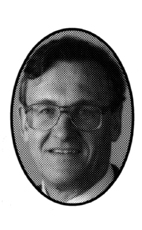
House of Commons photo

Crucial Fact

  • His favourite word was billion.

Last in Parliament April 1997, as Reform MP for Capilano—Howe Sound (B.C.)

Won his last election, in 1993, with 42% of the vote.

Statements in the House

Health September 21st, 1995

Mr. Speaker, of course the health minister's policy stance is not entirely irrational. It is rational if she expects provinces to raise taxes to pay for the financing deficit of the federally mandated program.

What does the minister say to those who see her policies as an unwarranted violation of provincial rights that feeds the demand for independence in Quebec?

Health September 21st, 1995

Mr. Speaker, my question is for the Minister of Health.

The provincial ministers of health are frustrated after yesterday's meeting with the federal minister. She insists that funding will be cut, but she also insists militantly that none of the provincial ministers' policies to save money are acceptable. This policy stance is not only arrogant, it verges on the irrational.

What precisely are provincial health ministers allowed to change in the allegedly perfect present system?

Questions On The Order Paper June 22nd, 1995

Concerning the announcement in the last budget of a decrease in the number of civil servants by 45,000, what number of these positions are expected to be eliminated by ( a ) not refilling positions which are now vacant, ( b ) the commercialization of government activities like airports, ( c ) early retirement and ( d ) voluntary quits (attrition)?

Criminal Code June 15th, 1995

Mr. Speaker, I find this a very disturbing discussion. It is implied by the hon. members who were speaking-I heard the last three speakers-that somehow by opposing this bill one is in favour of crime, hate crimes, crimes of passion, whatever. We are not. Reform is not.

The problem we face is that so much of what is being asked of us involves a curtailment of one of the most fundamental rights in a democracy. Some countries have established in their constitutions limits on government to pass legislation that restricts the freedom of speech. It is about the freedom of speech for people to say whatever they want to say. It is not possible to suppress this without going down a very slippery slope in the destruction of democracy.

The problem is that when anyone takes words and transfers them into violent action, that is when we should come down on them with a ton of bricks, not when they are saying what they believe. Where does one draw the line?

There have been Parliaments, there have been legislatures around the world, people with even greater indignity and self-righteousness than the speakers we have heard tonight, who say they have the solution to all the problems of mankind: all we have to do is shut down the ability of that person to speak.

The founding fathers of the United States have said that this is one of the greatest dangers to democracy. Nobody is in favour of those crimes. But what we are talking about and what I have heard being said here is that we must go to thought control, to speech control, and that means the end of our freedom. That is why I will vote against this bill.

Family Income June 15th, 1995

Mr. Speaker, since 1981 tax freedom day, the day when people's annual incomes go into their pockets, has advanced 73 days. The Fraser Institute announced that this year it is on July 5. The tragedy is that the ever higher taxes we all pay do not get us more services, they pay interest on our staggering debt.

When will the government close the bottomless hole for our tax dollars by cutting the debt and getting Canadian families once more to enjoy increases in after tax incomes as they had for decades before the deficit became out of control?

Family Income June 15th, 1995

Mr. Speaker, Canadian families are right; Statistics Canada has made it official. Family incomes after taxes have fallen 6.5 per cent in real terms since 1989; 2.1 per cent in the last year surveyed. Canadians are fed up with the performance of the economy and rightly blame the federal government.

Will the minister accept the blame for the decline in family income and change the policies responsible?

Firearms Act June 13th, 1995

Can you explain that?

Telecommunications June 13th, 1995

Mr. Speaker, increased competition in broadcasting by telephone companies will increase consumer choice and result in lower prices.

The people of British Columbia are in danger of losing these benefits because B.C. Telecom is partly foreign owned and therefore prohibited from holding a broadcast licence.

I urge the government to remove the relevant foreign ownership restrictions altogether to maximize benefits for consumers.

As a second best policy, I urge the government to permit B. C. Telecom to own a broadcasting licence by a special waiver of the foreign ownership restriction just like it has for the company's other activities.

The people of British Columbia would be sure to benefit greatly.

The Economy June 12th, 1995

Mr. Speaker, national income this year has been stagnant because exports are down. It is disturbing that housing starts are also down, car sales are down, manufacturing is down, retail sales are down and service industry output is down. The only things that are up are interest rates and taxes.

Will the Minister of Finance let the people know how he plans to get them out of the quagmire he created by his inadequate spending cuts in the past?

The Economy June 12th, 1995

Mr. Speaker, when interest rates are high economic slowdown and recession are inevitable.

Statistics now show the inevitable has occurred. Economic growth in this quarter at an annual rate is essentially stagnating; there is no economic growth. The tragedy is these problems could have been avoided if the deficit was smaller and had produced lower interest rates.

Does the Minister of Finance admit Canada's economy and employment situation would be better today if spending cuts in the last two budgets had been greater and the elimination of the deficit had been put on a definite time frame?