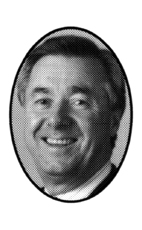
House of Commons photo

Crucial Fact

  • His favourite word was made.

Last in Parliament April 1997, as Liberal MP for Acadie—Bathurst (New Brunswick)

Won his last election, in 1993, with 66% of the vote.

Statements in the House

Manpower Training June 3rd, 1996

Mr. Speaker, we are in fact trying to identify throughout the operations of the Government of Canada items that would be of interest in discussions with the provinces, however, I must tell you we have to be careful. The mandate of the Minister of Human Resources Development is limited. I do not want to walk on my colleagues' toes, but we will try to do our level best to be sure to meet our commitment to show once again that Canadian federalism is flexible and that it works.

Manpower Training June 3rd, 1996

Mr. Speaker, clearly the aim of the Government of Canada is to ensure arrangements are made to ensure these programs are managed effectively and by those in the best position to do so.

I would like to assure the hon. Leader of the Opposition that we fully intend to act on the proposal we made to the provinces whereby the Government of Canada would co-operate in every way possible with the provinces, as the provinces wish. However, I have no doubt that, once discussions are underway, there will be little that is not on the table in the context of the question raised by the hon. Leader of the Opposition.

Employment Centres May 31st, 1996

Mr. Speaker, in the process of restructuring a department and changing service delivery to our clients, decisions are never easy.

However I would like to explain to my hon. colleague, as we have already tried to do on numerous occasions, that we are always ready and willing to provide him with all the information and explanations, either through our director general for Quebec or through officials of my department and myself. We had to take decisions throughout Canada and Quebec, and these are always very difficult. They are never decisions that will please those living in the communities hit the hardest.

As for the purpose of the exercise, we have only one criterion: that is to be certain that, at the end of the exercise, we can provide the necessary services to people. With yesterday's announcement, I hope that we will have strategies in the future that will perhaps improve the situation. But, for the time being, we believe we have acted fairly and equitably, particularly toward our clients.

Manpower Training May 31st, 1996

Mr. Speaker, this is obviously a highly complex matter, this entire area of training and active measures.

The hon. member is right, there are other departments in addition to my own with responsibility in these sectors with which we have long been involved. I wish to assure my hon. colleague, and particularly the governments with which we are going to negotiate, of our desire to ensure that these active measures, tailored to the specific needs of the provinces, are delivered by them.

As far as our withdrawal from manpower is concerned, the hon. member indicated that the money we do not spend on training will still be there somewhere, but that is not the case. As you know, despite the valiant efforts of the Minister of Finance, we still have a deficit in Canada.

It is not as if there were money left over somewhere. When budgets are cut, or when we pull out of one or another sector, the unspent moneys are reflected in the government's overall financial plan, and it is in that context that we have already committed ourselves to decreasing our expenditures year after year. This has, moreover, already been done already for some time; when we are no longer involved in manpower training, the budgets will have been totally used up as well.

Manpower Training May 31st, 1996

Mr. Speaker, I do not wish to suggest that we will not manage to sign any agreements, but even if it happened that no agreement was reached, we are already committed to withdrawing from the field of manpower training. Our decision in that connection was made months ago. As far as the estimates and appropriations earmarked for manpower training are concerned, it was our intention, and continues to be our commitment, to withdraw totally from manpower training.

This means the budgets will drop to zero. We will not be getting back into that area again; we have absolutely no intention of doing so.

As for the agreements we hope to negotiate, however, there is no doubt that for active measures, if the provinces so desire-and it will be of their own choosing-they will no doubt be able to do certain things in the occupational training sector which they consider to be legitimate and worthwhile.

Manpower Training May 31st, 1996

Mr. Speaker, the purpose of the offer made to all of the provinces and territories of Canada is as follows. We wanted to ensure that there was some element of certainty, if ever we were able, as I hope we will be, to reach some agreement that would last a minimum of three years. We wanted to be sure that it lasted at least three years. That is not the maximum, nor the set duration.

In this way, we hope to be able to show our good faith, our desire to find a new way of doing things, assuring the provinces and territories that any agreement concluded would last at least three years. This is not merely a question of revision; for as long as agreement continues thereafter, once the three years are over, we ought to be able to continue these agreements for an indefinite period.

Employment May 30th, 1996

Mr. Speaker, the hon. member raises an extremely important question. It goes far beyond the proposal we were able to put on the table today to the provinces.

The question of labour mobility is one my colleague, the Minister of Industry, has addressed. There is no question we have to rely on the provinces. If appropriate we would like to play some role as a catalyst in bringing the provinces together. We would like to set up arrangements which would allow for the mobility of the Canadian workforce.

As we function in a global society with NAFTA, free trade arrangements and all the rest, I think the hon. member will recognize it is a major challenge for Canadians, the federal government and the provincial governments to find ways to ensure complete labour mobility within the Canadian Confederation.

Employment May 30th, 1996

Mr. Speaker, I thank the hon. member for his question. Let me address its two parts.

First, the $2 billion being spent is not calculated in the surplus that is developing after quite a long period of deficit in the unemployment insurance fund.

With respect to the proposal the Government of Canada made today to the provinces and the territories, we believe we are responding to very legitimate and longstanding requests from the provinces to have more control, in some cases almost complete control, of the active measures they wish to put in place as they so desire.

This money is raised through premiums paid for by employers and their employees. We believe, as do most of the provinces if not all, that it is absolutely essential we find means to provide opportunities for people who are the passive recipients of employment insurance to get back into the workforce either by job creation or by providing wage subsidies, upgrading of skills, various techniques which we are very confident the provinces will take up and do a good job of administering.

Manpower May 30th, 1996

Mr. Speaker, certainly there were programs where training was financed out of the consolidated fund. What we are saying is that we have been easing out of training in the area, for example, of the direct purchase of space in CEGEPs and community colleges and in the purchase of training contracts from the private sector. We have planned for some time in all our budget forecasts not only to participate less in this sector but to cut funding as well.

That said, with part II of the Employment Insurance Act still before Parliament and with our upcoming negotiations with the provinces that would be interested in pursuing the proposal we tabled today, I hope that we will continue to find the means to provide job training throughout the country to those who need it.

Manpower May 30th, 1996

Mr. Speaker, the federal government has long been asked to withdraw from manpower training. We announced nothing new in this area this morning. We have already said, on many occasions, including in the throne speech, and the Prime Minister has announced it, that the Government of Canada would be withdrawing from manpower training.

Moreover, we have always indicated in our budget forecasts that funding for all these programs would drop to zero at the end of three years. We have already considerably reduced the amount of money earmarked for training.

Since we have to withdraw from this sector, because employment insurance and manpower training are two fairly different things, we are withdrawing and have been continuing to reduce the funding to zero.