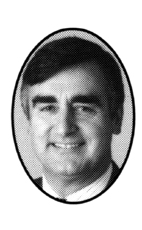
House of Commons photo

Crucial Fact

  • His favourite word was quebec.

Last in Parliament April 1997, as Bloc MP for Lac-Saint-Jean (Québec)

Won his last election, in 1993, with 76% of the vote.

Statements in the House

Maintenance Of Railway Operations Act, 1995 March 26th, 1995

Of course, there will be consequences. The government may have conducted fifteen polls over the last week-a government has money to conduct polls-and these polls may have shown that people in English Canada support the Liberals' position, but it has to be careful not to be shortsighted. This situation will have far-reaching effects and the government, having chosen to have working conditions imposed by a third party, will find itself in an awkward situation when it is all over.

I wonder how the government will be able to sell CN if the labour relations climate in that company is what it could become after this move by the government. I hope not, but the climate may not be very good. When employees are legislated back to work and, especially, when they know that their terms and conditions of employment will be determined by a third party, that nothing will be up to them to decide and that vested rights will be dropped, the climate may not be very conducive to efficient privatization.

Furthermore, this government feels it made a tremendous concession by promising, and in fact this is in the bill, to have judges chair the arbitration commissions. I have every respect for judges. I am a lawyer, and I know we have the best judges anyone could wish. The integrity of our judicial system is beyond question, and I am glad to have an opportunity to say this, but because of that integrity, our judges will act according to the mandate they are given.

What will that mandate be? If we look at clause 12, we see that the arbitrators will have an extremely narrow mandate to work with. The arbitrators have no flexibility because they will have to make their decisions strictly on the basis of economic viability and competitiveness in the short and longer term. This means, and I refer to the people who accept these appointments, that their hands are tied, and I know several people who will refuse to sit on these commissions. There are decent people who will refuse to sit under those conditions because they do not have enough latitude to hand down a fair judgment. I am not saying that those who do accept are any less decent, and I have every respect for them, but they will be working within a very restrictive framework where they will have no flexibility and will have to more or less accept the employers' arguments, one by one.

They are going to change the role of the arbitrators as well, or at least try, by turning them into the employers' allies. The Minister of Transport probably had something to do with that as well.

I wish the Minister of Labour, in her initial performance as minister, had been more impervious to the power-hungry demands of the Department of Transport's appetite for power.

We can only hope that everything will turn out well. I hope so. But the trouble with this debate is that the government tried to suppress it. The government tried to suppress the debate. This government does not like debate. It does not like dissenting opinions. This government will only give in to its own impulses.

In concluding, we will vote against this legislation, of course, and we hope that in the future, the Department of Labour will take a more objective stand and will act more responsibly with respect to its obligations to the parties, both employees and employers, because there are not only employers, there are also employees.

Maintenance Of Railway Operations Act, 1995 March 26th, 1995

What are we debating here this weekend? I understand that the government is very unhappy to be working on Saturday and Sunday-maybe not as unhappy as NDP members, our allies in the defence of social causes, who have not shown up at all during these two days-but are we not dealing with some important issues? We did not come here this weekend to talk about trivial things. We came here to talk about Canadian democracy. We came here to try and find a way to reconcile two fundamental rights, namely the right of citizens to have access to public services, in this case rail transport, and the right of unions and workers to negotiate their own working conditions instead of having these conditions imposed on them by the government or by an arbitration commission.

Let me tell you, Mr. Speaker, that the Bloc Quebecois is proud of the way it has defended the rights of workers in this dispute. Even if we were the last party left in this House to defend the rights of workers, and it seems to be the case, we would be proud to do so. It is a tribute to Canadian democracy and I think that we should be recognized for doing this job for and in the place of the Liberals who have abandoned their traditional creed and who, just like the New Democrats, frightened by the right wing wind that has been blowing in this House since the arrival of the Reform Party, have caved in to the pressure in a situation which, normally, would not have warranted this course of action.

All the Liberals who are here have made speeches in the House in the past to defend the very same viewpoint that we are defending today. I am sure that they feel bad and that they regret giving in to the pressure from the Reform Party because soon there will be only one party in Canada apart from the Bloc, and it will be the Reform Party and what it stands for.

Maintenance Of Railway Operations Act, 1995 March 26th, 1995

I think the government was swayed by the interests of the employers in this issue. You can tell just by the way it has handled it, if only at the parliamentary level. Will people not find it strange how eager the government was to muzzle the opposition, to use tactics which had never been used before in this House? For the first time ever, a gag was put on committee proceedings. That is really something. Was there an emergency? Was there an imminent political crisis? Was there a

state of war? No. But the government was eager to fulfil its commitments to its friends in the railway companies.

The government wanted to do a job on the CN collective agreements, in order to be able to sell the company for less. This is the goal it was aiming for and that is why, throughout last week, the government did things I really did not like. One of our hon. colleagues, the government whip, even stated yesterday that the Bloc was costing the taxpayers $17,000 a hour, all for nothing. We, in the official opposition, were blamed for having these sittings. We, in the official opposition, in a democracy, were blamed for making Parliament work. Here was someone complaining because we have a Parliament. With this kind of arguments, we will soon be without a Parliament at all, we will just have to close shop.

Maintenance Of Railway Operations Act, 1995 March 26th, 1995

The comments I just made raise a question. Those who may be listening to us on this lovely Sunday afternoon may ask themselves: What did he just say? Why would the government do such a thing? Why would a decent and responsible government do that? Why would a government team up with the employers to distort the conflict resolution process? This is a good question, but we have the answer.

The answer was provided by the Minister of Transports. The Minister of Transport himself told us in this House last week, I think it was on Thursday, but I could be wrong, any way he told us on Wednesday or Thursday in answer to a question put to him: "Yes, but the truth is that our goal is to get rid of some provisions in the collective agreements". They do not like these collective agreements, so they are going to change them, to do a hatchet job, to scrap them.

Once this is done, they will be able to soothe the employers and sell the CN. They will sell the CN and make a lot of money out of it, because they will do so at the expense of the workers and of their rights and entitlements. They will shave down the collective agreements and then hand a very nice package to the private companies interested in buying the CN. This is the goal sought by the minister. He has said so in this House. We thought that was what he was trying to achieve, in fact, we were quite sure of it, but now he has admitted it.

Maintenance Of Railway Operations Act, 1995 March 26th, 1995

Mr. Speaker, we have a system of law. We live in a society governed by laws. We have a parliamentary institution, and a government, charged with enforcing existing legislation. The entire Canadian legal system as it relates to labour relations is based on the freedom to negotiate, on the objective of ensuring peace between the parties to an industrial dispute and the harmonious operation of the factories and workplaces once the dispute has been resolved. I believe that the freedom to negotiate is a key element in all of this.

The freedom to negotiate is dependent on the balance between two powers: the very important economic power wielded by the employer, which is countered by the union with its own brand of power, given to it under law in the form of the right to strike. It is a legislated right.

One would think that, generally and normally, when both parties exert pressure, when they act in good faith without anyone trying to disrupt the process, when they are willing to make concessions, with common sense prevailing, an agreement will eventually be reached. The legal system and government services are designed to help reach an agreement because everyone understands that the best and only effective solution is a negotiated solution.

What happened in this case? They may well criticize the Bloc Quebecois for being the only party in this House which defends the legal system of free collective bargaining. Well and good, but they forget that the main culprit in this dispute is the government, in particular the Minister of Labour, who turned into an employer in this matter.

They will say that, the opposition being the opposition, it will attack the government and try to bend the truth a little. It is common practice in politics.

Instead, let us read the report and conclusions of an impartial witness, conciliation commissioner Hope, whose job was to observe, minute by minute, the progress of the negotiations.

This report contains devastating comments on the behaviour of the government and the Minister of Transport. In this matter, the government, far from favouring settlement and protecting against any external disruptions the progress of the usual settlement mechanisms whose results are based on free collective bargaining, sought to disrupt and destroy this balance by siding with the employer. I would even say that it became an employer. The government behaved like an employer in this matter. I would go so far as to say that it prevented the official employers from negotiating.

Let us suppose for a moment that we are all CN presidents-we would be happy in some respects, of course, as this would be a remarkable promotion-and that our representatives, reporting on the discussions, tell us that we ought to make concessions on our demands to drop non-monetary clauses, that if we make no concessions, the resulting strike would hurt us and that the public may not appreciate our behaviour during the negotiations, so that we must make concessions.

Normally in such conditions, an employer makes concessions and uses some common sense to reach a compromise with the union, which is also under pressure. But why would an employer negotiate when, like the president of the CN in this case, he has the government's assurance that it supports his position, as denounced in the Hope report, when he knows that the government is 100 per cent behind him and that, in the event of a labour dispute, the government will take out the bludgeon to quash immediately the right to strike and pass special legislation providing for a third party to impose working conditions? There is no motivation to do so.

In fact, the employers did not negotiate in this case. They did not negotiate because they relied on the complicity, I would say the collusion, of the Minister of Transport, expecting him to make sure that back to work legislation would be tabled in this House within hours of the start of a strike or lockout.

So, what was bound to happen did: the employers put on the table major clawback demands and, according to Mr. Hope, refused to negotiate. They even refused to consider the possibility that their demands be discussed or revised in any way, or that reservations be made about them. They did not even take part in

discussions on their demands. It was a take it or leave it proposition.

So, of course, this lead to a conflict. Barely 12 hours into this conflict-and this illustrates what I just said-the Minister of Labour, who is new to the issue, sets in motion a process to break the strike through special legislation. The Minister of Labour is therefore a major player in this issue. We must recognize however that there was not much she could do because, as the saying goes, the scene was set. All she now had to do was follow the script. The scene was set thanks to the great producing abilities of the Minister of Transport.

What could she do except become the employer herself and ensure that the strike could be quashed immediately, while at the same time setting the working conditions? I think that a Minister of Labour worthy of the name would have borne in mind that she or he has a job to do and is not accountable to the Minister of Finance-who wants to privatize CN-but is responsible for social peace and to the parties. Her role involved trust and confidence.

The Minister of Labour should tell her colleague for transport that, while he had been able to reach the agreements he wanted with his friends, the employers, she, as Minister of Labour, could not take sides, that she was responsible for social justice and fairness. What should she have done then?

I am not saying that the government should tolerate the negative effects of a strike indefinitely. It would have been appropriate to table this special legislation on Monday and get the parties back to work. It is at this level that the Minister of Labour could have played an important part in cabinet. She could have enlightened her cabinet colleagues and told them: "Yes, we will get these people back to work to avoid the negative effects of the strike, but we will also ensure that the parties can negotiate without interference, while it is still time to do so. For the first time in this conflict, we will put in place conditions such that the parties involved can negotiate in good faith and find a solution to their problems. We will force the employer to negotiate by not giving it the assurance that the government will impose back-to-work legislation and thus serve its interests".

The Minister of Labour knew what to do very well. She was very familiar with the usual solution in such a conflict. This is something that people involved in labour relations learn quickly. The minister knew what to do: go to mediation. She knew it so well that she did so in another conflict, in Montreal, which had persisted for 25 months. In this case, it has been 18 months, but in Montreal, it had been 25 months. So what did she do? Following the wise counsel of her senior officials, and assuming her responsibility as Minister of Labour, she decided that there would be mediation in the Port of Montreal conflict, to force the parties to conduct true negotiations under appropriate conditions, so that a negotiated solution might be reached. The process proved to be successful in the days that followed. Considering that the solution is known and that it gave very positive results in Montreal, why does the Minister of Labour decide to go all out in the case of the railway work stoppage and pass a piece of legislation imposing working conditions?

I want to be clear. We are not opposed to back-to-work legislation. We believe it is legitimate to resort to such legislation and we would have agreed to do so as early as tomorrow, so that by Monday evening the act would have been passed in this House. However, we do not accept the fact that this situation be used as a smoke screen. After all, what do you think is the goal of the government in this issue?

Maintenance Of Railway Operations Act, 1995 March 26th, 1995

In a democracy such as ours, in a country in which we have often been faced with labour disputes and in which we have acquired some experience in resolving this sort of conflict in a civilized and competent manner, it is vital that we take this opportunity to examine the need to maintain some sort of balance.

Mr. Speaker, I believe I am disturbing the people across the way who are speaking.

Maintenance Of Railway Operations Act, 1995 March 26th, 1995

Mr. Speaker, regarding this issue, the Bloc deplores the government's simplistic position and its extravagant if not biased speeches.

The government has always stressed the negative repercussions of the strike and its real economic impact, of which we all are aware, and really went overboard on the issue. It kept on repeating that factories were closing everywhere in Canada, coast to coast, particularly in Quebec, since the Bloc Quebecois was the government's main opponent in the House on the issue. Very few economic sectors in Quebec were spared the threat of imminent closures, yet nothing of the sort actually happened.

The government tried to terrorize and brainwash people by exaggerating the economic consequences. I do not want to minimize the consequences, but I think that a government dealing with such an extensive labour dispute, like the one currently affecting the country, should be more reserved, impartial and objective. The government should not upset people; it should reassure them while trying to find a solution. The government did the opposite. We were witness to an incredible demagogic offensive, we were bombarded with a slew of disastrous predictions, which did not turn out to be accurate.

We must nevertheless acknowledge that considerable economic interests and jobs are at stake, not only in the sector directly affected, but also in the sectors spinning off from it.

We are not oblivious to the economic impact of the strike. We proved this by proposing to the government, as early as last Monday, a classic solution of the sort normally used to settle this kind of dispute.

With such an important issue, it is not only necessary to look at the economic impact, but also to be nuanced. So, this is an example of the kind of issue debated in the Parliament of Canada where we need to examine all facets, if we are to debate it wisely and carefully, in the interest of all.

One of them is also, of course, that there are important issues and interests at stake that immediately call into question Canadian democracy, Quebec democracy and parliamentary democracy, and this has been forgotten in the debate.

What we in the Bloc Quebecois wanted to do was to situate the dispute, and the resolution mechanism, in the perspective of a balance to be achieved between the right to negotiate and peace on the labour front, for all of this was at stake. It is not true that because a strike has broken out that an illegal act has been committed. It is not true that because a strike has broken out that it is necessary to push the panic button, to bring out the big guns.

And it is not true that because a strike has broken out that the opposition can be prevented from speaking about it in this House. Events have taken a very strange turn this week.

The Bloc has been vilified for wanting to recognize rights that exist in law, in legislation passed not by a foreign Parliament, but by the Parliament of Canada, legislation that provides for the right to strike, that recognizes the existence in Canada of this fundamental democratic right.

Maintenance Of Railway Operations Act, 1995 March 25th, 1995

We just called.

Rail Transport March 23rd, 1995

Mr. Speaker, my question is for the Minister of Transport.

Everyone knows that the only reason why the federal government refuses to allow mediation for rail workers, as it did in the Port of Montreal dispute, is that it intends to break the unions so that it can sell CN for more money.

Does the minister not see that CN will be much harder to sell if it is hampered by a rotten labour relations climate resulting from a bludgeon law?

Rail Transport March 23rd, 1995

The federal government can settle the dispute in the next hour by being flexible and agreeing to mediation.

In this context, how does the Minister of Labour explain her refusal to make any concession, when the Canadian Manufacturers' Association begs her to be flexible and settle the rail dispute immediately? Does the government want to settle this dispute in the next hour, yes or no?