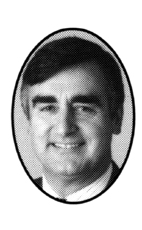
House of Commons photo

Crucial Fact

  • His favourite word was quebec.

Last in Parliament April 1997, as Bloc MP for Lac-Saint-Jean (Québec)

Won his last election, in 1993, with 76% of the vote.

Statements in the House

Rail Transport March 23rd, 1995

Mr. Speaker, I must remind you that the minister forgot to tell us that there was no mediation in the rail dispute and that mediation at the Port of Montreal did wonders. The government should apply the same approach to the railways, thus avoiding a bludgeon law.

Rail Transport March 23rd, 1995

Mr. Speaker, I am convinced that all members of the House are glad to see that the appointment of a mediator in the Port of Montreal dispute has paid off by allowing the employees to go back to work this morning while leaving the door open to a negotiated settlement.

My question is for the Minister of Labour. Given the success of mediation in the Port of Montreal dispute, where talks had dragged on for 25 months, why is the government stubbornly rejecting mediation combined with a return to work for the railways, as the official opposition has been proposing since Monday?

Rail Transport March 21st, 1995

We just wanted to remind the House.

Rail Transport March 21st, 1995

Mr. Speaker, the Hope report clearly states that the real responsibility for the current labour dispute lies with the federal government.

Given the current deadlock and its serious consequences, will the Prime Minister agree to set aside House rules and pass this afternoon a back-to-work law imposing a 60 day mediation period between the parties without the right to strike or lockout employees, so that a negotiated settlement can be reached?

Rail Transport March 21st, 1995

Mr. Speaker, although the minister says that Mr. Hargrove supports the government's position and the bill, the CAW president does not want the bill to apply to his own members. What kind of support is that? Let the law apply to the others, but not to his union.

How dare the minister defend his government's role in these talks when Commissioner Hope stated, and I quote:

"The controversial and provocative aspects of the employers' demands are found in the partisan role played by the government in supporting the position of the railways".

Rail Transport March 21st, 1995

Mr. Speaker, Commissioner Hope's report on labour relations in the rail transport sector points out the federal government's troubling behaviour during the negotiations leading to the current impasse. Mr. Hope concludes that the government was guilty of interfering in this dispute by systematically supporting the employers' position.

Does the Minister of Transport admit that the federal government's partisan pro-management attitude during the talks is responsible for the failure of negotiations and for the current dispute?

Rail Transportation March 20th, 1995

Mr. Speaker, after listening to the minister, we must conclude right away that there is really only one fundamental question: Does the right to strike still exist in Canada? If it must be taken away, a bill to that effect should be introduced and debated.

If this right to strike still exists, and it does, why does the minister refuse to consider a back-to-work bill that would provide for mediation instead of imposing work conditions and that we would support?

Rail Transportation March 20th, 1995

Mr. Speaker, the minister's comments are very enlightening; she has delivered an ode to free collective bargaining, after giving notice at 9.04 a.m. on Sunday, about 12 hours after the dispute started, that she would break up the strike.

How can the minister explain that, over a month before the dispute started, Commissioner Hope recommended back-to-work legislation although, according to his own report, the current stalemate results from the intransigence of the employers, who are trying to impose "extremely controversial and provocative" demands?

Rail Transportation March 20th, 1995

Mr. Speaker, CN, CP and VIA Rail management responded to the strike called by rail unions on Saturday by locking out over 10,000 workers, thus paralysing the whole Canadian transportation network. According to Commissioner Hope's February 6 report, these three employers have refused to back down from any of their demands as employers.

Given the employers' attitude, how does the Minister of Labour explain that, in the night between Saturday and Sunday, barely 12 hours after the dispute started, she prepared, at the

employers' request, to legislate employees back to work and to make arbitration compulsory?

Privilege March 15th, 1995

Mr. Speaker, what happened yesterday is even more serious. It is so because I submit to the Chair that this inaccuracy was stated on purpose. The minister had the report in front of her at the time, and it indicates the date I just gave.

Moreover, the question was asked by one of her Liberal colleagues, the hon. member for Brome-Missisquoi, who, as a courteous man, certainly served notice of his question to the minister. She knew what to expect and she was able to prepare an answer.

A third point is even more serious than this. The minister altered the official report so that today, Hansard does not contain the words she used yesterday. According to Beauchesne, and more particularly citation 1117, no member is allowed to alter Hansard the way the minister did yesterday after the blues came out.

If you compare the blues and Hansard , you will notice that two substantive corrections were made, so that the words which were so injurious to me yesterday as a member of this House in front of the TV cameras and everybody, while the minister scored political points by heaping ridicule on me and making me look like an irresponsible minister, no longer appear in Hansard today. Therefore, those injurious remarks made publicly yesterday in this House, in front of the TV cameras, must be corrected today in a immediate public statement including apologies by the minister.