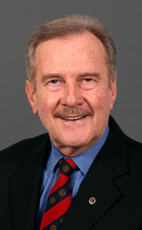
House of Commons photo

Crucial Fact

  • His favourite word was respect.

Last in Parliament March 2011, as Liberal MP for York South—Weston (Ontario)

Lost his last election, in 2011, with 33% of the vote.

Statements in the House

Fred C. Stinson November 19th, 2007

Mr. Speaker, I rise today to pay tribute to Fred C. Stinson, lawyer, veteran, diplomat and former member of Parliament, who recently passed away.

Fred Stinson was born in Toronto in 1922. Upon graduating from Trinity University, he joined the Royal Canadian Navy. It was then that his encounters with history would begin. From 1940 until war's end, Fred Stinson served valiantly on convoy duty across the Atlantic Ocean. While the threat of U-boats was always present, Fred was known to his fellow men of the sea as a congenial and courageous sailor.

As a member of Parliament, he was elected twice to represent the riding of York Centre. He was heavily involved in the debate over the Avro Arrow and tried unsuccessfully to convince Prime Minister Diefenbaker of the Arrow's merits.

Fred was sent to the United Nations as part of a Canadian delegation and witnessed first-hand the famous shoe-stomping antics of Nikita Khrushchev.

When his public career ended, Fred helped found the Churchill Society for the Advancement of Parliamentary Democracy.

I know that hon. members of this House will join me in sending our condolences to his family and dear friends, Robert and Anneli Jaeggin, as we honour Fred Stinson.

Food and Drugs Act November 19th, 2007

Mr. Speaker, I will not be supporting the bill. It should not come as a surprise to my colleague because I did not support it the last time.

Rather than be accused of entering into a diatribe or talking a bunch of crap, I will try to go through what I have attempted to develop is a more reasonable and focused approach to what we should do with respect to fetal alcohol syndrome and what research has indicated would be the right approach to take.

I will make this very clear to those who imply that members take positions because of economic or vested interests. Even if that were a bad thing, I thought we are supposed to attempt to represent all those, be they individuals who are involved in a particular sector or those who are consumers in that sector, and try to balance out all the interests of our constituents and communities.

Therefore, let me make it very clear. If there is a well researched and total comprehensive program, I would support it, as I am sure most reasonable members of the House would, and the industry involved would pay a large portion toward the cost of that program.

I am sure we also would support a more effective way, if there is one, to convey the dangers of alcohol imbibing in the extreme. We should find a program that reaches our young people and people in all chronological categories.

A lot has been said about research. In my reading of the research available, both in Canada and the United States, I have observed, and many have, that warning labels on alcoholic beverages have no impact on the incidence of drinking and driving or drinking during pregnancy. The labels are warning people about two things they already know; that drinking and driving does not mix and that drinking during pregnancy can be dangerous to the unborn child.

A survey of Canadians concluded by Ipsos Reid in 2005 found that more than 99% of Canadian women of child bearing age were aware that they should not consume alcohol during pregnancy. Likewise the number of people who recognize that one should not drink and drive is virtually unanimous.

Therefore, if we lose the focus and we overly depend on that particular graphic approach, we will get those who do not need to be convinced with respect to what the reality is and that in fact that approach will have virtually no impact. This alone is not the right way to go.

Our problem is not that Canadians are unaware of the risks associated with consuming alcohol. Rather our problem is that some people drink and drive or drink while pregnant despite knowing the risks. These people will not be convinced with warning labels. They need programs and services, and these programs are expensive. These are not just window dressing programs or window dressing research that can help them get the help and professional support that they need to deal with those problems, which have been very well articulated by all sides of the House.

For the minority of people who unfortunately continue to drink and drive or drink during pregnancy, studies have shown that warning labels have no effect on their consumption of alcohol. Let me cite some of the relevant statistics. These are researchers for fetal alcohol syndrome from the Hospital for Sick Children, researchers of known reputation.

Dr. Ernest Abel, a fetal alcohol syndrome researcher with over three decades of experience, has said that increased awareness of alcohol warning labels has not changed behaviour in the United States. He has found that behavioural change is resisted because the perceived risks of ignoring those warnings are low, which undermines the motivation to comply.

Dr. Abel further recommends programs targeted specifically at women with the highest risk of having children with prenatal defects, which he suggests is a much more efficient means of reaching the at risk segment of society than broad placed public programs such as warning labels.

A series of studies by another researcher, Dr. Janet Hankin, found that labels had no measurable effect on drinking patterns during pregnancy.

Even the United States Department of Health and Human Services, in its 2000 report to Congress on alcohol and health, specifically noted that research showed that warning labels did not have an effect on pregnant women who were the heaviest drinkers and consequently most at risk.

Canada has made a tremendous reduction in the incidence of drinking and driving, but not through the use of warning labels. Instead, these gains were made with programming aimed at changing societal attitude toward drinking and driving combined with intervention programs targeted at hardcore drinkers and drivers. The results of these efforts speak for themselves.

In the past two decades, the rate of police reported impaired driving incidents in Canada has declined by 57% and continues to drop. Today, impaired driving is largely undertaken by so-called hardcore drinkers and drivers. According to the Traffic Injury Research Foundation, these drivers represent only 4% of all drivers in Canada, yet they are responsible for 92% of all impaired driving trips. Unfortunately, warning labels will not change the behaviours of these drivers. They require more direct intervention, such as the use of alcohol ignition interlock devices, stronger legislation and so on.

The same thing goes for fetal alcohol syndrome. It is not just a case of articulating it through labels. We have seen through the drinking and driving relationship and through the cigarette and tobacco industry that labels themselves are not the intervention program and do not constitute the total regime that will make the absolute impact.

There are a number of potential costs, and we know that. It is not the argument of costs with respect to putting labels on bottles, if the bottles are to be read. As my colleague has already pointed out, glasses are usually used in bars. It is to shift the total focus to the interventions of scale and quality necessary for research and for programs specifically aimed at those who are, pardon the pun, carrying the problem. We have found that labels are not the total solution.

I personally believe the government must continue to work in partnership with stakeholders and industry to reach out to people who still drink and drive and women who drink while pregnant. Unfortunately, evidence from Canada and the United States has shown that warning labels are not the total answer. Rather we should be targeting our efforts at programs aimed directly at so-called high risk drinkers, those drinkers most likely to engage in alcohol misuse.

For these reasons, I will not support the bill, although I commend my colleague from Mississauga South on his tenacity in keeping this issue before the public.

Constitution Act, 2007 (Senate tenure) November 16th, 2007

Mr. Speaker, I congratulate the member on a very eloquent speech and an insightful one with respect to the issue at hand.

I would be interested, in that same vein, to hear the member's response to what I see as an inconsistency between the New Democratic position with respect to the Senate, based on accountability, and its support for proportional representation.

Proportional representation would have a group of members in a legislative assembly who would not have a direct responsibility to any constituency. That is the same argument, to some extent, that the member has been putting forward. I accept that and I am sure the House does, but it seems inconsistent with the position that his party has put forward on proportional representation. I wonder if the member could address that.

Nuclear Liability and Compensation Act October 30th, 2007

Mr. Speaker, my colleague from Skeena—Bulkley Valley certainly has insights into this issue of liability. I would like to expand on one point that he made with respect to the appetite that the public has for taking on high risk public interest related responsibilities.

He has indicated that across the country there is not a case where one would go out and ask whether someone would like to have a nuclear waste facility. I would like to point out that there have been examples where referendums have been taken and, in the higher public interest when risk has been minimized, the public has said that it will take certain responsibilities with respect to solid waste.

Therefore, it is not totally out of keeping with the public. Given that the risks are explained to them and every check and balance has been put in place, they will accept that risk.

In terms of unlimited liability as it relates to mining, subsidiary processing activities and so on, and particularly from a northern perspective, is the member satisfied that the bill covers that kind of liability that people would have confidence in this kind of legislation and support the industry?

Nuclear Liability and Compensation Act October 30th, 2007

Mr. Speaker, first, I commend the member for Western Arctic on probing into the bill from a perspective that is very important given the discussions we have had on possible environmental disasters in Arctic sovereignty, our responsibilities with respect to the north. I would hope that we would support the bill going to committee.

Could the member follow up with respect to unlimited liability, given that the use of nuclear submarines, the use of surveillance aircraft and so on with respect to the north is becoming a major issue for the government and our country's policy, and expand upon the implications of the bill as it relates to unlimited liability with respect to possible environmental disasters that could occur as a result of the increase in nuclear usage?

It is extremely germane and the House would appreciate the bill perhaps being expanded to accommodate some of the concerns that have been raised by the member.

Nuclear Liability and Compensation Act October 30th, 2007

Mr. Speaker, on the member's last point with respect to liability, is the member satisfied that the regime presented through this bill satisfies the existing liability? We have huge amounts of nuclear waste being stored in barrels around the various plants across the country. As part of the regime, does the bill assess and establish to protect the existing liability?

Would the member like to comment again on how absolutely critical it is to this industry to find appropriate storage within the context of some of the recommendations made by the commission currently reviewing this issue?

Business of Supply October 29th, 2007

Mr. Speaker, I have a great deal of respect for my colleague who just spoke, and I do understand that the context with which he said this was in response to the challenge from the government side with respect to the role of the Bloc Québécois. The comment that he made referenced Ontario and I could not believe what I heard. He said that his party does not care about Ontario.

As I said, I know the context, but I would like to give the member an opportunity to reply with respect to the close and common causes that Ontario and Quebec have in terms of the manufacturing sector, in terms of the environment, and in terms of the whole absence of research and development with respect to a wide spectrum of activity.

Could the member please point out whether, in his view, there is room for Ontario and Quebec, in fact all the provinces, to build a stronger Canada in a cooperative way?

Business of Supply October 29th, 2007

Mr. Speaker, I thank my colleague for the overview that he has given with respect to economic federalism in particular.

For the record, I would like to point out that one of the cases that he mentioned, the Canada social transfers, came out of the social union framework agreement, which was an exercise in cooperative federalism. The other case, contributions to training, came out of the labour market agreements that had been reached under the Liberal initiatives over the past several years. Therefore, it is not totally without context here that we start pointing fingers with respect to the nature of federalism.

However, my question is one that is more directed in terms of equalization. The same article that the member referred to also points to the dilemma, with respect to the province of Ontario, that the infrastructure, the investments, the research and development in industry and the trade that stimulates the Ontario economy in order for it to make the contribution through equalization are at risk.

In the member's notion of open federalism, can he see the day when Ontario will be one of those provinces that is a beneficiary with respect to that formula as opposed to the heavy duty load that it is carrying now against the liabilities that it has being a manufacturing economy?

Resumption of Debate on Address in Reply October 23rd, 2007

Mr. Speaker, I and this side of the House, I am sure, would like to congratulate the minister on his new portfolio and wish him well in it.

I suppose it should be obvious that one of the issues the Minister of National Revenue has to deal with is to continue to nurture and revitalize revenues so they can be redistributed for the various programs. The Conference Board of Canada recently did an analysis of the Ontario budget and came to the conclusion that contributions to equalization in fact exceeded the growth and projected growth in the Ontario economy. That bodes ill for the future of the Confederation in terms of being able to reinvest across this country from sea to sea to sea.

Other than on the area of tax cuts, I would like to know whether the minister, first of all, is going to assess very carefully on an ongoing basis the growth in the Ontario economy and its ability to contribute to equalization. Second, as part of an overall strategy beyond the throne speech, either in a budget or in other announcements, I would like to know whether the government is going to recognize the urgency with respect to manufacturing, in particular in Ontario, and is going to reinvest in strategies that would put the Ontario economy on a very solid and competitive basis as it relates to its responsibilities to contribute to equalization.

Eunice Grayson October 23rd, 2007

Mr. Speaker, I have the honour today to pay tribute to Eunice Grayson, an extraordinary volunteer, visionary and community leader. Sadly, last week Eunice left us, passing away peacefully at her home.

In our community, Eunice was best known for pioneering the Learning Enrichment Foundation. As the LEF's founding executive director, Eunice worked tirelessly to ensure that new and less fortunate members of our community had access to job training, language classes, child care, skills improvement and, above all, hope.

Today, the Learning Enrichment Foundation is a nationally recognized leader in the holistic approach to community economic development.

Eunice was a kind and caring soul, a citizen I was proud to represent in this House and a lady I was fortunate enough to count as a friend.

Eunice was born with the maiden name Service, a most fitting name for she gave so much of herself for the benefit of the less fortunate in our community. Her service, her sacrifice and her name will be fondly remembered in York South—Weston.

I know the hon. members of this House will join me in celebrating the remarkable life of Eunice and extending condolences to her family on her passing.