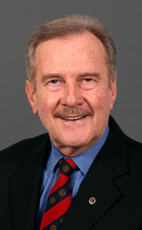
House of Commons photo

Crucial Fact

  • His favourite word was respect.

Last in Parliament March 2011, as Liberal MP for York South—Weston (Ontario)

Lost his last election, in 2011, with 33% of the vote.

Statements in the House

Resumption of Debate on Address in Reply October 22nd, 2007

Mr. Speaker, I would like to follow up on that question in terms of the proactive leadership role that Canada could play with respect to Iran.

The member mentioned the Ahmadinejad in Iran. I take it he sees in that Iran another Iran, one that has democratic roots, one that out of a recent conference in Paris saw thousands and thousands of Iranians, who no longer live in Iran but are expatriates who live in various parts of the world, including Canada, calling upon the government to renew its interest in those pro democratic organizations that could be very influential with respect to political developments in Iran.

Does the member have any additional information that he could suggest would be part of a strategy that Canada could take major leadership above and beyond those he has already mentioned, which are extremely important, in support of democratic movements that consist of Iranians who are expatriates and are willing to get involved in balancing those dictatorial, authoritarian and fanatic regimes that exist in Iran at this time?

Resumption of debate on Address in Reply October 18th, 2007

Mr. Speaker, I was taken by the spectrum of issues that my friend has covered. I do not think there is any argument that when one talks about impaired driving and the implications and fallout with respect to violent sexual predators and so on, this side of the House is in full agreement.

I did not hear anything as a follow-up to the illustration that the member used with respect to the Nunn commission and the observations and recommendations as they related to youth who are involved, as the member indicated in a very short time, in gang activity and drug related activity, an activity that became absolutely abhorrent in terms of the repercussions that it had in that particular incident.

The courts many times have found themselves unable to muster the tools and the programs to mentor and deal with youth who are part of the criminal justice system, the recidivism that occurs, and young people who are violent in their behaviour. I did not hear anything about the instruments that we as a society could use to deal with this very, very troubling issue throughout our country.

I would like the member to outline where the government is going in terms of backing up the criminal justice system in the area of youth.

Business of Supply June 7th, 2007

Mr. Speaker, I was following the discussion and the presentation made by my colleague from the Bloc. I am sure the House would be interested to hear a restatement of the relationship that the Atlantic accord has to the problem that is created with respect to equalization.

I ask that question deliberately because the Bloc is the party in this House that protects and stands to protect provincial rights. It seems to me that it was a recognition through the Atlantic accord that there in fact had been a longstanding shortage of equalization for the Atlantic provinces and that there was an agreement through the Atlantic accord to come to terms with that issue.

Yet, we find the Bloc is still resisting supporting this resolution and through the budget the continuation of the accord. Voting against the budget would at least show that the Bloc supports those provincial rights.

Would the member restate the reasons why the Bloc finds that the Atlantic accord is contradictory to the very essence of equalization and the fiscal balance that we in a federal state are attempting to achieve for the provinces?

Canada Elections Act May 31st, 2007

Mr. Speaker, on the surface it may look like we were showing two different sides to the same coin, one arguing an unnecessary intrusion because of the nature of the electoral process, where we are going to have an advance poll the day before the election, and then the flip side of that from the Bloc's perspective, where having more polling divisions is good.

Now my colleague from the New Democratic Party is saying that in terms of voter registration, his position from a northern perspective is that there would be people in those communities who do not have the necessary voter registration cards or something that identifies them.

However, in urban communities, the issue on the flip side of the same coin is ensuring that there are no irregularities with respect to voter discrepancies. People pick up their cards in apartment buildings and then vote. They do not have to provide, and are not compelled to provide, the appropriate registration card that identifies who they are and so on.

As I understood it, the NDP's position was that it was against the matter of including birth dates as part of the voter registration cards. I feel that is a progressive step to be realistic. The result of our discussion was that everybody should have that card and I think that probably everybody should try to have it in order that those kinds of irregularities do not happen.

Canada Elections Act May 31st, 2007

Mr. Speaker, this is the flip side. While I appear to have been arguing with respect to the advance poll on the Sunday before the general election, I was arguing that it was an unnecessary intrusion that by its very quantitative exposure would distort the electoral process in somewhat negative terms.

I was arguing that to some extent, more as the devil's advocate I suppose, but now my colleague from the Bloc brings the other side of the question, the flip side. He is indicating that in his constituency, because of distance factors, more polling subdivisions are required and that would be a qualitative extension, and would help people in his community to vote because of the long distances between the communities.

I would like to point out to my colleague from the Bloc that on that side of the coin the government actually has created the polling subdivisions in keeping with those that will be created for the general election. On that advance day prior, the Sunday before the election, his constituents will in fact have access to local polling subdivisions.

That is my understanding of how the bill is being presented. I suggest to my colleague from the Bloc, from his perspective, that this is a progressive step that will make the electoral process more accessible to his constituents.

Canada Elections Act May 31st, 2007

Mr. Speaker, it was part of what I was trying to grapple with when I talked about that cooling off period from the heat of an election to the actual deliberation, when the voters, Canadians across the country, would reflect on the issues. They would have been bombarded with election material and comment through the media and so on.

It is the one element that is an exception to the general rule by which the government is operating. It should, in the name of accessibility, make more time available. We have two extra days. However, it is the day before the election which is of concern from the perspective of both the question and my comments, but it is also the intensity.

It is not just a general advance poll. It is really the mirror of the general election the day before with polls in every constituency subdivision. It really is election day on the day before.

Yes, I do agree that there should be some balance that could have been brought in. Two days, yes, but is it necessary that it has to be on the day before and at the intensity that is being put forward by the government?

Canada Elections Act May 31st, 2007

Mr. Speaker, I am privileged to rise today to continue the debate with respect to Bill C-55.

There has been a great deal of extrapolation and overview with respect to the ingredients of the bill. I do not think there is anyone in the House who would take exception to the efforts of the government and the opposition to find ways to broaden the franchise and to encourage people to exercise their democratic right to vote. As has been pointed out, this is one of the most basic freedoms that we enjoy and we should always be perceptive and reactive to citizens' needs for accessibility in order to exercise that franchise.

This particular bill is systemic in the sense that it deals with the mechanics of the election through the availability of advance polls. The bill is suggesting two additional days, one of which would be exactly the same, and the other being the Sunday prior to the election. Polling subdivisions across the country would be the same as those that would be accessible in the general election. That is self-evident in the sense that it would be more accessible for Canadians across the country to avail themselves of their franchise. Thus, it would be surprising if there were any opposition to that.

One issue has been indirectly raised and I would like to bring it into the discussion. I would suggest that this is more of a discussion with respect to allowing people to exercise their franchise and encouraging them to vote rather than one in terms of the usual cut and thrust of debate where something is put forward and the opposition has to tear it apart and find some way to improve it.

There are many improvements, I suppose, that generally could be made to the manner in which we carry on the electoral process. Fixed dates has been mentioned, and it is generally considered that this would be advantageous and a step in the right direction toward democratic reform.

The advance poll would be on the Sunday prior to the election and would have the same level of accessibility as a regular polling day during an election. This advance poll would be held the day before the election. I do not know whether the government has given enough consideration to the implications this might have if there were an issue of a high level of interest such as we experienced during the same sex debate where amendments had been made and had became law, but there was a continuing discussion of that through the last election period.

The fact that there was an interlude or, what I would characterize it as, a cooling off period between the time the bill became law and the election, very strong positions were taken across the country among various groups, but at the end of the day everyone had the opportunity for discussion, decisions had been made and we were moving ahead.

This just occurred to me. In the heat of debate, where there are issues that touch on the moral and legal lines, is it in the national interest for there to be the heightening of concerns and a re-awakening of issues the day before the vote? The ability to have a cooling off period, a period where people have an opportunity to digest what has been done, reflect on it and then exercise their franchise during the general election is that implicated by the fact that we are now having a poll the very day before an election, a poll that will be accessible in every constituency, every subdivision across the country?

In fact, that might become the source of discussion as a matter of religion. We have always tried to consider religion as absolutely sacrosanct in terms of issues related to what people view as their religious feelings on a matter and balance that against what is a political issue that is being defined by charter issues and so on.

It is this kind of balance that Canadians have been able to advance civil society through our institutions and conventions. We treat our conventions with respect and tend not to over-moralize. We try to have a balanced perspective with respect to how we would like to entrench the rights of all Canadians in terms of our institutions through our Charter of Rights. This was both the process and substance of what that discussion was all about many months ago, and we advanced past that.

I have a concern, and I am not sure whether it has been reflected on by the government, about should an issue of this nature arise or one related to our history in conscription. This was an extremely divisive issue and we had to come to grips with it. It led to regional differences that in fact threatened to divide the country and it took years for us to move past that issue.

The day before the election is there a possibility that there could be a negative influence in terms of institutions that would now be used, in the name of religion, to mobilize around particular points of view and inordinately affect the outcome with respect to an issue as it relates to a political decision? I only put that out as a concern. It has not been mentioned and it is perhaps something, had there been a broader consultation, that would have been more clearly articulated with respect to the bill before us.

When we look at the statistics, particularly for young people and those who have felt disenfranchised for whatever reason, they indicate that voter involvement has gone down. It was as high as 75%, as I understand it, in the 1970s and 1980s and has gone down to 65% or 60%. We note also that even among seniors, for whatever reason, there seems to be a diminishing of interest with respect to exercising their franchise, which might be a surprise to some people. There are regional patterns with respect to people being less inclined to exercise their franchise.

Although this is an exception, it is worthy of mention. Where we have done studies empirically trying to establish why people get involved in the process of voting and so on, it has been very clear that new Canadians, particularly those who have become citizens in the last decade, are exercising their franchise at a higher level than those who have been here for a long time.

Is it because we take our democratic right to vote for granted? Is it because of the experience new Canadians have, coming from countries where they did not have those privileges? As immigrants always have in the history of our country, they come here to seek a better life, a life where they have more say in their own futures, the futures of their children, the legacy they are creating. It is obvious to me that with those higher voting ratios among new Canadians, there is something for us to learn.

It is why this discussion goes beyond Bill C-55. Bill C-55 provides another opportunity for people to exercise the franchise. For us to really come to grips in real terms with increasing the responsibility and accountability to be part of the electoral process, we have to look beyond Bill C-55.

My colleagues in the New Democratic Party were speaking yesterday about proportional representation. They were alluding to what was happening in the province of Ontario with respect to a citizens commission, which looked at different approaches to electoral reform. This will find its way through into the next election in which there will be a referendum, just as there was in British Columbia. This is one approach that could be taken with respect to mobilizing public opinion and attempting to focus that on improving our electoral system.

I believe the government has attempted to look at different approaches because two other bills were introduced. Bill C-56 was introduced to change the formula for redistributing seats in the House of Commons. Bill C-54 looked at the restrictions on the use of loans by political entities governed by the Canada Elections Act.

The amendments through those bills were earnest attempts by the government to focus on the whole issue of accountability and relevance, and hopefully a corollary to that, getting people involved in the democratic process and in political organizations and mobilizing them to become more involved in Canadian politics.

As part of the discussion, I will make a few comments without straying from the intent of Bill C-55. I have stated that we all should support Bill C-55 with respect to the amendments it is make to allow for two additional advance polls.

However, if we are to draw people into what we view as political life and the discussion of issues that affect us, we have to look at issues related to accessibility. We have to look at whether we are really debating the real issues that people are not only interested in, but also issues that they see as part of the legacy for them and their children.

We also have to take some reflection on whether we have and are earning the public trust. It is matters of accessibility and that we are dealing with the real issues that concern Canadians. If we are doing those in earnest, they will view that as us exercising what they deem to be the public trust.

I reflect yesterday when we had workers here from all over the country. I know many of us in the House joined with the Canadian Labour Congress. People from coast to coast to coast talked about job loss and about the dramatic and traumatic implications of that. Workers had tears in their eyes. At the gathering in room 200, I and many of my colleagues were moved as we listened to the descriptions of what was happening in small communities across the country, with respect to the loss of jobs.

I mention this because this is not something of a partisan nature. Yes, we can look at governments and say we did better than that. These issues are of a global nature, which reflect on very complex and interconnected issues related to capital and how we are competing with countries in the global economy and what is happening with respect to foreign investment in terms of how we can connect and convince Canadians that we have control over our economic future.

It is related to issues that people are caught in a sense of helplessness. If they see this House, both in terms of the substance of that issue and the style of addressing it, they will see us grappling with the issues about they are most concerned. In that way we will be earning to some extent their trust. They may think we are making mistakes in their opinion or they may think we are on the right track, and hopefully we are. They may exercise their franchise in different ways, but that is part of believing in this country and believing in our institutions of governance.

I use that as an example because it goes beyond this bill. It goes into the manner in which we have representation and the manner in which we debate and are seen to be debating. It relates to how we contribute to the positive culture of parliamentary democracy in Canada.

I have shared this on occasion with many of our colleagues, that sometimes we are less than up to the challenge in terms of meeting the expectations of Canadians.

I will talk just for a moment to Bill C-56 as it relates to broadening the franchise. As I mentioned, that bill deals with changing the formula to redistribute seats in the House. In terms of whether we are earning the public trust, both the province of Quebec and the province of Ontario have indicated great concerns with respect to what the bill says. The government should be aware that consultation is absolutely fundamental to gaining the public trust and that we are attempting to broaden the opportunities for people to get involved in the process.

The last comment I have is with respect to Bill C-54 on loans. One of our most sacred rights is the right to be a candidate. Under the Canada Elections Act, we have the fundamental processes and protection in place to ensure that loans are dealt with, that candidates cannot go beyond what they spend.

With respect to some of the content of Bill C-54, it becomes apparent that some are less equal than others when it comes to borrowing money. What we have said is we will make everybody borrow from the bank, thus making it impossible to go our friends and have them on record loaning us money and on record having to pay us back.

Everybody now has to go to the bank and I am not sure that it is a democratic principle that everybody has to go to the bank because everybody does not have the equal ability to get the same loan and get the same rate of interest, and so on. Everybody always has to negotiate.

That bill went, to some extent, philosophically in an opposite way. The legislation that the government had brought in previously was designed to deal with that.

I did not mean to stray by mentioning Bill C-56 and Bill C-54, but I did want to elaborate. If we are dealing with electoral reform to broaden the franchise, those are the things we have to increase. We have to increase accountability, we have to increase accessibility, and we have to earn the public trust.

Canada Elections Act May 30th, 2007

Mr. Speaker, the bill that is before us states as its objective to increase voter participation, the interest of our citizens to get involved in the electoral process.

I was taken by the comments made by the member with respect to ways in which we could become more effective in the House that would engage Canadians in critical issues. I think the member would agree the critical issues that affect Canadians range from the erosion of jobs in the manufacturing sector to world peace.

The point made by the member is that this bill falls short of really challenging us in a constructive and instructive way to change the system in order to engage Canadians and then bring them into democratic participation.

My question for the member is this. Is there any experience in Quebec with respect to the universities, reaching out to youth, and targeting those groups that have not been engaged in the democratic process? Is there any experience in Quebec that the member could allude to which might be instructive for the government to really engage Canadians and get them involved in the voting process in this country?

Criminal Code May 17th, 2007

Mr. Speaker, I actually found the member's overview to be quite eloquent and substantive. It is funny how members can sit in this place and draw different conclusions and inferences, but that is mine.

I would also like to make clear that in terms of mandatory minimums what is being offered up and the amendments that have been proposed by the opposition, in particular this party, are very close. In fact, there is only a difference of about a year in terms of the discretionary capacity. We really are not arguing from hugely different perspectives.

My area of York South—Weston in Toronto is one of 13 neighbourhoods that are at risk. At a public meeting I was told that we are treating the symptoms and not the disease when we come down heavily with respect to our criminal justice system. My son is a lawyer and he has told me that judges have indicated that they do not have a lot of flexibility with respect to people in the criminal justice system who in fact return to prison.

What tools are available within the criminal justice system, in particular in the prisons, for effectively dealing with those who have to go to prison? It is not that we want them to go to prison, but that is where they end up. How can we ensure that when these people, in particular the young people, get out they can be productive members of society?

Could the member perhaps give us a bit of insight as to what tools and programs the government could establish that would make sure that we are not creating further problems for our community when people do come out of prison?

Canada Elections Act May 11th, 2007

Mr. Speaker, I am very pleased to have the opportunity to give a few opinions on and discuss further some of the implications with respect to the legislation.

I will preface my comments. Coming from York South—Weston, I come from a riding that is very working class. It is an immigrants' turnstile type of riding. According to usual indicators, it is one of the less wealthy ridings in Ontario. In fact, it is second last in terms of those indicators. Most of the housing stock was built before 1950. Most of the people, about 60%, live in multiple occupancy high-rise buildings. There are a lot of issues that come along with this in terms of people coming here with hopes of being part of the mainstream of life in Canada.

One of those hopes is to be a fully empowered member of Canadian society, with the right to vote equally and equitably. I think this House stands for those values and works toward that objective so that we do not let down past, present and future generations with respect to their ability to become part of the mainstream of Canadian life, which is what they come to this country for.

Against that background, when I am looking at equity I think that we should not place one class of citizens aside and stereotype them with respect to having less rights. It always bothers me when I see a preamble to legislation couched in these kinds of terms: we will create “an airtight system of political financing that will eliminate, once and for all, the influence of rich, wealthy individuals from the political process”.

I never knew that one of the standard values of this country was that we should stereotype wealthy people and make them scapegoats for other inequities that may exist in society. In fact, our Income Tax Act makes it very clear that in order to be equitable we will take that wealth from those wealthy people and redistribute it to those who are less fortunate. We hope there will be many wealthy people and we will take that wealth and redistribute it. That is the objective of our Income Tax Act.

Nobody has ever said that this is a very tenuous and unclear objective or mechanism. It is like what we say about equalization in this country, which is that we disagree in terms of how we go about it and we disagree from time to time about those who are being advantaged or not, but we stand for equity. We stand for redistribution wealth on a federal level also.

When we come to an Elections Act, I hope that we are driven by that same objective, which is to be fair and even-handed with respect to making the Elections Act accountable. Accountability is the key. If this legislation does that, then there will not be and should not be one person in the House who would oppose it.

I know there is not an elected member in this House who would deny how very exhaustive the processes under the Elections Act are, to the extent that it is very difficult to even find lay people in our ridings who are up to the tremendous pressure and up to participating to the extent to which they want, to be agents and to be involved in our campaigns at the financial level. The checks and balances on accountability are now so weighted that it is getting to the point where one has to be a professional, such as an auditor or an accountant or whatever, to be able to carry on that role.

In my riding, if I did not have someone like my friend, Gunter Kujat, who has been loyal to being partisan, I do not know what I would do. I trust him. I have faith in him. I am sure there are similar examples in ridings throughout our country .

When legislation is layered on top of existing legislation and it has some inherent inequities in terms of treatment, it behooves us to understand whether what we are doing is counterproductive to the objective of bringing more people into the elections process. I am going to speak about three parts of this legislation that do that. The first that I believe is overly heavy-handed beyond the terms of the Canada Elections Act--