
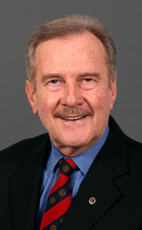
House of Commons photo

Crucial Fact

  • His favourite word was respect.

Last in Parliament March 2011, as Liberal MP for York South—Weston (Ontario)

Lost his last election, in 2011, with 33% of the vote.

Statements in the House

Business of Supply May 10th, 2007

Mr. Speaker, if things get really desperate, I will be splitting my time with the member for Brant.

These are issues of huge importance that we are dealing with today. Sometimes in the cut and thrust of debate and repartee, I am sure Canadians wonder just what the point is that we are trying to make. I want to try to make a balanced commentary on what has been proposed.

Every Conservative member who spoke has emphasized how important it is to get the capital regime in place that fits right within the global economy. That is based on the ever-pressing assumption that within the global economy the movement of capital is absolutely fundamental to the health and welfare of a modern global economy, of which Canada, Europe, Japan and China are a part. In a competitive world, all those that we are in competition with to add value to our economy need to get the capital regime in place that will add value to our economies.

The proof of that is that every member has addressed part of that regime. One cannot talk about the accelerated capital tax write-off for capital equipment without relating that to what value it adds in a competitive regime. It would add nothing if every country with a modern economy did exactly that, so it needs to be more.

In global capital markets, it is important that we have a free trade approach to the investment through securities. The government has indicated that it is moving in that direction. If every modern economy did that, that alone would not give Canada the competitive edge.

We can talk about a global commercial strategy with respect to breaking down cross-border tariffs and so on. Again, that alone would not give Canada the competitive edge.

The bottom line is that what will give Canada the competitive edge is to have something more that makes Canadian investments both in Canada and abroad more attractive in a competitive global world. That, in turn, will add jobs, which means that we can reinvest in our health care system and produce a civil society that has a quality of life that we want for all Canadians.

I do not want Canadians who are still watching, if, indeed, they ever were watching this particular cut and thrust of debate, although I am sure many are, to conclude that it is an either/or, that they must take the Conservative government position or the Liberal position, because the nature of the motion is to ask for sober second thought. Given the commentary with respect to interest deductibility, for example, and the implications that are being drawn, is it time to take a step back and re-evaluate that particular policy?

When the C.D. Howe Institute comes forward and says that the proposed changes in the Canadian tax system could place Canadian companies at a significant disadvantage both abroad and even in Canada in competing with its foreign counterparts, one cannot just slough it off as being irrelevant. When KPMG comes forward and says that more foreign takeovers of Canadian companies stifle Canadian investment in global markets and an exodus of head offices and a weaker Canadian economy overall will occur, we cannot say that is a one-sided commentary or a partisan shot at the government.

We could also quote from KPMG on interest deductibility. It states:

This is just disastrous and disables all businesses who wish to expand in a foreign jurisdiction, because they cannot borrow money outside and deduct interest on that money. It means everyone must rearrange their affairs and set up a U.S. subsidiary, which costs more money.

We cannot take that commentary and just say that it is totally irrelevant to this debate.

The nature of the global economy is one of an integrated economy. We used to have a subsidiary economy based on U.S. and multinationals. Now investment is going every way. We just had an example of that on the financial page of today's Globe and Mail where it was being cited that Magna was looking for a Russian investor.

When we talk about integrated investment, if we have a company that is active in China, that company in turn invests through Canadian capital in operations in Canada and employs people. It is a check and balance on foreign exploitation.

We cannot just simply take a partisan perspective on this and say that the government is all wrong and the opposition is all right. What we can say is that given what we understand of the movement of capital and the fact of where barriers are placed in stopping capital from moving in a liquid fashion, there is no question that Canadian companies and Canadian society will suffer.

The general bottom line of those experts is what this side has said to the government, through this motion, that we should have another look at what we are doing with respect to interest deductibility.

I will not make comments on income trusts but there are similar comments that can be made in terms of process. I am focusing more on interest deductibility because there is a huge body of opinion that is saying to the government that this is a time to take a step back.

I think the Minister of Finance himself is coming to the conclusion that once we can get past the issues related to double-dipping and using straw horse investment facades behind which corporate tax returns can be fudged, we should put in a regime that will protect Canadians against that kind of exploitation.

However, once we have done that then we need to get to the essential issue of what this is doing as a mechanism that undermines investment and high value added activity that will benefit Canadians. That is the message that the opposition is trying to give the government.

Business of Supply May 10th, 2007

Mr. Speaker, my colleague across indicated in his speech quite an understanding of the global markets and the conditions he cited, the accelerated capital tax write-off for machinery, which will be very important in the global economy. He talked about global capital markets and he cited four areas where the government is taking an initiative.

However, he also cited that $523 billion abroad in Canadian capital investments in fact is the higher order of capital investment through Canadian investors. Does that not give him cause to reflect, with that degree of integration of capital movement through other markets than the United States markets, that this may be an ill-conceived strategy? Is the government sure that it has the research and back-up to prove that this will not be ill-conceived?

Business of Supply May 10th, 2007

Mr. Speaker, I am attracted to the statement that the parliamentary secretary made in terms of a level playing field. I am sure she would agree that a level playing field is one thing within the Canadian context and it is quite another thing within the global context.

Many of those same experts that the parliamentary secretary has cited in fact have also given the other side of the coin with respect to capital transfers. The situation being in source countries for capital investments in Canada, there is a regime in place that is similar to interest deductibility.

My question is one of confidence. How do people really accept the government's position that there will not be irreparable harm in terms of value added impacts on the Canadian economy for this particular initiative on interest deductibility when we see on the income trust front there has been huge harm done to people who have lost their savings?

In particular, how can there be confidence when I am looking at a T-205 form which indicates that there actually is an increase in the taxable income of a quarter of a per cent in spite of the pronouncements by the government that it has reduced taxes for those on incomes below $35,000? That is not a fact.

How can the Canadian public have confidence if this relatively small issue has such an aberration, if you will, in fiscal legerdemain when, on the larger front, there is reason to believe that there will be a huge impact on the Canadian economy in terms of shifts of capital and the ability for Canadian firms to compete in the global economy?

St. John the Evangelist Catholic School May 7th, 2007

Mr. Speaker, within the context of world history Canada is a very young country, but I am sure that every member of this House could stand and attest to significant contributions that people in their ridings have contributed to our local and national history.

In this respect, my riding of York South—Weston is particularly significant. Located on the major fur trading route between Lake Ontario and the Upper Great Lakes, for over 200 years it was the Humber River that witnessed farming and industrial activity unparalleled in the region.

To serve this Humber River-Weston community, the sisters of St. John established St. John the Evangelist Catholic School 150 years ago in a tiny 25 foot by 35 foot log structure.

I am certain that members of this House will join me in saluting the heroic sisters of St. John and the students, staff and parents, past and present, for the magnificent contribution the school and church have made to our country and also in extending our best wishes for the future on this the 150th anniversary of St. John the Evangelist Catholic School.

Children's Mental Health Week April 26th, 2007

Mr. Speaker, May 7 to May 13 is designated as Children's Mental Health Week in Canada. In my home province of Ontario, one in five children is believed to struggle with some form of common mental illness, such as depression, anxiety disorder or bullying.

The chair of the Senate committee on social affairs, Michael Kirby, has described children's mental health services as the “most neglected piece” of the Canadian health care system.

The average cost of treating children's mental health problems in community based agencies is less than $2,500 per child.

When children with mental health disorders are not effectively treated, they become more vulnerable and less resilient as they approach adulthood, which may result in adult mental disorders, involvement with the law and homelessness.

I raise this important issue today so that we may do our share in combating the stigma associated with mental illness and all work toward a national strategy to address the needs of our most susceptible youth.

Business of Supply April 26th, 2007

Mr. Speaker, accepting the NDP at face value that it stands for the same values we do, human rights and all of the objectives that we have with respect to Afghanistan, if it could be illustrated that over the next two years that the transfer of authority to the Afghan military, which is being trained and deployed and appears to want to defend the judiciary, defend the educational system, and defend against those who are blowing up innocent women and children, if it could be illustrated that that was actually happening, would the NDP withdraw that motion?

Business of Supply April 26th, 2007

Mr. Speaker, I have a great deal of respect for the opinions of the member who has just spoken.

My colleague mentioned Vietnam. My memory of Vietnam is that the lesson that came out of it, with respect to the values of freedom, human rights and so on, is that these values cannot be fought for by anybody other than the people who, hopefully, will come to believe in them. Those are the people who have a tremendous responsibility to engage the enemy. In Vietnam, of course, it was the North Vietnamese who had invaded.

I have never heard NDP members refute the ideals of our engagement in Afghanistan in terms of human rights and establishing democratic government under the articles of NATO.

However, I will take the member's Vietnam analogy. If those are the values, and they are still relevant and the argument is that there needs to be safety and security, would the member agree that it is incumbent on us to train Afghani personnel and the military in policing, defending and promoting those values? Would he be in favour of that role for our troops?

Business of Supply April 24th, 2007

Mr. Speaker, I would like to follow the line of questioning that our colleague from the Bloc initiated. My comments for the member are similar to those for the member for Ottawa South. The member has a tremendous amount of knowledge in this area. His views are extremely relevant and credible. My question is similar to the one that I posed to the member for Ottawa South.

It could appear that this motion, in positioning the Montreal exchange, might be somewhat divisive in the inference that other exchanges draw and that Canadians draw. The member for Ottawa South indicated the wide spectrum of activity, from resourced based industries to our manufacturing industry, to technology and innovation. I think the House and Canadians would be interested to hear the member's view with respect to that ultimate potential, such that no wrong inferences would be drawn from our supporting this motion. This is very much a national strategy that will add value to every part of the Canadian economy. The emissions credit regime and exchange would in fact underpin that.

Business of Supply April 24th, 2007

Mr. Speaker, I know the House shares my opinion that the member, through his long experience, is very well informed on all of these issues related to the environment.

I would like to ask him, though, in order that we do not get divided on this road to Kyoto that we are all committed to--and through this motion we can achieve that--would he make a comment with respect to where an emissions trading carbon exchange should be located? It has been suggested in the motion, and it is linked, that it should be in Montreal, and perhaps it should, but would he give an opinion to the House with respect to the process we might undergo in order that we do the right thing with respect to this particular part of the Kyoto regime, the emissions and carbon trading system?

Business of Supply April 24th, 2007

Mr. Speaker, I would like to address a question to my colleague who has just spoken. I sat with him on the environment committee and have a great deal of respect, as I am sure the House does, for his insights into matters related to Kyoto and in particular what he has spoken to, which is the matter of setting up an emissions credit trading system that would be effective in meeting the objectives of Kyoto.

I am drawn to the point he has made with respect to the location of an emissions credit system that would be administered through the Montreal Exchange as opposed to Toronto's. I do not want this debate to descend into one of city versus city. That is not the intent or the objective of my question. The objective of my question is to establish clearly what would be the best regime and where a commodities type of trading regime would be most effective.

When we were discussing the emissions credit system, there were concerns raised about investing in credits that would simply be buying hot air, in particular from former Soviet countries and Russia, which are much behind with respect to their industrial and technology applications to reduce carbon.

Given that our economy, as Europe is finding, is so integrated with that of the United States and given that we should be closely cooperating, not setting competitive mechanisms in place, does the member feel that the Montreal location would be better suited to working in the North American context as to setting a price for carbon and as to making it most effective as the administrative tool for meeting our Kyoto objectives?

Does he feel that Toronto's exchange or other exchanges across the country would have no role to play in that? We are talking about a matter of national policy, not establishing one mechanism in one particular geographic or regional part of the country. What would be the most effective approach to that?