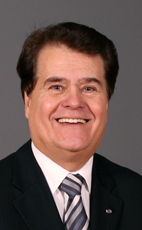
House of Commons photo

Crucial Fact

  • His favourite word was health.

Last in Parliament March 2011, as Liberal MP for Pierrefonds—Dollard (Québec)

Lost his last election, in 2011, with 31% of the vote.

Statements in the House

Middle East December 9th, 2002

Mr. Speaker, violence only leads to violence. All violence, no matter what kind or who perpetrates it, must be roundly condemned.

This is why, as a parliamentarian, I must speak out against and strongly condemn the remarks made by the leader of Hezbollah's political wing, Sheik Hassan Nasrallah. Last week, he called upon young Palestinians, encouraging them to become human bombs around the world.

This call for suicide bombers will only increase terrorism and the number of innocent victims worldwide. Furthermore, these senseless remarks will only delay negotiations to re-establish a dialogue aimed at finding a fair, equitable and lasting solution to the Middle East conflict.

For this reason, I am urging the Government of Canada to take direct action to intensify efforts to rapidly renew peace talks and ensure an end to all this needless violence.

World AIDS Day December 2nd, 2002

Mr. Speaker, a number of activities took place around the world this past weekend in conjunction with World AIDS Day.

In Italy, Gabon, China, Iran, France, Great Britain, the United States, and in this country and many others, there were manifestations of great solidarity with the battle against this disease, which continues to claim far too many victims.

The marches, prayers, demonstrations and declarations are all highly encouraging. I join with all those who took part in these activities in encouraging action to halt the progress of this disease.

The battle is not yet won. The UN reports that there are close to 42 million individuals in the world who have contracted the AIDS virus.

This magnificent solidarity which unites us all must be reflected in our actions. Let the research continue so that this dread disease can be overcome.

Veterinary Medicine November 27th, 2002

Mr. Speaker, since its opening in 1947, the department of veterinary medicine of the Université de Montréal, in Saint-Hyacinthe, has made significant advancements and trained many veterinarians. It is hard to believe that the December 9, 2002, deadline for the accreditation of that department is fast approaching.

Very few institutions in Canada provide this professional training. Besides the protection and health of domestic and farm animals, one must recognize that what is at stake ultimately is human health. Think for instance of the role played by these institutions in the pharmaceutical, agri-food and cosmetics industries.

Need I remind the hon. members of all the questions that have been asked about mad cow disease, listeriosis, or the equine infectious anemia outbreak in southern France since last February?

Let us not wait for a serious emergency in Canada to act. An ounce of prevention is worth a pound of cure. Let us find the financial resources to replace outdated equipment and inadequate infrastructures.

Let us make sure that our veterinary colleges can continue to operate.

Committees of the House November 20th, 2002

Mr. Speaker, I have the honour to present, in both official languages, the second report of the Standing Committee on Foreign Affairs and International Trade relating to Bill S-2, An Act to implement an agreement, conventions and protocols concluded between Canada and Kuwait, Mongolia, the United Arab Emirates, Moldova, Norway, Belgium and Italy for the avoidance of double taxation and the prevention of fiscal evasion and to amend the enacted text of three tax treaties, without amendment.

Committees of the House November 6th, 2002

Mr. Speaker, I have the honour to present, in both official languages, the first report of the Standing Committee on Foreign Affairs and International Trade on Bill C-14, An Act providing for controls on the export, import or transit across Canada of rough diamonds and for a certification scheme for the export of rough diamonds in order to meet Canada's obligations under the Kimberley Process, with amendments.

Association des médecins de langue française du Canada November 5th, 2002

Mr. Speaker, I would like to inform the House that on November 1, a gala luncheon was held in Montreal to celebrate the 100th anniversary of the Association des médecins de langue française du Canada.

This association, with more than 5,000 members in Canada, the United States, and the West Indies, was created to promote the use of the French language at all levels.

On the occasion of its centenary, Dr. Jean Léveillé, past president, unveiled a medal representing the association's founding president, Dr. Michel Delphis Brochu.

The first recipients of the medal were Drs. Jacques Boulay, Jacques Genest and Victor Goldbloom of Quebec, as well as Ms. Gisèle Lalonde from Ontario, and Dr. Aurel Schofield from New Brunswick.

Congratulations to these first recipients and long live the one hundred-year-old association.

Francophonie Summit October 30th, 2002

Mr. Speaker, my question is for the Secretary of State (Latin America and Africa) (Francophonie). The Francophonie Summit took place in Beirut, Lebanon, October 18 to 20. The Prime Minister and the Secretary of State for the Francophonie were there to represent the interests of all Canadians at this important meeting.

Were the goals and objectives that Canada had set for the summit met?

United Nations Day October 24th, 2002

Mr. Speaker, today is United Nations Day. I am pleased to acknowledge the importance of this organization to Canada.

A founding member of the United Nations Organization, Canada has always been a strong champion of the system based on rules established when the UN Charter came into effect, on October 24, 1945.

We believed at the time, and still do, that multilateral cooperation is the safest way to ensure the safety and security of the world community in the long term.

Today, we look back on recent achievements—the summit on sustainable development in Johannesburg, the special session on children and the consensus achieved in Monterrey, Mexico—that have strengthened the partnership between developing countries and donor countries.

The potential for improvement has increased considerably under the leadership of Secretary-General Kofi Annan, whose ideas for a reform of the organization have earned him the Nobel Peace Prize.

The UN must be and will be at the heart of the international community's response to the challenges it faces today. Canada will continue to provide it with its steadfast support in this regard.

Francophonie Summit October 8th, 2002

Mr. Speaker, the Francophonie Summit will be held next week, from October 18 to 20, in Beirut, Lebanon. The Prime Minister and the Secretary of State for La Francophonie will be in attendance to represent the interests of Canadians on that occasion.

Could the hon. Secretary of State tell us what the stakes and objectives of Canada will be at the summit?

Committee Business and Reinstatement of Government Bills October 7th, 2002

Mr. Speaker, I welcome this opportunity to rise today to speak to this motion. It is simply designed to allow a minister, during the first thirty sitting days of a new session of Parliament, to ask that a government bill be reinstated, provided it is in the same form as in the previous session. I stress the latter, namely that it has to be in the same form as in the previous session. With the permission of the Speaker, the bill could be reintroduced at the stage to which it had progressed at the time of prorogation. This would allow the various committees to pick up where they left off.

First, it should be noted that such a procedure is not new to this House. Bills have often been reinstated, and even recently. In 1970, 1972, 1974 and 1986 for example, the House unanimously approved motions to reinstate bills. Indeed, one such motion was passed in 1991, under the previous government.

In 1991, a one day prorogation ended the second session of the 34th Parliament, and the third session opened the following day. At that time, two standing committees were reactivated by unanimous consent in order to allow them to finish what they had been mandated to do in the previous session, provided they would cease to exist after their report was tabled. A special joint committee was even reactivated, and two bills were reinstated.

In 1977 and 1982, the House adopted amendments to its Standing Orders to carry over to the next session consideration of a bill. As recently as March 1996, the House adopted a similar motion. Also, in October 1999, the House unanimously passed a motion similar to the one before us today, in order to be able to pick up where it had left off in the previous session.

Finally, the motion put forward today is similar to the provisions of the Standing Orders allowing private members' bills to be reinstated following prorogation.

Clearly, there are many precedents for the procedures put forward today. The government's motivation is equally clear. It wants to set the work of the House and its committees in motion without sacrificing the rights and privileges of parliamentarians.

In fact, this motion would save precious time and spare members work, who would otherwise have to spend time on bills and committee work that had already been studied and adopted. If this motion were adopted, the first result would be substantial and impressive savings in terms of public funds. If the motion were adopted, it would also allow Parliament and committees to devote themselves to what all Canadians consider to be new and important work. Thus the pressing need for such a change. In fact, last summer, when the session ended, more than ten government bills disappeared.

Allow me to list them. These bills are all very important. There was the bill on species at risk, before the Senate; the bill to amend the Criminal Code on cruelty to animals and firearms, also before the Senate; the bill to amend the Canadian Environmental Assessment Act, before a committee of the House; the bill to amend the Copyright Act, before the Senate; the pest control products bill, also before the Senate; legislation to promote physical activity and sport, before the Senate; a bill on assisted reproduction, in committee. As a doctor, this bill is very important to me and must be passed, as soon as possible. There is also the specific claims resolution legislation, in committee. Finally, there is the bill on first nations governance, which was also in committee.

If the Standing Orders contained procedures to reinstate legislation, the House and members would have been spared a great many hours. For example, bills having already been passed by the House could have been reinstated and submitted to the Senate without having to debate them or consult again, because all of that work would have been done in the previous session. Bills that had been referred to committee could also be resubmitted, without delay.

The government wants to speed up the business of Parliament, but let us not lose sight of the fact that we have a duty to protect the rights and privileges of members so that they may give careful study to bills, and ensure that the interests of all Canadians are fully represented and protected. The procedures of this motion would not bypass the parliamentary process and no stage would be skipped.

Bills would instead be tabled in the same form and at the same stage as they were before the end of the last session. In this way, no period of consideration and no debate would be eliminated and no opposition critic would, of course, have his time cut short.

Finally, freeing up the House's time with the measures included in this motion would also enable us to keep a closer eye on new measures that might be tabled in future.

Obviously, redoing the work already done on old bills cuts into the time that can be devoted to new ones, and makes us less available to respond to the emergencies that crop up from time to time.

The committees should be able to continue where they left off and move forward from there, without having to start all over again.

This motion is, therefore, essential if we are to make up for lost time on old business and prepare ourselves for the new challenges we are likely to be confronted with in future.

The opposition said that it would oppose the motion, for the sole purpose of delaying the bills that were introduced during the last session.

This is unfair. This is contrary to the practice that has been in effect in the House for the past 30 years. This shows that the opposition does not have any new agenda and wants to prevent us from meeting the new challenges that are facing Canadians. The official opposition often asks the government to proceed with parliamentary reform and to change certain rules. We are making a proposal, but it is opposed to it. The opposition is only interested in reviewing bills from the previous session.

Because of this attitude on the part of the opposition, the House, Canadian taxpayers and the witnesses who appeared before and who will have to give the same evidence that they gave barely a few months ago will all lose.

In conclusion, this motion is fair and reasonable, and it deserves to be supported, since it would give ministers a simple way to reintroduce bills at the stage they were at when the previous parliamentary session came to an end. It would allow committees to continue their proceedings without interruption. This is what the House has been doing for over 30 years. It is the same procedure as the one that applies to private members' bills. It is in the best interests of the House, of members of Parliament and of the public, since it would ensure that our time and taxpayers' money are not wasted. This motion would also allow the House to deal with critical issues, rather than rehashing bills that, in many cases, have already been passed, to a large extent.

For all these reasons, I am seeking the support of all the members of this House to ensure that this procedural motion is adopted and that the House of Commons can conduct its proceedings effectively and focus on the fundamental issues facing Canadians.