
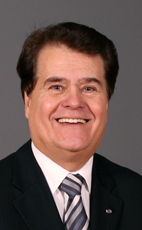
House of Commons photo

Crucial Fact

  • His favourite word was health.

Last in Parliament March 2011, as Liberal MP for Pierrefonds—Dollard (Québec)

Lost his last election, in 2011, with 31% of the vote.

Statements in the House

Tuberculosis May 9th, 2002

Mr. Speaker, I am pleased to bring to the attention of the House a recent agreement between the foundation run by the former president of South Africa and Nobel Peace Prize winner and the pharmaceutical company Aventis to fight tuberculosis in South Africa.

The purpose of this joint initiative of the Mandela Foundation and Aventis Pharma is to increase the country's rate of detection and treatment based on standards established by the World Health Organization, and to set up the infrastructure needed to educate health professionals and patients on the need to ensure the continuity of treatments.

Aventis has made a commitment to support this important project and inject close to $20 million Canadian over a five year period.

The Nelson Mandela Foundation was established in September 1999 to expand and formalize the work Nelson Mandela has done throughout his life. The foundation focuses its efforts on three primary sectors: democracy, education and health.

I congratulate them on this partnership.

L'@venue-Centre Internet communautaire May 8th, 2002

Mr. Speaker, I would like to pay tribute to L'@venue-Centre Internet communautaire, located in the riding of Hochelaga—Maisonneuve. L'@venue is a training centre designed to help young people find work by learning about computers and information and communication technologies.

In 1998, as the federal government official representing Industry Canada, I had the pleasure of meeting the whole team when the centre officially opened its doors. Thanks to the energy of the team members, this project has achieved tremendous success.

In the fall of 2000, L'@venue inaugurated a network of four community access centres to the Internet, thus allowing access to new information and communication technologies, at an affordable cost and on highly performing work stations.

The funds obtained from the federal government through the Internet community access program were properly managed, and the results show it.

Congratulations to the whole team at L'@venue for its exceptional contribution to our community.

Health Research May 7th, 2002

Mr. Speaker, I am pleased to bring to the attention of the House the creation of three new research chairs in transplantation.

This joint announcement was made by the President of the CanadianInstitutes of Health Research, Dr. Alan Bernstein, and the CEO of Wyeth-Ayers Canada Inc., Mr. Aldo Baumgartner.

Dr. Norma Kneteman, of the University of Alberta, will conduct research with the aim of reducing the toxicity of immunosuppressive therapies and develop prevention models for recurring hepatitis C, the leading indication for a liver transplant.

Dr. James Shapiro, also from the University of Alberta, and Director of the “Edmonton Protocol” Team, will conduct research in pancreatic islet transplantation that could ultimately reduce or eliminate the need for people with type 1 diabetes to take insulin.

The University of Toronto's Dr. Li Zhang will investigate the mechanisms involved in donor-specific transplant tolerance.

This demonstrates the importance of research at the national level, thanks to the constant co-operation between universities and the pharmaceutical industry.

Petitions May 7th, 2002

Mr. Speaker, pursuant to Standing Order 36, I submit a petition signed by rural mail couriers from all over the country.

These Canadians are asking parliament to repeal subsection 13(5) of the Canada Post Corporation Act, which denies them the right to collective bargaining.

While they perform the same task as their city counterparts, the petitioners feel their most basic rights to decent wages and fair and equitable working conditions are being violated.

Guaranteed Income Supplement April 23rd, 2002

Mr. Speaker, my question is for the Minister of Human Resources Development.

The Bloc Quebecois candidate in the riding of Verdun--Saint-Henri--Saint-Paul--Pointe Saint-Charles as well as other spokespersons from this party are saying that the Government of Canada is deliberately depriving 2,700 senior citizens in this riding of their guaranteed income supplement.

Could the minister clarify these statements?

Interparliamentary Delegations February 21st, 2002

Mr. Speaker, pursuant to Standing Order 34, I have the honour to table, in both official languages, two reports by the Canadian branch of the Assemblée parlementaire de la Francophonie and the related financial report.

The first report is on the political committee meeting, held in Paris, France, from January 25 to 27, 2002. The second report has to do with the executive committee meeting, also held in Paris, France.

The Budget December 13th, 2001

Mr. Speaker, our government's objective has always been to create a framework of excellence to improve the Canadian context for research.

My question is for the Secretary of State for Science, Research and Development.

In order to preserve what has already been achieved and secure the future, what did the Canadian government provide in the 2001 budget for university research?

Tobacco Control December 10th, 2001

Mr. Speaker, every year smoking kills over 45,000 Canadians. It is our country's most pressing public health issue. The new federal tobacco control strategy is ambitious and bears witness to the government's commitment to fight tobacco use and its effects on the health of Canadians.

This comprehensive strategy is based on our significant successes in recent years: the Canadian tobacco use monitoring survey for 2000 indicated that tobacco use among Canadians aged 15 years and over had reached its lowest point, 24%, since the survey was initiated in 1965.

Among young people, one of our greatest challenges in the fight against the use of tobacco. The rate of use among youths aged 15 to 19, which had been 28% in 1999, is now reported to be 25%.

In the next 10 years, we will be working to achieve our objective of cutting the number of smokers by 20%, reducing the number of cigarettes sold by 30% and increasing to 80% the number of retailers complying with the provisions of the Tobacco Act, which prohibits the sale of cigarettes to young Canadians.

Petitions December 5th, 2001

Mr. Speaker, pursuant to Standing Order 36, I have the honour to submit the following petition signed by 918 students and teachers at the Collège Notre-Dame de Montréal.

Following the tragic events of September 11, they denounce any act motivated by a desire for revenge or racial or religious prejudice.

In this spirit, they ask parliament to ensure that Canada is a model of peace for all humanity, based on justice for all, respect for each human being and an equitable distribution of wealth.

Diabetes Month November 28th, 2001

Mr. Speaker, somewhat belatedly, I have the pleasure of informing the House that November is Diabetes Month.

Diabetes is a national public health problem in Canada and in the world. It currently affects over 2.2 million Canadians, contributes to over 5,500 deaths annually and costs Canada's economy some $9 billion annually.

Type 1 diabetes, previously recognized as a disease that affected adults only, now affects children as well.

As Canada's population ages, the number of cases of type 2 diabetes is expected to increase. Unless we change our lifestyle, our eating habits and our physical activity, we run an increased risk of developing type 2 diabetes.

In 1999, so that Canadians could benefit more from the expertise available throughout Canada, the Government of Canada invested $115 million over five years to develop a Canadian strategy on diabetes.

I take this opportunity to thank all those who contribute in any way to research into this disease.