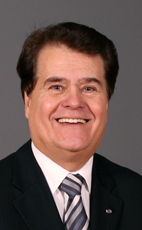
House of Commons photo

Crucial Fact

  • His favourite word was health.

Last in Parliament March 2011, as Liberal MP for Pierrefonds—Dollard (Québec)

Lost his last election, in 2011, with 31% of the vote.

Statements in the House

Terrorism October 25th, 2001

Mr. Speaker, my question is for the Minister of Foreign Affairs. The Commonwealth Heads of Government meeting which was postponed earlier this month would have provided an opportunity for Commonwealth leaders to discuss measures for international co-operation against terrorism.

Has the Commonwealth taken any steps since the postponement was announced to address the terrorism issue?

Air Canada October 23rd, 2001

Mr. Speaker, the Minister of Transport has told the House that the government supports a private sector solution to the challenges facing Air Canada. Could the minister please tell the House what he intends to do to support this idea?

Infrastructure Program October 23rd, 2001

Mr. Speaker, I would like to point out that a year ago the Government of Canada and the government of Quebec signed an agreement on infrastructure projects.

Given the economic downturn affecting the country at the moment and given that one way to stimulate the economy is to undertake infrastructure projects in traditional areas or in the area of the environment; and

Given that, in my riding of Pierrefonds--Dollard, no application has yet received provincial approval, I ask all those involved to be diligent in the matter.

Trade October 18th, 2001

Mr. Speaker, my question is for the Minister of Industry.

It was reported today that the World Trade Organization will issue an interim ruling on the Air Wisconsin transaction and that this ruling will be against Canada. In light of the expected ruling, what will happen to the financing commitment which convinced Air Wisconsin to buy 150 regional jets from Montreal based Bombardier?

Supply October 15th, 2001

Mr. Speaker, I thank the hon. member for the question. I think the hon. member is completely right. If we want to do a great job we need to understand that part of the world properly. The only way to understand that part of the world is to understand the vision of these people, not through the eyes of North Americans but through the eyes of the people who have the knowledge.

Supply October 15th, 2001

Mr. Speaker, the problem is very complex and the solutions do not come easily.

We must remember that around 1979, during the east-west cold war, the former Soviet Union with its president, Mr. Brezhnev, decided to invade Afghanistan. One reason for this decision was an attempt to have access to the Arabian Sea. At the time, the Soviet Union had access to the North Sea, which is blocked by ice in winter, and to the Black Sea, where traffic is controlled by Turkey.

So in order to have a military base so they could establish a fleet on the Arabian Sea the Soviet Union invaded Afghanistan in 1979 and failed.

However, to offset the Soviet attack on Afghanistan, mercenaries arrived from Saudi Arabia and some of the Maghreb states. They were all Wahhabis. This is one reason for the tinder box in this part of the world, especially in Afghanistan.

Supply October 15th, 2001

Mr. Speaker, if there is still some time left at the end of my speech, I will share it with the member for Mississauga West.

I am pleased to speak today on the opposition motion of the Progressive Conservative/Democratic Representative Coalition. To start with, my comments will deal with the motion but they will mainly be a reflection on the tragic events.

For many of our compatriots, including Americans, the present times are very difficult. I support wholeheartedly the position of our government, which has decided to take an active part, within our means, in the eradication of terrorism.

I refer to eradication of terrorism and not to a war against Muslims, and even less to a clash of civilizations as some have already called this conflict. The expression clash of civilizations, which we often hear, comes from the title of a book written by an American academic, Samuel Huntington. According to him, the west has become a favourite target because of its behaviour, its materialism and because it has replaced old colonialism by a new form of colonialism by which it regularly intervenes in the culture of other countries. One can easily be seduced by this kind of theory, but the reality is quite different.

In order to try to understand the events of September 11, if it is at all possible to understand such an act of barbarism, one has to go back and, in this case, read history. As a matter of fact, history teaches us, among other things, that kamikazes do not commit suicide in the name of religion but rather for a cause, an ideology.

We only have to think about the ideology of Japanese kamikaze pilots, who were not Muslims, during the World War II, and closer to our time to the Tamils, who are not Muslims either, who act as human bombs and commit suicide to protest against the government of Sri Lanka.

We must understand, after analyzing the issue, that the present problem finds its source in Islam. The present war is not only a war between the west and fundamentalists like bin Laden, but also a religious war inside Islam itself. As North Americans, we tend to see in that a resurgence of the crusades. It is not at all the case. The answer is much closer to us, to our time.

This extreme violence, this intolerance and this fanaticism have their origins in Saudi Arabia at the end of the 18th century. It is Wahhabism, a political and religious movement that bears the name of its founder, Muhammad ibn Abd al-Wahhab. This movement is based on the principle of one god whose instructions must be followed blindly. Wahhabites are known for their rigid moral standards. They condemn music, poetry, tobacco and alcohol. Their goal is to create other states that adhere to their puritanism. It is the most extreme form of fundamentalism. It should be noted that all the September 11 kamikaze belonged to that group.

Bin Laden, who was born in Saudi Arabia, is a Wahhabi. Those responsible for the assassination of President Sadat in Egypt were Wahhabis. Those responsible for the attacks against tourists in Luxor, Egypt were also Wahhabis. In Algeria, this political and religious movement is responsible for over 100,000 deaths. Moreover, it should be noted that all those killed in Algeria were Muslims.

The same thing is happening in Kashmir, where the Wahhabis kill Hindus. It is also the same thing in Chechnya. There is always a common denominator and that common denominator is Wahhabism.

So what must the western world do? What must Canada do? Currently, there are over six million Muslims in the United States, and theirs is the fastest growing religion. According to some sources, 80% of mosques are under the control of Wahhabi imams and these mosques are funded by Saudi Arabia. Moreover, whether in the United States or elsewhere, the vast majority of these imams preach extremism. This is certainly not to say that the Muslims who go to these mosques all accept the views of their imams.

But the fact remains that we must act. So, what are we to do? What action should we take? The issue is much more serious, much deeper than bin Laden himself. The first question to ask ourselves is how to help Muslim groups resist fundamentalism. The United States undoubtedly have to do some thinking, considering who they supported in Pakistan and in Afghanistan during the cold war with the former Soviet Union.

Second, if bin Laden were to disappear somehow, would this mean the end of the bombardments and the climate of terror? The answer is obvious. Could it mean the end of Wahhabism? Surely not. So, who are we going to discuss and negotiate with?

Professor Seyyed Vali Reza Nash of the political science department of the University of California at San Diego, the author of a book on the extremists in Pakistan, believes that Saudi Arabia alone is capable of resolving this impasse.

In conclusion, although engaged in this necessary fight against terrorism, Canada must try as well to play the role of peacemaker, facilitator, be it within the UN or other bodies. Canada must help Islam find a solution, because, in the long term, the solution has to come from Islam.

I conclude by reiterating my full support for and solidarity with our Canadian forces, who are coming to the defence of liberty and democracy as part of an international military coalition. I will be pleased to support the opposition motion.

Interparliamentary Delegations September 27th, 2001

Mr. Speaker, pursuant to Standing Order 34, I have the honour to table, in both official languages, two reports by the Canadian branch of the Assemblée parlementaire de la Francophonie and the accompanying financial report.

The first report has to do with the bureau meeting held in Quebec City, on July 6, 2001. The second has to do with the 27th regular session held from July 8 to 10, 2001 in Quebec City as well.

Air Transportation September 26th, 2001

Mr. Speaker, whereas the U.S. government, which is generally disinclined to provide government assistance to the private sector, has provided substantial support to its airline industry;

Whereas Canadian airlines have been substantially affected by the tragic events in New York and Washington;

Whereas air transportation in Canada is essential to the population, in remote regions in particular, and to our businesses; and

Whereas the over 50% reduction in the activities of Canada's airlines is jeopardizing financial stability throughout our economy,

Therefore, I invite my colleagues in the House of Commons, the Senate and in the government to provide assistance similar to the assistance provided by the U.S. government to its industry, both to preserve a Canadian infrastructure and to reassure the public in general and the workers in this industry in particular.

Awards of Excellence for Exporters September 25th, 2001

Mr. Speaker, yesterday evening in Montreal the Minister for International Trade presented awards of excellence to last year's leading exporters.

It is with great pleasure that I inform the House that FieldTurf of Montreal, and Lauzon Distinctive Hardwood Flooring of Papineauville, two Quebec companies, were among the ten recipients of awards of excellence.

Toronto's Teknion Corporation received the prestigious exporter of the year award. Teknion Corporation is an innovative company. The office systems and office furniture products it markets are original and of high quality. It has distributors in over 50 countries.

In addition, this company has created a large number of jobs. Its success in the export sector is an example to other Canadian countries.

In conclusion, I congratulate Teknion Corporation and all the other award winners. I wish them much success in the future.