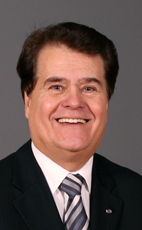
House of Commons photo

Crucial Fact

  • His favourite word was health.

Last in Parliament March 2011, as Liberal MP for Pierrefonds—Dollard (Québec)

Lost his last election, in 2011, with 31% of the vote.

Statements in the House

Petitions March 14th, 2001

Mr. Speaker, pursuant to Standing Order 36, I have the honour to submit a petition signed by residents of my riding of Pierrefonds—Dollard.

As the right of landing fee of $975 for each prospective immigrant creates an impediment for those with large families wishing to immigrate to Canada and places a heavy burden on those who are seeking to integrate themselves into the Canadian economy, the petitioners are asking the Canadian parliament to abolish this right of landing fee.

Interparliamentary Delegations February 15th, 2001

Mr. Speaker, pursuant to Standing Order 34, I have the honour to table in the House, in both official languages, the report of the Canadian section of the Assemblée parlementaire de la Francophonie, and the financial report relating to it.

The report concerns the meeting of the assembly held in Caen, France, from December 13 to 15, 2000.

Black History Month February 9th, 2001

Mr. Speaker, in 1995, parliament passed a resolution proclaiming February Black History Month.

This annual celebration grew in popularity during the 1960s, as blacks in Canada became increasingly aware of their contribution to Canadian society with the growth of the civil rights movement in the United States.

The Mathieu Da Costa awards program shows the importance the government places on Black History Month.

Historically recognized as the first black person to settle in Canada, Mathieu Da Costa helped the Mi'kmaq and the first French explorers understand each other, thanks to his skill as an interpreter.

The awards program is aimed at encouraging primary and secondary school students, aged 9 to 19, to explore the contributions persons of various cultural and racial origins have made to Canada's development.

In this, Black History Month, I hope celebrations are lively and I offer my thanks for their contribution to Canada's culture.

Interparliamentary Delegations October 19th, 2000

Madam Speaker, pursuant to Standing Order 34 I have the honour to table in the House in both official languages two reports of the Canadian section of the Parliamentary Assembly of the Francophonie, as well as the related financial report.

The first report has to do with the meeting of the executive which was held at Yaoundé, Cameroon on July 4, 2000, and the second with the 26th ordinary session held July 6 through 8, 2000 also at Yaoundé, Cameroon.

Proportional Representation October 17th, 2000

Mr. Speaker, I thank you for giving me this opportunity to address Motion M-155, which reads as follows:

That, in the opinion of this House, the government should work towards incorporating a measure of proportional representation in the federal electoral system, making use of a framework which includes: ( a ) a report on proportional representation prepared by an all-party committee after extensive public hearings; ( b ) a referendum to be held on this issue where the question shall be whether electors favour replacing the present system with a system proposed by the committee as concurred in by the House; and ( c ) the referendum may be held either before or at the same time as the next general election.

I listened carefully to the eloquent speech by the hon. member for Regina—Qu'Appelle on his Motion M-155, and while I find his arguments very interesting, I do not agree with his proposal. There are, in my opinion, very good reasons to keep our existing electoral system. That system is based on ridings, with each riding electing a member of parliament.

This means that a member of parliament has a great responsibility toward his constituents, who can vote against him the next time around. Similarly, voters can get rid of the government in office if they no longer trust it. The verdict is decisive in the case of a majority.

Moreover, as the only representative for his riding, a member of parliament is responsible for representing his constituents regarding any issue that comes before parliament.

Under the current system, a member of parliament must take into account a whole range of opinions. He does not speak only on behalf of his party. As the sole representative of his riding, he must try to correct all sorts of wrongs and he must take into consideration the interests and opinions of all his voters.

Thus, the role of a member of parliament is to fulfil the basic function of any political system, which is reconciling a large number of views.

We also saw that in some countries using an electoral system based on proportional representation, it can sometimes take weeks after an election before the government is formed. Also, once the government has been formed, often under a coalition integrating small specialized parties—not to say extremists—it is not in a position to maintain the confidence of the legislature.

Electoral systems based on proportional representation often require the establishment of a coalition between parties of diverging political views. A plurality system tends to lead to the formation of broad based parties bringing together members from different regions and linguistic and ethnocultural groups.

Proportional representation is likely to lead to a coalition government formed following in camera political negotiations and not as the result of balloting.

Some countries have realized that proportional representation exacerbates regional differences and rifts within societies and that the search for a national consensus on vital issues is accordingly complicated.

Finally, in our electoral system, voting is a simple act. The voter simply indicates the name of his preferred candidate. This permits the reduction of the number of spoiled ballots.

The vote count is quick and simple. Generally, only a few hours after the polls close, Canadians know which party will form the government and which will form the opposition.

Of course, even the best systems are open to criticism. However, we must not forget that Canada's political system is one of the most stable and democratic in the world. It serves as a model for many countries.

Our electoral system has stood the test of time, while remaining flexible in the face of change. Clearly this is a delicate and complex matter, which must be handled wisely, especially since there is nothing to indicate real public support for such a change.

Holding a national referendum on this issue is not warranted. This is why it would not be a good idea to carry this private member's motion through, and I would advise the members of all parties to oppose it.

In closing, Mr. Speaker, I would like to thank you wholeheartedly for your excellent work. I am most grateful to you.

Supply October 16th, 2000

Mr. Speaker, it is very important to mention that at the end of the past millennium, instead of erecting statues to the glory of our Prime Minister or the Liberal government, this government decided to invest in our youth and provide them with grants to go to university or college.

In Quebec, 23,000 students have received bursaries from the federal government. This is important, because it means we have faith in our country's future.

Supply October 16th, 2000

Mr. Speaker, I thank the member of the Canadian Alliance for his question. I will deal with his first point regarding health care.

Since 1996, the federal department of health has been setting up centers of excellence for women's health. We are talking about five focal points for multidisciplinary research financed over six years. By studying what determines women's health, they will help shape policies. Women's health is a very important issue.

Another issue that is very important is child poverty. Our government has been promoting policies to fight child poverty. It is important for every child to enjoy equal opportunity right from birth.

We have programs to help mothers even before the birth of their child. For single and low income families, the government of Canada has introduced benefits to help mothers and mostly children. We all know that when children are born, their brain is made up of billions of neurones that are not yet interconnected. Children need the right stimulation to make sure that when they start school, they are ready for it. If they are, they will experience less problems during their teens. They will not drop out and will have fewer run-ins with the law.

For us Liberals, policies are there to ensure that in the long run children will become good citizens.

Supply October 16th, 2000

Mr. Speaker, I will be sharing my time with the member for Ottawa West—Nepean.

I am very pleased to rise in the House to talk about the World March of Women, a very important event for Canadian women and all Canadians.

Since March 8 of this year, many women from coast to coast have been working hard to make this march a memorable success. For more than seven months now, they have been organizing numerous activities at the local, regional and national level to make Canadians more aware of the cause of women.

For days, they have been marching hand in hand with their sisters from all over the world to fight poverty and violence against women.

And tomorrow, the World March of Women will culminate in New York, when women from more than one hundred countries will speak with one voice before the United Nations. As a matter of fact, it was in the Big Apple that women started making demands almost a century ago.

Armed only with their will, their courage and their determination, women took to the streets to speak out against their dangerous working conditions and their meager wages. These women rose above prejudice to make sure their message was heard.

Then other women throughout the world took up the torch in the name of justice and equity. Little by little, progress was made: the right to vote, respect of fundamental rights, massive entry into the labour force. Gradually, women took their place in society.

Here, in Canada, a country known as one of the most progressive countries, women also had to fight hard to acquire the status of a person, to have access to higher education or to have the right to vote. There is no doubt that their collective progress has been slow, too slow, and often very difficult.

We needed the work of pioneers like the Famous Five to give Canadian democracy its true meaning.

But today we can see the concrete results of that progress. Canadian women are present in all areas of our society. They travel in space, they push back the limits of science, they amass great wealth, and they are elected to our democratic assemblies.

Despite this considerable progress, however, the road to equality is long and obstacle-ridden. For example, Canadian women are still considerably under-represented in the rapidly developing areas of science. Far too many are still in insecure employment.

But there are other still more serious problems that remain with us. In 1997, 88% of the victims of spousal abuse in Canada were women, and 65% of these reported more than two incidents of violence. One victim in four has been involved in ten or so such incidents.

Our government is very much aware of these problems. Moreover, poverty and violence toward women are among its highest priorities. In the area of justice, we have stepped up our efforts in recent years to eradicate violence toward women and children. Women cannot develop their full potential except within a society that is totally free of violence toward them.

In recent years we have made the necessary changes to make substantial improvements to the situation. We have passed appropriate and effective gun control legislation. We have amended the criminal code in order to bolster the provisions on high-risk offenders.

In 1999, we also passed three extremely important pieces of legislation. These have made it possible to provide more rights to the victims of violent acts, to promote the personal safety of women and children, and to ensure that the legal system provides a better response to the needs of abused women.

Despite this significant progress, we are firmly determined to continue our quest for a society in which everyone, men and women, may live in safety. That is why we have been working so hard to eradicate the evil at the root of it by fighting poverty vigorously, especially poverty among children. We are helping families to ensure that each child gets a good start in life.

The unanimous and historic agreement on health care concluded by the first ministers includes considerable investment in women's health and help in early childhood. We are continuing to increase our help to Canadian families through the national child benefit.

Between now and 2004, we expect to invest an additional $2.5 billion annually in this initiative, which has been called the most innovative social measure in the country in the past generation. We are also investing more in public housing.

We are making available effective initiatives such as the Canada prenatal nutrition program, which gives considerable help to pregnant women in Canada. We have also decided to double the length of maternity and paternity leave to enable mothers and fathers to devote the necessary time to their family.

These actions merely form the basis of our fight against poverty and violence against women. More than ever, we have to do more. And so we will. Yesterday, the Prime Minister met the organizers of the march. He reiterated his support and that of the Government of Canada.

He reiterated our intention to work closely with all our partners to improve the status of women. However, our government is well aware that legislative measures alone will not ensure equality. They must absolutely be supported by effective and flexible policies that take into account the realities and diversities of women's lives.

In 1995, our government launched an action plan in order to advance our government's policy on equality. This plan, which includes the initiatives of 24 federal departments and agencies, enables us to conduct comparative analyses between the two genders. This revolutionary approach allows us to accurately analyze the impact of each legislative measure and policy on women and men.

This new data helped us learn important lessons. First, it was imperative to approach the issue of gender equality from a new perspective. We can never eliminate the anatomical, physiological and psychological differences between men and women. Men and women will never communicate, make decisions or solve problems in the same way. To be sure, we are always striving to achieve equality, but we must do so while taking these differences into account, not by imposing uniformity.

In March 1999, the federal Minister of Health introduced, among other initiatives, the women's health strategy. This innovative strategy will allow us to not only target inequalities but, more importantly, to meet the specific needs of women when it comes to health.

We also took measures in the area of justice with our National Crime Prevention Strategy, and we are firmly determined to continue in that direction. We have not given up, far from it. Rather, we want to intensify our efforts. We know that our comparative analyses by gender can be improved.

We are working to design new tools and new methods to promote equality in all areas of our society. However, we are also aware that governments cannot do everything alone. In Canada, there are currently over 3,000 women's groups that are active.

Through its equal opportunities for women program, Status of Women Canada provides financial assistance and professional services to groups of women working at the regional, provincial and national levels for equality.

In 1998-99, we contributed $8.2 million in funding to 267 projects and groups throughout the country. To advance a cause, ideas and a vision are needed, but much more is often needed as well, such things as determination, courage, tenacity and willingness.

For a number of days now, participants in the World March of Women have left the beaten path to take up just causes, values and ideas. The Government of Canada supports their efforts. We have invested close to $1 billion in promoting the World March of Women nationally and internationally.

As we begin a new century and a new millennium, it is wonderful to see women throughout the world speaking with one voice. They are sending us a clear message that poverty and violence against women must be ended.

Today, I am sure that all members of the House will want to join with me in congratulating women on their efforts and sacrifices, which will help improve the status of women both at home and abroad.

We are going to work together to ensure that this historic march signals the beginning of a new era, an era which will see us step up our efforts to build a fairer and more equitable society, a society in which equality of the sexes will be not a noble objective but a daily reality.

International Co-Operation September 27th, 2000

Mr. Speaker, a few weeks ago we all heard the announcement by the Minister for International Co-operation outlining the four new social development priorities on which CIDA's budget will be focused: health, nutrition, basic education, HIV/AIDS and children.

Will the minister tell us what she is planning to do for children?

Petitions September 20th, 2000

Mr. Speaker, under Standing Order 36, I would like to present a petition signed by 1,261 people in my riding. They ask the government to have more compassion for the elderly in Canada.

The petitioners ask parliament that the elderly, who are often poor, be exempted from taxes, the GST, the costs of medication, dental care, eye care, prostheses, therapeutic devices, ambulance, and public transit.