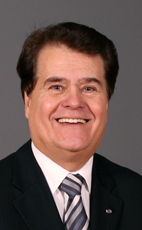
House of Commons photo

Crucial Fact

  • His favourite word was health.

Last in Parliament March 2011, as Liberal MP for Pierrefonds—Dollard (Québec)

Lost his last election, in 2011, with 31% of the vote.

Statements in the House

Canadian Film Industry March 27th, 2000

Mr. Speaker, the Canadian film industry is a key player on the international scene.

We have every reason to be proud of our creative energy, which is used to show the Canadian heritage on screens all over the world.

The federal government supports Canadian talent. It has established various audiovisual support programs to promote growth in that sector.

Among others, the Canadian television fund allocates $200 million annually for the production of Canadian television programs. As for Telefilm Canada, it provides in excess of $35 million for feature film production.

Canadian artists can also get tax credits to help them complete audio-visual projects. In 1997-98, these credits totalled $21 million.

These are all means by which the Canadian government contributes to the quality of the cultural life in Canada and in Quebec.

Liberal Party Of Canada Convention March 20th, 2000

Mr. Speaker, this past weekend, Liberal activists sent Canadians a clear message. They proposed and voted on resolutions aimed at a future electoral platform responding to the aspirations of the population.

Our party membership wishes to see their government pursue its agenda as far as health, the economy, and the bolstering of Canadian unity is concerned.

When Liberal activists call upon their government to invest in infrastructures, their focus is on regional development, and rightly so. When Liberal activists call upon their government to invest in health, their focus is on improving the quality of life of the Canadian population, and rightly so.

I am proud to belong to a political party with the well-being of the people of Canada at heart, a party whose ultimate aim is greater equity for all.

Fight Against Racism March 13th, 2000

Mr. Speaker, the launching of the week against racism is taking place today, at the Cinémathèque québécoise. This year's theme is about the faces of racism in Quebec.

We must lead the fight against racism on an individual and collective level.

We must always appreciate the opportunity that we have to share our values of support and solidarity with cultural communities.

As individuals, we have a responsibility to apply these values in our daily lives, so that those who settle in Canada feel at home here.

However, the fight against racism is far from over. We must eliminate the resistance that still exists, to ensure that all new Canadians have access to a certain quality of life.

I call on all governments and organizations to work together to ensure the best possible future for those who decide to come to live in Canada.

Supply March 2nd, 2000

Mr. Speaker, I thank the member for Acadie—Bathurst for his question. I totally agree that we should not fall for what the Reform Party and the Progressive Conservative Party propose on this issue. We have to maintain a public system open to all Canadians.

As for the funding issue, I think we should question quite a number of things, but the main issue is that we must put the patient first. This is what is missing now. In Canada, there are too many technocrats, who deal with all sorts of things, and the patient is not the major concern.

When provinces get the opportunity to do whatever they can to make the patient the top priority and when the medical and nursing stakeholders return to the decision making circles within provincial governments, then I am sure we will have the necessary funds to provide adequate medical services to people.

Supply March 2nd, 2000

Mr. Speaker, I want to thank the NDP member for his question.

This is a very good question, but the member knows that this is a funding issue and not a leadership issue. We know that there is a provincial jurisdiction in that matter and that we cannot move forward without a consensus of all provincial and federal health ministers.

In Quebec, my home province, we are ahead of all other Canadian provinces in that we have local community service centres or CLSCs as well as home care.

We have thus taken a shift to ambulatory care, which is very important and quite appreciated by the people. But, before applying this to all provinces, there must be consensus and true dialogue between the provincial ministers and the federal minister.

Supply March 2nd, 2000

Mr. Speaker, for your information I will be sharing my time with the hon. member from Abitibi—Baie-James—Nunavik.

I am pleased to speak on the opposition motion, which I consider very important. I too have concerns about access to necessary health care, including emergency room services.

Crowded emergency rooms create numerous problems involving various factors. As we know, there is a shortage of doctors after hours, there are not enough beds available, and a good number of the available beds are occupied by patients requiring long term care because home care and community services do not meet the needs of these people.

Those are but a few of the reasons why emergency rooms may have to turn back ambulances for example.

As the health minister already said, this long-standing situation is unacceptable. That being said, we cannot logically deal with the issue of short term hospital services without studying the whole care program. We need an integrated health care system.

To increase accessibility, we have to change our practices and our way of delivering health care services. However, we must make appropriate changes that will ensure the future of our medicare system.

As was mentioned by my colleague, the Minister of Health, two elements are essential. First, a change is needed in the way primary health care services are delivered in our communities. Second, home and community care must be provided so as to ensure that long term, rehabilitative and chronic care beds are available as required, and to free beds for short term care in hospitals.

Those are also the main priorities that health ministers have indicated at their last annual meeting. We all agree on the need to resolve those urgent concerns. Now we must take action. We need a plan to implement these changes.

If primary health care were provided in a different way in communities across the country, the problem of crowded emergency rooms would be resolved. Different models were proposed. However, if we do not change the way primary health care services are provided, we will not meet the needs of the communities. We will not succeed in alleviating the pressure on the emergency rooms.

If we do not put the emphasis on prevention and health promotion, we will not be able to take maximum advantage of the skills of all the health care providers.

Therefore, we must agree first on the kind of reform needed to provide integrated and full primary health care services. Then we must develop outside hospitals ways of dealing with those who need home and community care. I think there is a direct link between the availability of home and community care and the pressure on the hospitals.

If emergency wards are crowded, it is due in part to the shortage of space caused by patients who cannot go home, but do not have access to chronic, rehabilitative or long term care beds. They are stuck there and they occupy the beds that those on stretchers in the emergency wards could use. In this respect, home care is one solution among others.

Through facilitation, co-ordination and co-operation, the government will help the provinces and territories to implement a clear and coherent vision of a renewed, integrated and comprehensive health care system.

Let us talk about funding. As we know, the premiers expressed the need for additional funding for the health care system and will continue to do so. Last year the federal government invested $11.5 billion in health care through the Canada health and social transfer, or CHST. It was the most important one-time investment ever made by this government.

Increased federal funding for health care was provided to the provinces and territories to them alleviate immediate public concerns, such as overcrowded emergency rooms, long waiting lists and diagnostic services.

As we all know, budget 2000 increased by $2.5 billion over four years CHST funding for health care and post-secondary education. This increase raised the level of transfers to $15.5 billion for 2000-01 and subsequent years. Through the increase in cash transfers, coupled with increasing tax transfers, the CHST will reach an all time high of $30.8 billion in 2000-01.

By 2003-04, total transfers to the CHST should reach $32.7 billion.

Increased federal transfers will provide for a stable growth of transfers and will ensure that high quality health care will be available to anyone who needs it.

We have fully restored what was commonly known as the health component of the CHST to the levels existing before the spending reduction period of the mid 1990s.

However, this is not only about money, it is about the way this money is used. It is crucial to understand that the Canadian medicare system will not be able to give Canadians an appropriate access to quality health care in the years to come if it is not renewed considerably through co-operation and innovations. Status quo is not an option.

With respect to the management and delivery of health care services, innovative approaches to renewing Canada's public system of health care will be necessary.

Clearly, the challenge will be to find a way to accomplish this while maintaining the fundamentals of medicare. Through the health transition fund, the Government of Canada provides funds for innovative pilot projects, based on four priorities, including primary health care, home care and community care.

Many projects funded by the HTF look at ways to improve the use of emergency rooms and access to alternative services.

HTF projects allow us to collect and analyse data on what works and what does not. We must cope with change, learn from the past and use the knowledge we gain from the pilot projects carried out across our country.

Consequently, in order to settle the crisis in the emergency rooms, we must start by dealing with primary health care, home care and community health care.

To this end, the Minister of Health wrote to his provincial counterparts, proposing a meeting in May to develop a plan that would make these items a reality. The minister will certainly keep you informed of any new development arising from this meeting.

I repeat that the answer is not simply to increase funding. The federal government, the provinces and the territories must work together. If we keep on doing what we have always done, we will continue to achieve the same results, with emergency rooms turning away ambulances and problems regarding accessibility to services.

We have the necessary resources, incentives and environment to implement changes that will allow us to improve our health care system and to provide Canadians with a comprehensive, integrated health care system.

Canadians are proud of their health care system, which was built over the years. We will protect it and make the changes necessary to ensure that it remains a part of our Canadian heritage.

The Budget February 29th, 2000

Mr. Speaker, in the budget speech, the Canadian government announced its intention to invest $2.5 billion, over a four year period, through the Canada health and social transfer.

I wish to point out that this is the fourth consecutive increase under that program. Our government is receptive to the requests and needs of Canadians.

The government also announced that the Canada child tax benefit will get an additional $2.5 billion by the year 2004.

Finally, under budget 2000, the amount of maternity and parental benefits paid under the employment insurance program will double, since these benefits will paid for 12 months, instead of six. The criteria will also be more flexible and more people will have access to these benefits.

These are concrete initiatives that will allow us to help Canadian families and improve their quality of life.

Mouvement Desjardins February 22nd, 2000

Mr. Speaker, last weekend, the Mouvement des caisses Desjardins elected a new president, Alban D'Amours. Mr. D'Amours will officially take up his new duties on March 25.

When the Mouvement des caisses Desjardins was first formed, globalization and free trade were unheard of. Modernizing this financial institution has required skill and imagination.

Caisses Desjardins are an economic force in Quebec. Many regions in Quebec owe their development in part to this institution. It gave them access to credit denied them by other major financial institutions.

We therefore wish Mr. D'Amours good luck in his new position and the best of success in achieving the objectives of the Mouvement des caisses Desjardins.

Supply February 17th, 2000

Mr. Speaker, I have a question for the member for Lotbinière.

The hon. member suggests that we take up this issue with the Minister of Intergovernmental Affairs. Was the question put to Mr. Facal, Quebec's intergovernmental affairs minister, who said, in November, that the government of Quebec would never comply with the supreme court opinion? This was a call to civil disobedience. Does this means that the hon. member is for civil disobedience?

I would even go further. If 50% plus one is the democratic limit universally accepted, why is it not mentioned in Quebec's referendum legislation? Why did Mr. Burns, the PQ minister responsible for this legislation in Quebec, say, when introducing this bill, that the “moral weight” of a referendum that would be won based on the clearly and widely expressed will of the people would have to be assessed?

I have a very interesting question for the hon. member. If 50% plus one is the democratic limit universally accepted, does he support the precedent that France created regarding Comoros, the group of islands off Madagascar, when it decided that regions that vote against independence may remain a part of France?

Suicide Prevention February 15th, 2000

Mr. Speaker, during this 10th provincial suicide prevention week we must express a wish for greater involvement by society as a whole on this issue.

Governments have an important role to play in preventing despair and the resort to unfortunate actions by a large number of people. A heightened awareness of this serious problem, which is a trait of modern societies, reminds each of us that we share a certain amount of the responsibility toward those who are suffering profound distress.

The causes of suicide are many and they are highly complex. Our individual and collective involvement is essential if we are to attenuate this misfortune which strikes too many families. Sometimes just lending an ear is sufficient to help put someone on the path toward a solution and prevent him or her from undertaking some desperate act.

As a government, as individuals, let us increase our awareness of our responsibility toward those who need our help.