Mr. Speaker, pursuant to Standing Order 32(2), I am pleased to table, in both official languages, two copies of the 1996-97 annual report of the implementation committee on the Sahtu Dene and Metis comprehensive land claim agreement.

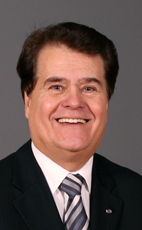 House of Commons photo
Lost his last election, in 2011, with 31% of the vote.
Sahtu Dene And Metis Comprehensive Land Claim Agreement May 8th, 1998
Mr. Speaker, pursuant to Standing Order 32(2), I am pleased to table, in both official languages, two copies of the 1996-97 annual report of the implementation committee on the Sahtu Dene and Metis comprehensive land claim agreement.
Quebec City May 7th, 1998
Mr. Speaker, I protest the decision of the Quebec City national capital commission, which wants to rewrite Canadian history from a separatist standpoint by ignoring, denying and twisting reality.
We all recall that Quebec City hosted meetings between the leaders of the allies in 1943 and in 1945. Present at the meetings were the President of the United States, Franklin Roosevelt, the British Prime Minister, Sir Winston Churchill, and the Prime Minister of Canada, William Lyon Mackenzie King.
Today, the commission is going to unveil statues of President Roosevelt and Prime Minister Churchill in this connection, but it is giving no recognition to the Canadian Prime Minister. This is a distortion of history, and indirectly, a moral affront to our soldiers in the last world war.
Aboriginal Affairs May 1st, 1998
Mr. Speaker, I think what this government has done in this regard should be pointed out. Including the first nations in certain areas, such as forestry in New Brunswick, is very important for them.
We are working with New Brunswick and with all provinces across the country. I am very pleased to point out, with respect to forestry, that the Government of New Brunswick has established a round table with New Brunswick first nations.
Mi'Kmaq Education Act May 1st, 1998
Mr. Speaker, I rise to address the House on second reading of Bill C-30, the Mi'kmaq education act. I will be asking hon. members to join me in supporting this proposed legislation which provides for the transfer of jurisdiction for education from Canada to nine Mi'kmaq first nations in Nova Scotia.
Bill C-30 is neither a lengthy nor a technical bill. It deals with a very specific issue for a distinct group of people. Yet, this is a truly historic piece of legislation that will stand as a milestone in the strengthening of aboriginal communities in Canada.
Why is this bill so important? It is for the simple reason that it represents the first time in our history that jurisdiction for education will be transferred from the federal government back to first nations where it belongs.
In one sense Bill C-30 is a step into the past because we are returning control of an important community activity to the local level, but it is also a step into the future in that it signals the beginning of a new relationship between governments and Nova Scotia first nations. We are hopeful it will lead to many more undertakings.
When this government unveiled its aboriginal action plan in January it made a clear commitment to strengthen aboriginal communities by investing in people. In my view the single most important investment we can make in a community is in the education of its youth.
For aboriginal people in particular education is an essential instrument for achieving self-sufficiency and solidifying Mi'kmaq identity. By providing the tools children and youth need in today's society education can help break aboriginal peoples' traditional reliance on governments and social assistance. Higher levels of education are critical if aboriginal people are to achieve self-government, take full advantage of land claims agreements, participate effectively in the new economy and live longer and healthier lives.
In short, education will open many doors of opportunity that have been closed to first nations people for far too long.
I know that the members of this House are in favour of providing aboriginal people with quality education. I am sure also that some of my distinguished colleagues will agree that decisions regarding the education of Mi'kmaq children and youth should not be made here, in Ottawa, but in the communities where these children live and go to school, communities like Eskasoni, Wagmatcook, Whycocomagh and Pictou Landing.
Thanks to this transfer of jurisdiction over education, the Mi'kmaqs of Nova Scotia will be able to preserve their past and participate in their future.
Bill C-30 will allow the nine participating first nations to determine their children's curriculum. They will be able to develop programs and courses in keeping with their own customs, traditions and culture, all in their own language.
This initiative will have a huge positive effect on the sense of identity in Mi'kmaq communities and on students' self-esteem.
This is not a new concept. It has long been recognized that there are tangible long term benefits to transferring education management to aboriginal communities. That is why, in the past 30 years, it has been a policy of successive governments to transfer educational responsibilities to the first nations.
Bill C-30 goes well beyond the mere transfer of responsibility over the program. This delegation of powers is based on the recognition of the inherent right to control education locally.
This initiative is fully consistent with this government's inherent-right policy and responds to a recommendation of the Royal Commission on Aboriginal People to give aboriginal people more power over education.
While not a self-government agreement per se, Bill C-30 will pave the way to self-government for these first nations.
The bill will also help meet the objectives stated in the document entitled Gathering Strength: Canada's Aboriginal Action Plan , which is the government's recent response to the royal commission.
One of these objectives is for the federal government to work with aboriginal people, the provinces and territories, as well as other partners, to develop practical, sustainable governance arrangements for aboriginal people that are built on legitimacy, authority and accountability. The bill is an important step toward this objective.
Bill C-30 provides the necessary legislative framework to implement the agreement to transfer the powers and duties related to education, which was signed in February 1997 by Canada, Nova Scotia and the leaders of the nine Mi'kmaq first nations.
Through this proposed legislation the government will delegate to the participating first nations the authority to pass laws for primary, elementary and secondary education on reserves for band members.
Bill C-30 also transfers jurisdiction for post-secondary student support funding for members of participating communities living on and off reserve. In accepting this jurisdiction the Mi'kmaq agree to provide equivalent education to non-members living on reserve. The level and the quality of education they provide must ensure that students can successfully transfer to any other education system in Canada.
In order to exercise education jurisdiction, each Mi'kmaq first nation will establish its own education authority. These authorities will adopt a constitution that clearly outlines their responsibilities, accountability and reporting structure, the process that will be used to pass laws, and a transparent appeals process.
Bill C-30 also provides for the establishment of the Mi'kmaw Kina'matnewey, a new corporation that will assist first nations in the exercise of their education jurisdiction.
The chiefs of the participating first nations will form the board of this new corporation, which will provide collective services such as curriculum development, culture and language initiatives, special education and post-secondary support services, and reporting functions. Like the education authorities, this corporation will be governed by a constitution that ensures a fair and open accountability regime and dispute resolution process.
The final agreement also provides for the transfer to the nine first nations of approximately $24 million per year. This funding will be used to operate and maintain education facilities and for related band administration and capital requirements. Funding levels will be reviewed after five years.
This funding will come from the Department of Indian Affairs and Northern Development's existing education budget. It is not new money, but money that has already been allocated on a per student basis to provide education services to these nine Mi'kmaq first nations.
I would be remiss today if I did not acknowledge the Government of Nova Scotia for its support of this transfer of education jurisdiction.
As hon. members know, education is primarily a provincial responsibility and the Government of Nova Scotia has a long and effective partnership with first nations in the province. In recognition of the aspirations and capabilities of the Mi'kmaq people, the provincial government has acknowledged Mi'kmaq jurisdiction for education on reserves. This will be affirmed through separate provincial legislation.
The participation and co-operation of the provincial government in this transfer process is indicative of the commitment that exists in Canada today to build new partnerships with aboriginal people. It is also further proof that the Canadian federation is flexible and can accommodate the interests and expectations of all people.
We are transferring jurisdiction over education to certain Mi'kmaq communities, because they want it, they need it and they deserve it. The transfer process began in 1991, when Mi'kmaq leaders made representations to the federal government to have greater control over education programs in their communities.
After several years of discussions and negotiations, we reached an agreement that satisfies everyone's needs. In January 1998, the nine participating first nations approved a resolution asking the federal and provincial governments to pass legislation to implement the agreement. Today, I am asking members of parliament to take that resolution into account.
I can assure them that Bill C-30 was drafted in close co-operation with Mi'kmaq leaders and provincial officials.
The views of individual band members were also taken into consideration, through a vast consultation process held in the communities, and a ratification process conducted by the first nations. We received letters of support from many non-aboriginal groups in Nova Scotia, including colleges and universities, school boards and the Diocese of Antigonish.
I should also point out that this legislation is not imposed on any first nation. The other four Mi'kmaq first nations will be able to benefit from the bill at a later date and any of the signatory first nations can opt in or out just by having their names added to or withdrawn from the Schedule to Bill C-30.
As I said earlier, the government hopes that this legislative measure will be the first of a number of similar agreements with first nations throughout the country. In fact, I can tell the House that similar negotiations are underway with several first nations in Ontario. Bill C-30 and the final agreement it will implement could be used as a model for future devolution of powers in the area of education.
Bill C-30 positively recognizes the capability of the first nations to take control over their lives and their future. It will give control over the Mi'kmaq education system back to the native people, at the local level, back to the parents and officials who take care of the Mi'kmaq children.
This is certainly an initiative that members from both sides of the House can support and I would ask them to quickly pass this bill, so that we can implement the final agreement in spring, in time for the 1998-99 school year.
The Late Maurice Tremblay April 30th, 1998
Mr. Speaker, Saguenay-Lac-Saint-Jean has just lost an eminent physician, Dr. Maurice Tremblay.
This very humane, humble and generous man has left his mark on many. In 1954, after completing his studies in Boston and Paris, the young pediatrician devoted himself body and soul to the care of his young patients, at a time when there were many dangerous childhood diseases, including polio, scarlet fever and meningitis.
He was also very concerned about the children in the Chicoutimi orphanage, and visited it regularly, free of charge.
Along with several colleagues, Dr. Tremblay founded the Institut médical de Chicoutimi, and was also instrumental in the creation of family centres.
I speak for all the patients and friends of Dr. Tremblay in offering my most sincere condolences to the family in their great loss.
Supply April 28th, 1998
Mr. Speaker, I thank the member for Repentigny for his question.
When I looked at the wording of the Bloc Quebecois' motion today, I asked myself a question. The Liberal Party of Canada held its convention last March, here in the national capital, and there were observers from the other political parties, including two from the Bloc Quebecois. The Bloc Quebecois must have looked at the priority resolutions passed by the Liberal Party of Canada. One priority resolution was from Quebec and I will be pleased to send it to the hon. member. That resolution dealt with the issue of poverty.
Supply April 28th, 1998
Mr. Speaker, I thank my colleague for his question.
What is important is not really the word “globalization”, but the fact that, for a country like Canada, it means an increase in our exports.
One must not forget that here, in Canada, almost one job out of two is related to the export trade, especially in the province of Quebec.
Therefore, for us, globalization means access to various markets. When we finally have access to these markets, jobs will be created in Canada. Then the government will be in a better position to give more money to CIDA and to help other countries in the world. I think it is very important.
Supply April 28th, 1998
Mr. Speaker, I would like to thank the hon. member for Repentigny. I am sure he does not want to involve me in his argument with my colleague from Abitibi.
I just want to point out to the hon. member for Repentigny that the government has already started to fight poverty. If you had gone through the previous budgets brought down by the government, you would have noticed that the first step to take is to reduce the deficit, which is what the current government has done.
But even in its attempt to reduce the deficit, the government decided to start by helping the poorest of the poor, the unborn child. In our minds, poverty starts with pregnant women who do not have the means or the money to eat three meals a day. We started by creating a fund to help those mothers. That was a start. It is very interesting to note that, for young people living in poverty, the first years are the most crucial.
The first thing we did was to help pregnant women to ensure that their children, the future generation of Canadians, were born healthy.
Then, in the last budget brought down by the government, you must have noticed that we have taxable and non-taxable benefits that are handed out to the poorest members of our society. Unlike the Reform Party, which wants to reduce taxes for everyone, our government has decided to help out the most needy, the poorest of the families.
In a family earning $20,000 or less, the mother would get $1,600 for her first child and $1,400 for her second child, for a total of $3,000 or 15% of her family budget.
We have chosen to fight poverty by helping out the poorest members of our society, which we did in the last budget. We had set aside $850 million for 1998, and we will add $425 million for 1999 and another $425 million for the year 2000.
Supply April 28th, 1998
Mr. Speaker, I want to stress the importance for Canada to meet the challenges of globalization. Our country is well known for its active participation and for the leadership it has often displayed in the development of an international trade system.
Canada's vitality is quite impressive. Our country is among those that rely the most on foreign trade. Indeed, foreign trade accounts for more than 40% of our gross domestic product, the highest percentage among all G-7 members. Our favourable trade balance increased from $7 billion in 1991 to $41 billion in 1996. The total value for Canadian exports of goods and services was a record $280 billion in 1996, almost twice as much as in 1989.
Through its trade policy, Canada seeks to promote the constant improvement of the quality, accuracy and scope of international rules on trade and investment.
Over the past 50 years, our country has been a leader in the development of rules for international trade. We contributed to the establishment of GATT, in 1947, and to the gradual improvement of these rules during successive negotiations rounds that led to the Uruguay Round, in 1994. Canada can be proud of the rules that now exist under the World Trade Organization for goods and services.
It is only natural that we would support changes to include something as critical as international investment. In the current context of globalization, direct foreign investment goes hand in hand with trade. The two cannot be dissociated.
The government's role in developing trade is to support Canada's businesses in such a way as to maximize their chance of success in foreign markets and thus to help create and maintain jobs everywhere in Canada.
For Canadians, there has never been a better time for exports and for taking advantage of international investment opportunities. Markets are opening up, trade barriers are dropping, and goods and services are moving freely between countries.
Foreign investment in Canada triggers employment and growth. Too often, too much attention is paid to the heavy impact of direct foreign investment on Canadian employment and prosperity. Three out of ten jobs in Canada are directly or indirectly linked to direct foreign investment in Canada. More than 50% of exports and 75% of manufactured exports are directly linked to direct foreign investment in Canada.
Every $1 billion in investments contributes to the creation of over 45,000 jobs over five years.
Direct foreign investments bring new technologies to Canada and bring new production processes on line more quickly. New technologies make it possible for Canadian businesses to maintain or even increase their competitive edge, both in world and domestic markets.
Finally, the liberalization of financial markets and the relaxation of restrictions on foreign investment no doubt explain the remarkable vigour of Canadian direct investment abroad in the 1980s.
This investment provides an increasingly vital contribution to our economic prosperity. Since 1996, the value of Canadian direct investment abroad has surpassed the value of foreign direct investment in Canada.
Canadian direct investment abroad has tripled since 1986, reaching a figure of $194 billion in 1997. The growth of this investment also reflects a new approach to emerging economies.
These investments are a source of substantial revenues and dividends for Canadians and allow our businesses to compete internationally. Canadian investment abroad produces benefits at home for research and development activities, growth and export opportunities, thus creating jobs in Canada.
By investing their own resources in target countries, Canadian companies are displaying confidence and thus positioning themselves favourably to take advantage of potential trade opportunities.
An increasing number of Canadian competitors are very actively promoting and expanding their businesses worldwide.
Canada would like a set of internationally accepted rules on foreign investment, just as there are rules on foreign trade.
Our objective is very clear. The Government of Canada wants to conclude a good deal at the right moment. We do not want to sign just anything at any old time. Therefore, if OECD countries reach an agreement that serves the interests and respects the values of Canadians, in keeping with our specificities and the exceptions we put forward, we believe such and agreement would be beneficial to Canada. But our commitment goes further than that. Our government has been consulting Canadians since the negotiations started and will continue to do so.
We have consulted the provinces, the NGOs, and of course Parliament. In this regard, I will remind members of the House of Commons that last November, at the request of the Minister of International Trade, the Sub-committee on International Trade, Trade Disputes and Investment of the Standing Committee on Foreign Affairs and International Trade held public hearings on the MAI. In December, the committee tabled its report with as its main recommendation that we continue to participate in the MAI negotiations.
The Bloc Quebecois concurred in the report. Last week the government tabled its response to the report. In short, the government accepts all 17 recommendations. At the recent annual meeting of OECD ministers, the Minister of International Trade unequivocally restated Canada's basic position in these negotiations. The ministers agreed to keep on negotiating without setting any specific deadlines. This is in keeping with Canada's position to take the time to negotiate the best possible agreement.
The government will keep on consulting as many groups as possible to ensure that Canada's positions reflect the interests of all Canadians.
Hepatitis C April 27th, 1998
Mr. Speaker, I am pleased to support today the decision made by the Minister of Health and his partners from the provinces and territories with regard to the compensation of hepatitis C victims. Of course, the easy way for the minister would be to simply pay all those who are asking the government for compensation.
Opposition members seem to believe that moral superiority belongs to those who favour the easiest and quickest solution: offering a global compensation package today without thinking about the consequences it would have tomorrow. However, it is clear that moral superiority belongs to those of us, on the government side, who will oppose the motion.
We have chosen to oppose the motion because we accept the responsibility given to us by Canadians to protect the health care system that is cherished by everyone in this country.
I would like to conclude these brief remarks by congratulating the Minister of Health for having the courage of his convictions and for holding up in the face of harsh, misinformed and petty criticism from those who would want us to compromise the long term welfare of Canadian society for short term political gain.