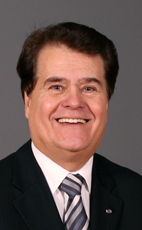
House of Commons photo

Crucial Fact

  • His favourite word was health.

Last in Parliament March 2011, as Liberal MP for Pierrefonds—Dollard (Québec)

Lost his last election, in 2011, with 31% of the vote.

Statements in the House

Armenian People April 24th, 1998

Mr. Speaker, the Armenian community is commemorating today the 83rd anniversary of the 1915 Armenian massacre.

As an expression of solidarity, I offer my deepest sympathies to the Armenian people, and I share their grief. Today, we commemorate the death of one and a half million Armenian martyrs, and the death of all the victims of the terrible carnages of our century.

In so doing, we are helping the international community in its efforts to end such killings. As you know, Canada has always been and will continue to be a great protector of human rights.

I take this opportunity to commend Montreal's Armenian community for its spirit of justice and for its constant efforts to have that historic tragedy recognized as it should be.

Taxation March 24th, 1998

Mr. Speaker, some people are wondering why the government is not investing in home care today if it is so urgent.

The government knows full well that Canadians need help to provide care at home and in the community. That is why, in the last budget, it gave back $1.5 billion in transfer payments to the provinces for this year and that is also why, in the 1998 budget, it increased tax relief for caregivers, as promised.

Finally, it is why the government has invited Canadians as well as experts in home care from across Canada to meet in Halifax last week to discuss the measures that should be taken with regard to home care.

The message from the national conference on home care was very clear. Delegates agreed that a national approach is required in the area of home care. Participants at the conference have asked us to find the best solutions, not only the quickest. They want us to do things right.

The government started to work on that last year in response to recommendations by the National Forum on Health. We responded immediately by creating, for a period of three years, the federal-provincial-territorial fund for health services adjustment. Home care is one of four priority areas for evaluation and innovative projects.

We know that the provinces and territories provide home care services to their residents. However, we have a variety of standards, services, eligibility criterias, user fees and funding levels across the country. It is a complex situation.

There is a lot more work to be done. We have to form a partnership with the provinces, hold further consultations with Canadians, define priorities, develop a plan and make careful investments to reach our goal. We are planning to do that over the next 12 to 18 months. That is what we will do.

Journée Internationale De La Francophonie March 19th, 1998

Mr. Speaker, tomorrow, March 20, Canada and every country where French is spoken will celebrate the Journée internationale de la Francophonie.

As we know, the international francophone community is an integral part of Canada's foreign policy and all Canadians benefit from this window on the world, as a result of the cordial relationships we have established with French-speaking countries on all continents.

As one of the most active members of this multinational community, Canada will continue to uphold the fundamental values we all share, values such as democracy, human rights and, above all, the rights of women and children.

I would like all members of this House to join me in wishing all francophones in Canada and around the world a great Journée internationale de la Francophonie.

Mackenzie Valley Resource Management Act March 11th, 1998

Madam Speaker, I rise to address the House on third and final reading on Bill C-6, the Mackenzie Valley resource management act.

I want to say again how pleased I am to be sponsoring this proposed legislation.

Bill C-6 will have important ramifications for the people and the environment of the Mackenzie Valley and I am delighted to have played a role in bringing it before the House.

I am also delighted that we have finally come to this point in the legislative process.

Although Bill C-6 was tabled in the House only a month ago, this legislation has been five years in the making. It previously died on the order paper as Bill C-80 when the election was called.

It has been the subject of one of the most extensive consultation processes I have ever witnessed in government, with 35 drafts of the bill developed and distributed for comments and review.

An information package on the proposed resource management regime was widely distributed across the Mackenzie Valley.

Federal officials have held literally dozens of meetings with aboriginal leaders, the territorial government, the resource industries and the public.

As a result of this exhaustive process we have before us today a better bill. This is a lengthy, complex and technical piece of legislation but it is also a solid bill that will withstand the test of time.

I would like to take a few minutes to acknowledge the many groups and individuals who have contributed to Bill C-6 which, as hon. members know, will establish an integrated resource co-management regime and environmental assessment process for the Mackenzie Valley.

I want to begin with the leaders of the Gwich'in, and the Sahtu Denes and Metis of Northern Mackenzie Valley. Bill C-6 is the logical step following the land claim settlements signed by these native groups in 1992 and 1994.

Despite a three year delay in the adoption of this legislation, the leaders of these communities showed remarkable patience. They understood the need to proceed with wide consultations, to accommodate various interests and to make sure the legislation is fair.

The Northwest Territories administration also deserves special recognition for its role in establishing a resource management system which allows for a decision-making process involving both regional and valley-wide levels. The territorial administration helped make sure that the new system reflects today's realities and needs while respecting the close relationships the native peoples have with the lands and the waters of the Mackenzie Valley as a whole.

Resource industries also made a big contribution to the proposed bill. They recognize that it is necessary to evolve with time in the Mackenzie Valley, and to adapt to new ways of doing business and managing the environment. Bill C-6 will provide them with the certainty and coherence they need to realize their investments in the valley, investments that will create jobs, increase government revenues and make Northerners economically more independent.

I also wish to commend the Minister of Indian Affairs and Northern Affairs and her predecessor for having developed a bill which will provide a just balance between the numerous different interests in the Mackenzie Valley. Thanks to their perseverance, Bill C-6 will reach its main goal, which is to protect the fragile environment of the Mackenzie Valley, while at the same time allowing the government to fulfil its constitutional obligation towards the Gwich'in, the Metis and the Sahtu Dene.

Finally, I would be remiss if I did not commend my colleagues of the Standing Committee on Aboriginal Affairs and Northern Development for the important work they carried out. As my distinguished colleagues know, the committee undertook a comprehensive study of Bill C-6 before Christmas recess. Several witnesses offered convincing testimony and the committee was able to benefit from different point of views and discussions between its members.

Again, we have before us a better bill than the initial version. Thanks to the amendments proposed by the government and the standing committee, and to the support of the territorial government, the mining industry and some native groups, Bill C-6 has been improved and made more precise.

These amendments have improved the clauses of the bill dealing with consultations, bringing greater openness and transparency.

These amendments will increase the participation of natives, including the first nations which have not already signed territorial land agreements, in the joint resource management regime.

The amendments will facilitate the transition process to the new regime by providing an additional protection to the present users of lands and water.

The amendments have also allowed us to include in the bill some guarantees that its implementation will cause no prejudice to future negotiations on land claims and self government.

I would like to quickly recap the key elements of Bill C-6 so that hon. members can appreciate the importance of this legislation to the people and the environment of the Mackenzie Valley.

Hon. members will recall that Bill C-6 will establish six boards of public government to administer the new resource management and environmental assessment regime. Two of these boards, the Mackenzie Valley land and water board and the environmental impact review board, will have jurisdiction throughout the valley. The other four will be regional institutions responsible for land use planning and land and water issues in the two settlement areas.

Bill C-6 also provides for the establishment of additional regional boards by order in council as land claims agreements are finalized with other aboriginal groups in the Mackenzie Valley.

The need for a co-ordinated and integrated approach is an underlying principle of Bill C-6. The Mackenzie Valley must be viewed as a single ecosystem, not just a collection of political or demographic regions. Activities that take place upstream can and do affect communities downstream. Decision making processes must take into account what is right for the entire ecosystem and all its communities and residents.

Even First Nations that stand in opposition to Bill C-6 have not disputed the need for a single valley wide system. There is essentially unanimous agreement that we cannot have several different resource management systems in place in the valley. It simply will not work.

The question is not whether to proceed with an integrated approach, but when. Some First Nations that have not yet signed land claims agreements would like us to wait. The government's view is that further delays are not only unwarranted but could put Mackenzie Valley's environment at undue risk. Clearly the time to act is now.

A single integrated system is also the best way to proceed in terms of cost and efficiency. Bill C-6 will ensure regulatory consistency between the settlement areas and adjacent lands. Virtually all lands in the Mackenzie Valley will be subject to the same environmental review requirements in keeping with this government's commitment to streamline environmental processes, avoid duplication of effort and reduce costs to industry and others.

One of the main features of the new system is that native peoples are assured they will have a role to play. The first nations get to designate half the members of the new resource management boards, with the federal and provincial governments designating the other half.

Therefore, the various native groups living in the Mackenzie Valley area have the assurance that their traditional activities and lifestyles will be able to coexist with other forms of economic development. At the same time, non-native valley residents will have the opportunity to voice their concerns through the management boards and the hearing and public consultation process provided for in Bill C-6.

I am also glad to point out that the legislation follows up on a recommendation made by the Royal Commission on Aboriginal Peoples, promoting the implementation of a co-management system in the Mackenzie Valley. Such an approach would be impossible without high levels of respect, recognition and mutual responsibility, all principles on which is based Gathering Strength , a native action plan the government announced recently.

From a different perspective, Bill C-6 is another step towards the transfer of federal responsibilities and programs to the territorial government. The Northwest Territories Water Board, which is currently administered by the Department of Indian and Northern Affairs, will be integrated into the new Mackenzie Valley Land and Water Board.

As for the new Mackenzie Valley Environmental Impact Review Board, it will take over from the Department of Indian and Northern Affairs in co-ordinating and conducting environmental assessments. Once Bill C-6 is passed, the department will no longer be involved in issuing land use permits.

In other words, Bill C-6 will put in the hands of northerners the decision making process for issues directly affecting the Mackenzie Valley lands and waters. The new system shows a high degree of sensitivity and accountability to northerners and reflects both good planning and sound public management.

In spite of the major changes that will result from Bill C-6, the proposed legislation will not cause any disruption in the valley. It is based on existing regulations, with which industry is familiar.

It neither extinguishes nor overrides any right that aboriginal people of the Mackenzie Valley have. It will not take precedence over constitutionally protected land claims settlements or the Indian Act.

Under the new system, aboriginal people will have a much greater say in the decision making process than they do now.

In addition, it provides for land and water use applications to be processed quickly and fairly. It will also ensure that clearly defined procedures are used for the purposes of environmental assessment and protection throughout the Mackenzie Valley.

In closing, I would ask hon. members to consider the words of Richard Nerysoo, president of the Gwich'in Tribal Council. When he gave evidence before the Standing Committee on Aboriginal Affairs and Northern Development, Mr. Nerysoo said “Bill C-6 sets up a state of the art framework for land and water management in the north that is second to none in the Canadian north and for that matter in the world”. A state of the art framework that is second to none in the world. These are not the words of a government spokesperson. They are the words of a respected aboriginal leader whose people will live with Bill C-6 on a day to day basis. They are words of pride, hope and confidence.

I urge hon. members on all sides of the House to recognize that Bill C-6 is a necessary, practical and responsible approach to resource management in the Mackenzie Valley. It has widespread support in the valley because it is a balanced and workable regime and because it will achieve its stated goal. It deserves the same level of support from this House.

Canada-Yukon Oil And Gas Accord Implementation Act March 11th, 1998

Mr. Speaker, I rise to address the House on Bill C-8, the Canada-Yukon Oil and Gas Accord Implementation Act.

I am pleased to join my colleagues in support of this legislation which promotes the historic changes that are occurring in Yukon.

Hon. members have heard how Bill C-8 will provide for the transfer of the administration and control of onshore oil and gas from Canada to the Yukon government. It will also give the territorial government the authority to legislate all aspects of oil and gas.

Passage of this proposed act is a necessary and logical step in the Yukon's political evolution.

For too long Ottawa has been making decisions for Whitehorse and for Yukoners. The time has come to turn control over to those who live in Yukon so that they may deal with the issues on a daily basis. That is why the devolution of all remaining provincial-type powers and programs of the Department of Indian Affairs and Northern Development in Yukon to the Yukon government continues to be a priority for this government.

Canada and Yukon have worked together for more than a decade to respond to northerners' desire for more control over their lives. The process of placing responsibility where it belongs, at the local level, is well under way. We are providing the platform for northerners to find solutions to northern concerns.

For several years now, Yukon has drawn certain advantages from the transfer of responsibilities. At the present time, it delivers provincial-type programs in such areas as education, health and economic development.

The federal government, however, still administers Crown lands, forestry, water, environmental issues, mines and minerals, and of course oil and gas.

This current undertaking to transfer oil and gas jurisdiction shows the government's constant determination to give provincial-type jurisdictions to the territories. The administration and control of oil and gas resources constitute significant and obvious provincial-type functions.

I cannot overemphasize the importance of transferring this role to the people of the Yukon. Natural resources lie at the very heart of the Yukon economy. Natural resource development is essential to the territory's prosperity in the 21st century, as well as to its residents' survival.

The present government is agreeable to Yukon administration and control of oil and gas resources. Transfer of this program represents an important step in the political and economic evolution of Yukon.

Subsequently, of course, there will have to be a transfer to the Yukon government of other provincial-type powers and programs on its territory. To that end, in January 1997 the federal government announced a proposal for making such transfers.

I will give a brief explanation of what the transfer of responsibilities for oil and gas means to the Yukon and its economy.

For too long Yukon has had to watch its oil and gas resources go untapped because of uncertainty over land and resource ownership. That is changing. Our ongoing negotiations with Yukon First Nations and efforts to finalize the remaining land claims in the near future will soon set the stage for a renewal of oil and gas activities.

The move to transfer onshore oil and gas resources to Yukon will strengthen northern independence and provide stable, predictable revenue to the territorial government and Yukon First Nations who have signed land claims agreements.

Once Canada transfers responsibility, it will no longer be directly involved in managing oil and gas resources in Yukon. Canada will, however, maintain jurisdiction over offshore areas.

With the transfer the federal government will pay Yukon the moneys it has collected in onshore petroleum revenues.

Once the transfer is complete, Yukon will collect the annual revenues from the Kotaneelee project which are valued at approximately $1.5 million per year. These revenues will be shared with the six Yukon First Nations that have land claims agreements in effect.

The Yukon will enact new territorial legislation that will allow it to address exploration, development, conservation and environmental and safety issues. This new territorial legislation will provide for a management and regulatory regime that is generally modelled after existing regimes in Canada.

Bill C-8 would allow the governor in council to transfer the legislative powers to Yukon once the territorial legislation is in place.

The bill before us today and the transfer process have the wholehearted support of the Yukon government. Setting the pace of the transfer, the territorial government said the time had now come for it to take control of its own oil and gas resources.

The Yukon First Nations also support the bill. Once passed, it will provide them stable and predictable revenues, as well as signed land claims agreements, which will help them move toward self-sufficiency and financial independence.

I would like to congratulate representatives of the Yukon First Nations and the Yukon government who have been working together to develop a system to jointly manage oil and gas resources in the Yukon.

This is a historical alliance which bodes well for the development of the Yukon and further transfers of powers to the territory. This close co-operation has become even closer as a result of consultations held by the federal government and the Yukon over the past few years, which led to the transfer of responsibilities for oil and gas resources as proposed in the bill before us.

The bill has also the support of the industry. Bill C-8 will help create a stable and predictable environment, which in turn will attract new ventures and open up new opportunities to the area.

Passage of the bill will send a clear signal to Yukoners that Canada is committed to fostering economic development in their territory.

In conclusion, I would like to mention that all those involved in the work of the Standing Committee on Aboriginal Affairs and Northern Development support this bill and approved its decision to send it back to the House without amendments.

In view of the widespread support for this major initiative, I urge my distinguished colleagues to join me in supporting this bill.

The Budget February 25th, 1998

Mr. Speaker, yesterday, in his budget speech, the Minister of Finance announced an important measure for young Canadians that will help reduce the high level of student indebtedness.

Taxpayers who are repaying their student loans will receive assistance from the federal government. For instance, a student repaying a loan of $25,000, or $3,800 a year, will be entitled to a federal and provincial tax credit of $530, representing 17% of the $2,125 in interest.

This measure shows that the federal government is listening to young people struggling to repay student loans. Under no circumstances does our government wish to see student indebtedness jeopardizing the future of our young people.

This measure shows the Liberal government's desire to improve the quality of life of Canadian citizens, young people in particular, as they undertake or pursue job training.

Annie Perreault February 19th, 1998

Mr. Speaker, the news has just broken that Annie Perreault is the first Quebec woman to win a gold medal in speedskating.

We wish to draw attention to this young woman's courage, as she has coped with a number of difficulties throughout her training. Yet she never gave up, and now has been rewarded with this wonderful win.

Representing Canada is in itself a source of pride to all of the athletes at the Nagano Games. Our thoughts are with them all, each and every minute of these competitions, and we are well aware of how much effort our athletes have put into doing their best for Canada.

In congratulating Annie for her well-deserved win, let us remember all of the other athletes who are over there representing us so worthily, and let us wish them all the best of luck.

Interparliamentary Delegation February 17th, 1998

Mr. Speaker, pursuant to Standing Order 34, I have the honour to table, in both official languages, the report of the Canadian section of the International Assembly of French-Speaking Parliamentarians, as well as the financial report of the meetings of the IAFSP executive, held in Pointe-à-Pitre, Guadeloupe, December 14 and 15, 1997.

Aboriginal Affairs February 16th, 1998

Mr. Speaker, the member knows full well that this is an agreement between the federal government, the Manitoba government, Manitoba Hydro and the Norway House First Nations.

This means that his question is purely hypothetical, and I do not think this is appropriate here.

Aboriginal Affairs February 16th, 1998

Mr. Speaker, based on the available information, it appears that the band council will pay for the legal fees of both Mr. Whitney and Mr. Starlight.