
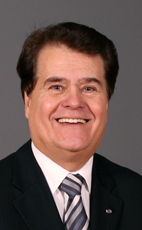
House of Commons photo

Crucial Fact

  • His favourite word was health.

Last in Parliament March 2011, as Liberal MP for Pierrefonds—Dollard (Québec)

Lost his last election, in 2011, with 31% of the vote.

Statements in the House

Criminal Code February 3rd, 1998

Madam Speaker, I am pleased to respond to the hon. member for Wetaskiwin on behalf of the Minister of Indian Affairs and Northern Development.

Aboriginal inclusion in Canada's economic prosperity is important not only for aboriginal people but for all Canadians. The aboriginal labour force is young and is growing at twice the national average. The Royal Commission on Aboriginal Peoples estimated that 300,000 jobs will be needed by the year 2016. A major increase in the aboriginal economy and activity, both rural and urban, is essential to meet the needs and aspirations of aboriginal youth.

The government is committed to working in partnership with the aboriginal leadership and business people, Canadian industry, the provinces and the voluntary sector to take action that will create the conditions to maximize economic activities and jobs in aboriginal communities.

On January 7 this government announced our response to the Royal Commission on Aboriginal Peoples. This response includes a commitment to change social assistance on reserves from passive income maintenance toward more active measures such as training and skills development to increase individual and community self reliance.

As part of our aboriginal action plan we announced the creation of an aboriginal human resources development council which will bring together the public and private sectors to identify employment opportunities for aboriginal people. The Regina Leader Post welcomed this initiative and said that it is encouraging that workable solutions are now being developed to help native people help themselves.

The solution is not to cut almost a billion dollars out of programs that support basic services for aboriginal people as the Reform Party plans to do, nor is the solution assimilation or Ottawa imposed paternalism. The solution is to work with aboriginal communities and businesses to help them acquire the tools they need to become full partners in Canada's future.

Ice Storm February 3rd, 1998

Mr. Speaker, during the ice storm that hit the provinces of Ontario, New Brunswick and primarily Quebec, Canadians the country over again demonstrated their generosity and solidarity with their unfortunate fellow citizens.

In addition to the untiring efforts of volunteers responsible for emergency measures in my riding of Pierrefonds-Dollard, I would also like to mention the invaluable contribution of our neighbours to the south, particularly those of Connecticut Light and Power. These people temporarily left their families, their state and their country to come to our assistance.

John. D. Siclari, an engineer with the company, came to my riding office in search of Canadian flags to put on their vehicles, in order to demonstrate their pride in helping us, and in particular to reaffirm the ties between our two countries. Having gone through this ordeal, I can state that these ties are all the stronger.

I would like, once again, to thank these linesmen, all these workers whom we do not know by name but who are dear to our hearts.

Criminal Code December 10th, 1997

Mr. Speaker, on behalf of the Minister of Indian Affairs and Northern Development I am pleased to respond to the question of the hon. member for St. Albert regarding the Alexander First Nation.

The hon. member suggests that the Alexander First Nation is not an example of good management. I disagree. The remarkable turnaround this first nation has made in a few short years deserves credit.

Three years ago the auditor of the Alexander First Nation gave a denial of opinion on the 1994-95 financial statements. At that time the first nation, in open consultation with its community, took a number of steps toward rectifying the situation, including holding open community meetings with the band auditor. Over the past two years the first nation has made positive steps by showing an operating surplus each year and plans to have no deficit by March 1999.

Under the terms of its remedial management plan Alexander must make arrangements for professional accounting assistance and provide monthly financial statements to the department. Regional officials meet regularly with band representatives to review progress on the plan.

Aside from the department's reporting requirements, the chief and council hold general band meetings each year to provide information to community members on the band's financial picture, to inform members of achievements and new initiatives, and to seek clarification on any issue. Each year, members are provided with a copy of the annual report which includes the financial statements.

In addition, this community, under the direction of the chief and council, has been able to reduce the number of community members on social assistance from 100 to 12 persons as a result of innovative economic development projects. These results illustrate real progress within this first nation.

Criminal Code December 10th, 1997

Mr. Speaker, the hon. member has raised the matter of a special examination by the auditor general of the Cape Breton Development Corporation.

Let me begin by saying that I, and I believe all members, share a concern for the Cape Breton region. All of us want to see successes on the island. I believe that Devco can be a success and I have confidence in the management and employees of the corporation to achieve this.

To return to the audit, according to the Financial Administration Act, all crown corporations must undergo a special examination at least once every five years. The purpose of this examination is to determine if the corporation's financial and management controls, information systems and management practices are acceptable.

These systems and practices should provide reasonable assurance that the assets of the corporation are safeguarded and controlled; the financial, human and physical resources of the corporation are managed economically and efficiently; and the operations of the corporation are carried out effectively.

The auditor general's examiner has indicated to Devco that he expects to submit his report to Devco's board of directors soon.

As I understand the process, if the auditor general's office believes the report contains information that should be brought to the attention of Parliament, his office would prepare a report for inclusion in the next annual report of the corporation. Mr. Desautels, like every previous auditor general, will not be reluctant to bring forward any concerns he might have.

To repeat, Devco has not yet received the report of the special examination. Until this happens, I cannot speculate on next steps by the auditor general's office or possible reaction by the government.

Now I would like to mention some of the ways in which Devco has established public accountability. Like all crown corporations, Devco prepares an annual report that is tabled in Parliament. In addition, Devco produces quarterly performance reports which are made public. As well, Devco has established the practice of consulting at least twice annually with its various stakeholders. Finally—

Division No. 68 December 9th, 1997

Mr. Speaker, on behalf of the Minister of Indian Affairs and Northern Development I am pleased to respond to the hon. member for Charlotte.

Financial accountability for federal funds is assured through the ongoing monitoring of terms and conditions for funding arrangements and annual audited financial statements.

Officials from the Department of Indian Affairs and Northern Development have received the Oromocto First Nation audit for the 1996-97 fiscal year. Band members accepted the audit at a duly convened band meeting on November 24, 1997.

Departmental officials spent the week of November 24, 1997 on the reserve attending meetings dealing with co-management and the band's financial position. Officials worked in an advisory capacity for the First Nation on several issues and met with the band council. These meetings proved to be very productive. The department is currently working with the First Nation to assist in implementing the auditor's recommendations.

While the Department of Indian Affairs and Northern Development has been working with the First Nation through a co-manager, the current financial situation at Oromocto indicates a need for outside intervention. The department has contracted the services of a third party to work with the First Nation.

This will ensure there is the required financial control on the reserve and accountability to both the department and the First Nation community members. Further, the third party and a recovery team from DIAND will assist in strengthening the capacity of the Oromocto First Nation so that it will be able to assume control in the long term.

It is also important to keep in mind that First Nations are not federal agencies. While First Nations do receive and administer funds from the department for specific purposes, they may enter into contractual agreements with other parties. These are private transactions and as such, a First Nation is responsible for dealing with issues that arise between it and another party.

Departmental officials continue to work with the Oromocto First Nation to ensure that essential services are being met for eligible community members.

First nations support the need for audited financial information for management and accountability purposes. The department reviews the audits and various reports. The funding agreements make provision for the Department of Indian Affairs and Northern Development to take remedial action where a problem exists.

It is important to note that 82% of first nations and first nations organizations are managing below the line above which intervention is required.

Division No. 68 December 9th, 1997

Mr. Speaker, I am pleased to respond to the hon. member for Halifax West on behalf of the Minister of Indian Affairs and Northern Development concerning the government's response to the Royal Commission on Aboriginal Peoples.

The government has every intention of publicly responding to the RCAP report in the near future. Contrary to the hon. member's belief, the government has not been silent on this matter. Over the last year we have been consulting partners while undertaking an in-depth government-wide review of the commission's recommendations.

This is a lengthy, serious and important document that cannot be implemented overnight. The government is committed to making significant structural change in its relationship with aboriginal peoples. Therefore, we cannot proceed in isolation. Many partners, aboriginal people, provincial and territorial governments and the private sector and other interested parties are involved in the development of responses to the recommendations.

The royal commission set out a 20 year program for change. It would be a disservice to the commission and the aboriginal people if we responded to the report in haste or without thorough consultation.

Let me also add that many of the changes recommended by RCAP are already in place or under way. For example, this government recently expressed its commitment to the creation of a national aboriginal health institute, which was called for by RCAP.

This government will not table a response for the sake of tabling a response. We want to address the many issues raised in the RCAP report in a manner that is reasonable and that best serves aboriginal people. We want to table the right response to address the needs of aboriginal people.

Violence Against Women December 4th, 1997

Mr. Speaker, Saturday, December 6 will mark the National Day of Remembrance and Action on Violence Against Women.

Eight years ago, Geneviève Bergeron, Hélène Colgan, Nathalie Croteau, Barbara Daigneault, Anne-Marie Edward, Maud Haviernick, Barbara Maria Klucznik, Maryse Laganière, Maryse Leclair, Anne-Marie Lemay, Sonia Pelletier, Michèle Richard, Annie Turcotte and Annie St-Arneault were assassinated at the École Polytechnique de Montréal.

The pain of this day is still with us. We mourn their deaths, as we mourn all women who have died through violence.

I urge all members to work with women's groups, communities, businesses and individual citizens to end violence against women.

Interparliamentary Delegations December 4th, 1997

Madam Speaker, pursuant to Standing Order 34, I have the honour to table, in both official languages, the report of the Canadian section of the International Assembly of French-Speaking Parliamentarians as well as the financial report of the meetings of the 23rd regular session of the IAFSP and its executive committee, held in Luxembourg from July 7 to July 10, 1997.

Joe Beelen November 28th, 1997

Mr. Speaker, I would like to pay tribute to Joe Beelen, a resident of my riding of Pierrefonds—Dollard returning from a voluntary assignment to Thailand for the Canadian Executive Service Organization, CESO.

The purpose of this assignment was to provide assistance to a pharmaceutical products laboratory. Joe Beelen used his skills and experience to develop an exhaustive index of all standing operating procedures as well as to provide technical information and assistance in preparing the products.

Later, he developed a personnel training program and designed a system for setting production standards to meet government requirements. This first class volunteer is one of the many Canadians who go on assignments outside the country for CESO.

We can be proud of the work accomplished by these volunteers who represent Canada so well abroad.

Thank you, Mr. Beelen, and congratulations on your involvement in this important project.

Aboriginal Affairs November 21st, 1997

Mr. Speaker, the answer is that we are not doing such a thing.