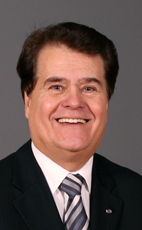
House of Commons photo

Crucial Fact

  • His favourite word was health.

Last in Parliament March 2011, as Liberal MP for Pierrefonds—Dollard (Québec)

Lost his last election, in 2011, with 31% of the vote.

Statements in the House

Mackenzie Valley Resource Management Act October 28th, 1997

Madam Speaker, I thank the member for Esquimalt—Juan de Fuca for his speech. I have a few comments to make.

He was asking why we have three new boards. The first one is the planning board. It is quite simple. It is on the Gwich'in settlement claim. It is according to the law. This is why we have planning boards for them. It is similar to what we have in our own municipalities. We need to take care with the planning.

Concerning the rest of the member's comments, I had a problem deciding if he was more in favour of industry or the First Nations. My question is what does industry want? Industry is eager to see land claims settled, greater certainty for investment and fair and expeditious administration of application for land and water use. This stable regulatory regime with a single environmental process and clearly defined regulations and environmental assessment standards will provide a positive environment for development in the western Northwest Territories. We have had many consultations with the Canadian Association of Petroleum Producers, the Canadian Energy Pipeline Association and the Mining Association of Canada.

When the member talks about the First Nations I agree with him that a lot needs to be done. I have one simple question for my colleague from Esquimalt—Juan de Fuca. If he is concerned about First Nations government, why did the Reform Party vote against self-government in the Yukon and against the Sahtu land claim?

Mackenzie Valley Resource Management Act October 28th, 1997

Mr. Speaker, Bill C-6 is partially in response to those who wanted resources management in the north to be accessible to northerners. This is a more open, visible and locally responsible form of managing resources.

Having original panels of a board with meetings and hearings held in regions is expected to be more cost effective than holding meetings in Yellowknife. In this integrated system, the developer will apply for land and water authorization in only one place. If the development is wholly within a settlement area, the developer will obtain the authorization from the original panel.

My question is the following. Does the member feel that the creation of a regional land and water panel and a valley-wide board is a duplication or an increase in bureaucracy?

Mackenzie Valley Resource Management Act October 28th, 1997

Mr. Speaker, I thank my colleague for his remarks and his concerns.

In December 1993, DIAND published an information package on the Mackenzie Valley resources management bill. The package was announced in the northern media in January 1994 and distributed to all first nations in the Mackenzie Valley, other pertinent aboriginal and non-aboriginal groups, communities, industries, federal and territorial government departments.

In June 1994, DIAND officials met in Calgary with the Canadian Association of Petroleum Producers, CAPP, and with the Canadian Energy Pipeline Association, CEPA; in May 1995 in Calgary again with CAPP and CEPA; in June 1995 in Vancouver with the Canadian Mining Association and Northwest Territories Chamber of Mines; in August 1996 again with CAPP and CEPA; in April and September 1997 with the Northwest Territories Chamber of Mines.

Does the member feel the government has an obligation to the Gwich'in and Sahtu regarding their land claims?

Mackenzie Valley Resource Management Act October 28th, 1997

Mr. Speaker, I rise to address the House on Bill C-6, the Mackenzie Valley resource management act.

I am extremely pleased to be sponsoring this bill which will build on two other legislative initiatives that are already redrawing the political, social and economic face of the Mackenzie Valley in the Northwest Territories.

In December 1992 legislation was enacted to implement the comprehensive land claim agreement of the Gwich'in of the Mackenzie Valley. In 1994 the Sahtu Dene and Metis comprehensive land claim agreement was also given effect by legislation passed by this House. We are also continuing to negotiate agreements with the other claimant groups in the Mackenzie Valley. These are historic agreements for the beneficiaries, for the residents of the Northwest Territories and for all Canadians.

The aboriginal beneficiaries now have the land base and the financial resources that will enable them to more fully manage their own affairs. Residents of these areas in the territories as well as the territorial government and industry have the certainty of land ownership and resources rights that come with settlement agreements.

I am pleased to inform hon. members that many provisions of these land claim agreements are already being implemented. After many years of difficult negotiation, the Gwich'in and Sahtu Dene and Metis are finally beginning to enjoy the benefits of land ownership and financial security.

However, the government has a number of important issues to resolve on these agreements.

Chapter 24 of the Gwich'in agreement and chapter 25 of the Sahtu Dene and Metis agreement provide for the establishment of a system for co-management of resource use in the regions covered by the agreements.

More specifically, two agencies will be set up for each region covered by the agreements: a land use planning board and a water and land board.

Moreover, an environmental impact review board will be established for the Mackenzie Valley, which includes the whole western part of the Northwest Territories, with the exception of the region inhabited by the Inuvialuit.

Bill C-6 will establish these bodies. Also, in order to ensure responsible management of the environment and to strengthen the government in western Arctic, Bill C-6 will create a land and water board for the whole Mackenzie Valley.

The board will ensure a co-ordinated and consistent process to regulate the use of land and water throughout the Mackenzie Valley. This is very important to the residents of that region, since activities taking place upstream can have a major impact on communities living downstream.

I would like to take a few minutes to expand on the provisions of Bill C-6 so that hon. members can appreciate why it is a good bill for the Northwest Territories and for Canada.

Bill C-6 provides a co-ordinated system of regulating land and water use throughout the Mackenzie Valley. In so doing it ensures regulatory consistency between the settlement areas and adjacent lands within the Mackenzie Valley. Bill C-6 also meets the government's commitment to give aboriginal people a greater role in determining resource use as provided for in the two land claim agreements.

Within each claimant area the representatives of aboriginal people will make nominations for half of the members on each of these new boards. This will ensure that the traditional activities and lifestyles of the different aboriginal groups in the Mackenzie Valley will be considered in the making of resource management decisions.

It is expected that this type of resource co-management will allow traditional aboriginal activities and lifestyles to successfully coexist with other forms of economic development. This is resource co-management in the truest sense of the term and in the form of co-management that the Royal Commission on Aboriginal Peoples fully endorsed.

In addition to guaranteeing a voice for aboriginal people, the new land and water regulatory regime will provide more opportunities for the public to participate in decision making. People from the Mackenzie Valley will sit on these boards and there will be an opportunity for input from private citizens and interest groups through public hearings.

Bill C-6 defines how the new system will work and the interaction between the various bodies. However, I should point out that the bill does not deal with surface rights. A surface rights board designed to settle any dispute relating to private land access in the Mackenzie Valley will be established under another bill. In the meantime, land claims agreements include provisions for the settling of such disputes.

The bodies established under Bill C-6 are government boards whose mandate is to look after the public's interests. Members will be appointed by the Minister of Indian Affairs and Northern Development, to whom they will be accountable.

Each body will have to consult the public, more specifically aboriginal groups, government organizations and industries, before making decisions or recommendations.

This new system is patterned on the Northwest Territories' resources regulating system which puts, as it should, the decision making process in the hands of local people.

The Minister of Indian Affairs and Northern Development is currently responsible for managing and regulating crown lands in the Mackenzie Valley, while the Northwest Territories' water board monitors the use of water.

Under Bill C-6, each region that will be governed by an agreement will have its own regional land and water board.

Outside the areas covered by the agreements, and with respect to transregional activities, the Mackenzie Valley land and water board will be responsible for making regulations. In other words, the land and water boards of each region covered by the agreements will become a standing committee of the main Mackenzie Valley land and water organization, which replaced the Northwest Territories water board.

Bill C-6 also provides for the establishment, in each of the regions covered by the agreements, of a land use planning board responsible for developing a land use plan, whose approval it will recommend to the government. These boards will develop land use plans for all land in the regions covered by the agreements.

An important purpose of land use planning is to protect and promote the social, cultural and economic well-being of the residents of the settlement area by setting goals and priorities for governments and industry. While the interests of all Canadians must be taken into account, special attention will be given to the rights and well-being of any affected aboriginal group.

Bill C-6 will also create a new environmental assessment regime for the Mackenzie Valley. The environmental impact review board will be established as the main instrument for environmental assessment and will carry out the duties currently performed by the northern affairs program of the department under the CEAA, the Canadian Environmental Assessment Act.

While this new assessment regime has adopted many of the features of the CEAA, including extensive consultation requirements and the same assessment criteria, it goes beyond the CEAA in that it applies not only to the federal crown lands and projects but to settlement and commissioner's lands as well.

This means that virtually all lands in the Mackenzie Valley will be subject to the same rigorous assessment process. Industry will welcome the certainty, consistency and efficiency of the new regime. Great effort has been put into ensuring that duplication is avoided and all will receive equal treatment.

Additionally Bill C-6 undertakes the creation of a cumulative impact monitoring program. This program will carry out periodic environmental audits and will pull together the data which will help track the cumulative impacts of development activity throughout the Mackenzie Valley.

I want to assure the House that the Government of the Northwest Territories and First Nations were thoroughly consulted on this proposed legislation.

These past few years, federal officials met on a number of occasions with their Northwest Territories counterparts and with representatives of the Gwich'in and the Sahtu Dene and Metis to develop an approach to the establishment of these organizations that would be acceptable to all parties.

We also conducted extensive consultations about the legislation per se. Drafts of Bill C-6 were distributed to various interest groups to get their input and feedback. In addition, a background document on the proposed resource management scheme was released to the public.

After this information was distributed, Indian affairs officials went on a public consultation tour in the Mackenzie Valley. These consultations have proven highly productive. Government employees have prepared information kits on the bill and the regulations for the public to provide the private sector and the aboriginal and non-aboriginal residents of the Mackenzie Valley with a clear understanding of the entire process leading up to the resource management clauses in the bill.

I am pleased to announce to the House that there was a great deal of support for our bill. A number of the aboriginal groups in the Mackenzie Valley, however, have not yet settled their land claims, and therefore feel that the establishment of regulatory bodies for the entire Mackenzie Valley is premature.

Although the government acknowledges their concerns and is dealing with them, we feel that it is important to move ahead with the establishment of these bodies so as to avoid confusion later. These aboriginal groups will be entitled to appoint members to these bodies without jeopardizing their ability to negotiate their land claims.

I firmly believe that the new resource management regime offers these groups better representation than they currently have within the decision making process.

The establishment of a new regulatory mechanism for the Mackenzie Valley cannot be done piecemeal. The hon. members will readily understand that we cannot end up with more than one regulatory mechanism for the same territory.

A cohesive regulatory process for land and water use will be to the advantage of the entire Mackenzie Valley. It will provide the private sector with the transparency and certitude required to enhance the attractiveness of investing in the area.

From an environmental review perspective, it is also important to have a valley-wide regime. More and more we are looking at environmental problems in total. Rivers and streams cannot be arbitrarily separated by artificial boundaries. We must deal with entire ecosystems and adapt to a new way of managing environmental regions.

I want to assure the House that the proposal to establish valley-wide boards for the regulation of land and water use and environmental impact review is fully consistent with the Gwich'in and Sahtu agreements and has their support. These are examples of good planning and good public government.

First Nations that have not yet settled their claims will have the opportunity to be represented on these new boards. For all residents of the Northwest Territories the new regime will mean more immediacy in decision making.

This bill also is fully consistent with the devolution of provincial type responsibilities to the territories and with, as I mentioned, the report of the Royal Commission on Aboriginal Peoples which endorsed this unique type of resource co-management for the north.

The Government of the Northwest Territories will over time assume the federal role of responsibilities in each of these areas. The territorial government strongly supports the concept of public valley-wide boards.

As hon. members can appreciate, Bill C-6 will accomplish three important goals.

First, it will meet the requirements of the agreements with the Gwich'in and the Sahtu Dene and Metis on regulating the use of land and water. Bill C-6 therefore represents a major step toward meeting our obligations under territorial claims and will form the basis of new partnerships with aboriginal peoples and other residents of northern regions.

Second, Bill C-6 will provide a new system for managing the Mackenzie Valley, which will be more user friendly, more transparent and easier to understand.

It will ensure that all residents will be involved in decisions on issues involving them. It will also ensure a fair assessment of proposals by allowing all residents of the region to give their opinion when positions are taken.

These improvements will encourage investment and economic development in the regions covered by the agreements and throughout the Mackenzie Valley. The people in the north, like all Canadians, will reap the rewards of this economic activity.

Third, Bill C-6 will also establish a system that complies with standards of prudent environmental management. In keeping with our national goal of protecting and preserving the environment for generations to come, the bill will guarantee that environmental assessments will be standardized and thorough.

I will now ask my hon. colleagues to support Bill C-6 so that the government's obligations under these regional land claim agreements can be fulfilled and that the evolution of strong, local public government can continue in the Mackenzie Valley.

Canada-Yukon Oil And Gas Accord Implementation Act October 28th, 1997

Mr. Speaker, I rise to address the House on Bill C-8, the Canada-Yukon oil and gas accord implementation act.

I am extremely pleased to be introducing to the House yet another bill which reflects the changing political circumstances in Yukon. I know that my hon. colleagues will want to join me in supporting and applauding the territorial government's ambition to take a new provincial-type responsibility at this time.

These are exciting times in Yukon, which is in the midst of a number of historic developments. The 35th Parliament dealt with land claims and self-government legislation for Yukon's First Nations. We also addressed the establishment, through separate legislation, of the Yukon Surface Rights Board.

Today I am asking hon. members to support the transfer to the Yukon government of the administration and controls of onshore oil and gas resources. I am also proposing through Bill C-8 that the territorial government be granted the authority to legislate in regard to these resources. In other words, I am seeking the support of the House to move the devolution process forward another step in Yukon.

The first steps of this transfer to the Yukon Territory were taken in the 1980s. The present government made a commitment to continue implementation in a planned and orderly manner and without delay.

Prime Minister Chrétien confirmed this course of action and the government's desire to promote political development in the North in his speech to the Northwest Territories legislative assembly in November 1993.

The people of the Yukon including the Yukon's First Nations fully support the transfer of responsibilities and the passing of the bill.

The transfer process does not mean that the federal government is trying to abdicate its responsibilities. Instead it is the expression of the real and justified desire of the northern people to take greater control of their lives. It is a matter therefore of transferring responsibilities to the appropriate authorities and of ensuring that decisions are made locally in the best interest of those concerned.

For the people of the Yukon, the transfer of responsibility for natural resources is vital to their political development. They are convinced that resource development will provide the basis for a strong and healthy economy in the territories through to the 21st century.

The Yukon's gas and oil resources are for the most part as yet undeveloped, although not for lack of interest. Uncertainty as to land and resource ownership has slowed the development of the Yukon for over 20 years. With the passing of the Yukon land claims legislation in 1994, negotiations currently under way with the Yukon First Nations and the settlement of pending territorial claims in the near future will get oil and gas exploration activities going once again.

Bill C-8 is being brought forward under the terms of the Canada-Yukon oil and gas accord which was signed in May 1993. Under this accord the federal government agreed to introduce legislation to give the territorial government the additional legislative powers necessary to manage and administer onshore oil and gas resources. This will be accomplished through amendments to the Yukon Act as set out in Bill C-8.

On the date of transfer the federal government will also pay to Yukon the moneys it collected in petroleum revenues from onshore sources in Yukon. Once the transfer is completed Yukon will receive an annual revenue of approximately $1.5 million from the Kotaneelee project.

I assure hon. members that no new federal money will be required to support this transfer process. Once the transfer of responsibilities and funding is completed, the federal government will no longer be directly involved in managing onshore oil and gas resources in Yukon. It will be done at the territorial level.

However, the offshore areas will continue to be under the jurisdiction of the federal government and the federal regime will continue to apply.

Territorial legislation will be passed which will establish a new regime for managing and regulating oil and gas activities. The legislation will address exploration, development, conservation, environmental and safety issues, as well as the collection of resource revenues. The replacement of federal legislation by territorial legislation will take place simultaneously with the transfer of administration of oil and gas.

I also assure hon. members that the transfer of these legislative powers to Yukon will not affect the ability of the Government of Canada to fulfil its mandate in any area of federal responsibility. It will not diminish our authority with respect to international affairs, national security, the environment, the resolution and implementation of land claims, or the creation of national parks.

It is also important to keep in mind that the Government of Canada will also have the power to resume responsibility for the administration and monitoring of gas and oil operations on all of the lands, with a view to settling aboriginal land claims. This clause will therefore guarantee Yukon First Nations the possibility of selecting underground lands.

In addition, the supplementary rights assigned to the territories will not in any way reduce the authority of the National Energy Board over pipelines.

Subsequent to the transfer of legislative powers to the Yukon, Yukon First Nations subject to settlements already in effect will receive a portion of the royalties collected by the Government of the Yukon Territory, as set out in the land claims agreements.

Bill C-8 will allow the Government of the Yukon Territory to exercise its jurisdiction over onshore gas and oil. The territorial government will not obtain greater powers than are given to the provinces under section 92( a ) of the British North America Act of 1867.

In addition, no party to this agreement or this legislation shall modify aboriginal rights or rights arising out of existing treaties protected under section 35 of the Constitution Act, 1982.

This is of major importance to the Yukon First Nations. These provisions ensure that Bill C-8 cannot and will not undermine the advantages the Yukon First Nations have obtained through agreements on land claims and self-government.

In fact, since the bill was presented during the 35th Parliament, further consultations have been held with the First Nations concerned. The Yukon Council of First Nations has indicated its support of the bill.

The Yukon government will be expected to manage oil and gas in a manner that serves the interests of all Yukoners including aboriginal people. I note that the Yukon government is also working closely with the first nations on the matter.

Hon. members should also be aware that Bill C-8 has strong support from the oil and gas industry.

This transfer is clearly in the best interests of the governments of Canada and Yukon as well as individual Yukoners. It is fully consistent with the devolution initiatives taken by previous governments.

With that in mind I urge my hon. colleagues to support Bill C-8 so that the devolution process can move forward and Yukon can continue to evolve politically and administratively.

Nunavut Implementation Commission October 24th, 1997

Mr. Speaker, under the provisions of Standing Order 32(1), I have the honour to table, in both official languages, copies of the 1996-1997 annual report of the Nunavut Implementation Commission.

Pursuant to Standing Order 32(2), I have the honour to table, in both official languages, copies of two reports by the Nunavut Implementation Commission, a compilation of the supplementary reports published by the Nunavut Implementation Commission in 1996, and Footprints in New Snow, volume 2.

Aboriginal Affairs October 24th, 1997

Mr. Speaker, that is a very good question.

Yesterday I had a conversation with Mr. Watso of the Micmac Indian Band. We addressed the problem. It is a very serious problem coming from the report of the Canadian Human Rights Commission released on October 6. We are looking at it. When the minister returns we will have more consultations with the Micmacs of Newfoundland.

Aboriginal Affairs October 24th, 1997

Mr. Speaker, this is why we have supplementary estimates. In the supplementary estimates we have some money for infrastructure. There was $8 million for infrastructure. For the youth employment strategy we have $24 million in the estimates. This is what we are doing and doing well.

Aboriginal Affairs October 24th, 1997

Mr. Speaker, as mentioned yesterday in response to another question in the House, the Government of Canada will respond to the royal commission of inquiry, the commission of Justices Dussault and Erasmus. The response will be given as soon as possible.

In the meantime, we have established priorities. We are meeting with all interested parties and we will report to the House as soon as possible.

Canada Health Act October 23rd, 1997

Madam Speaker, first I want to remind the hon. member that, as the Minister of Human Resources Development recently pointed out, the last federal budget and the main estimates already contain a great deal of information on the employment insurance fund.

This being said, there is no great mystery about the reserve in the employment insurance fund. A reserve is necessary because it allows us to set more stable contribution rates throughout the economic cycle, so that we do not have to increase these rates should a recession occur. It also helps us ensure there is enough money to pay the benefits when these benefits are most needed.

Let us take a look at what happened during the last recession. Within a period of two years, the employment insurance fund went from a surplus of $2 billion to a deficit of $6 billion, and the government had to increase contributions by 30% at a time when it was already difficult to create jobs. Given these facts, the government believes it is wise to have a reserve in the employment insurance fund.

The reserve itself can vary at any given time. It goes up and down with the payment of benefits. Right now, it is estimated to contain about $12 billion. However, this amount is going to be reviewed and the government will soon announce its decision in this regard.

Let us remember that the money is held in the account against future expenditures that could be required under the program. As for the interest, it is credited to the employment insurance account. As indicated in the Main Estimates for 1997-98, the interest this year was $345 million.

The employment insurance premiums paid by workers and employers make it possible to offer income protection, which is very important for those who unexpectedly lose their jobs. But best of all, employment insurance helps the unemployed to obtain stable jobs as quickly as possible. That is why—