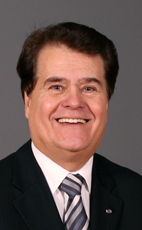
House of Commons photo

Crucial Fact

  • His favourite word was health.

Last in Parliament March 2011, as Liberal MP for Pierrefonds—Dollard (Québec)

Lost his last election, in 2011, with 31% of the vote.

Statements in the House

Aboriginal Youth November 21st, 1997

Mr. Speaker, I want to remind the hon. member that the government should not table a response just for the fact of tabling a response. We want to table the right response. We are working with the provincial governments and the aboriginal peoples.

I will quote Mr. Phil Fontaine who said in the Calgary Herald “I am confident at least at this stage that the government is serious about doing something”.

Aboriginal Youth November 21st, 1997

Mr. Speaker, I thank the hon. member for his question.

I just want to report to him that there were 440 recommendations in the RCAP. The report is not on the shelf. Rather it is one of the most important tools we have at our disposal. What we are going to do is in the Speech from the Throne and the government will act as soon as possible.

Egypt November 19th, 1997

Mr. Speaker, like everyone else, I was horrified by the shocking images transmitted by Egyptian television after the carnage involving more than 60 innocent tourists in front of the temple of Hatchepsut in Luxor.

This massacre, for which the group al-Gamaa al-Islamiya has taken credit, demonstrates just how irresponsible its perpetrators are and, in the long run, accomplishes nothing except to push back peace efforts.

I wish to express our sincere condolences to the relatives of the victims, and to assure the Egyptian people of our support in their fight against terrorism.

Sommet De La Francophonie November 6th, 1997

Mr. Speaker, as many members of this House know, the Sommet de la Francophonie will be held in Hanoi, Vietnam, from November 14 to 16.

The seventh summit will be a turning point in the development of multilateral francophonie. Indeed, this summit will elect a new secretary general, who will become a political spokesperson and arbiter of multilateral francophone co-operation.

The summit will also formalize the move of the Francophonie into a new era, by focusing on the information highway and promoting economic development.

Canada has been a leader of the Francophonie since its inception more than 25 years ago. The fact that the Prime Minister will lead the Canadian delegation to the Hanoi summit shows how important he feels our participation in this international forum is. He will be accompanied by the Minister for International Cooperation and Minister responsible for Francophonie.

I wish them both a successful participation in the seventh Sommet de la Francophonie.

Mackenzie Valley Resource Management Act October 29th, 1997

Mr. Speaker, I would like to thank the hon. member for Davenport for his speech, knowing his dedication to environmental issues.

I have one question. Is the member supportive of the provisions of Bill C-6 where it provides for joint environmental reviews, co-operation and co-ordination, by the National Energy Board, the Yukon and Nunavut territory, a province or the Minister of the Environment under the Canadian Environmental Assessment Act?

Mackenzie Valley Resource Management Act October 29th, 1997

Mr. Speaker, I would like to thank my colleague from Nanaimo—Cowichan for his speech and his dedication to the First Nations. I would like to tell him some of the features of the Mackenzie Valley Resource Management Act.

First, an advantage to the Mackenzie Valley First Nations without land claims settlements is that the aboriginal and treaty rights will be protected. The act will also be reviewed in consultation with First Nations with respect to any self-government agreements that might be negotiated. It does not affect the Indian Act. First Nations may also nominate members to the boards, providing a much stronger voice in resource management decision making throughout the Mackenzie Valley. It also allows for permanent regional land and water panels upon settlement of claims.

What are the changes for the industry? The implementation of land claims brings the certainty required to enhance the investment climate. The integrated resources management brings efficiency and consistency to the Mackenzie Valley. The land and water system is based on familiar regulations: the Northwest Territories Water Act; the territorial land use regulation with some changes to reflect the land claims; aboriginal water rights, clauses 73 to 79; modernizations from security deposits in clause 71; and a penalty for offences clause.

Finally, it encourages and provides for co-operation to eliminate duplication and environmental reviews.

We know the people living and working in the Mackenzie Valley are in favour of this bill. We know the large majority of the population of the Mackenzie Valley is from the aboriginal population, and the Northwest Territories government with a majority of members coming from the aboriginal people is supportive of this bill. The Council of the Gwich'in First Nation and the Council of the Sahtu Nation are in favour of this bill.

Knowing that this bill brings many advantages to the actual situation, my question to my colleague is, why is it that the Reform Party wants to impose its solution knowing that this proposed solution is one drafted with and for the population of the north?

Mackenzie Valley Resource Management Act October 28th, 1997

Mr. Speaker, I first of all thank my colleague for his speech.

My first comment is that I am sure he did not read the bill. He is talking about the criteria for naming the people to the board. There is just one criteria for naming people to boards, and that is competence. I hope by raising this question in the House he does not feel it means the First Nations are not competent.

Second, the member talks about court, about delay and about frustration. We are just replacing what we are doing now. We are devolving. We are giving back to the people living in the Mackenzie Valley what they should have had long ago.

The member said that the boards are not integrated. It is totally the opposite. This system is integrated because the Mackenzie Valley Land and Water Board and the Mackenzie Valley Environmental Impact Review Board will end those issues relating to the valley. It is integrated, totally integrated. One thing is that the GNWT supports this bill because it is integrated valley wide. It is for the people living there.

My question is quite simple. Why does the member of the Reform Party want to impose her view and not take into consideration the remarks, the views of the people, the wishes of the people living in that area?

We told that to the premier of the Northwest Territories and he agreed. The bands living there agree. The minister of renewable resources agrees. The people and the Government of the Northwest Territories agree.

Why does the member not take this into consideration? Why does she always want to impose her view and not take the views of the First Nations?

Mackenzie Valley Resource Management Act October 28th, 1997

Madam Speaker, I listened carefully to my colleague from the riding of Dewdney—Alouette and I listened to my colleagues from the Reform Party and to their contradictions and misunderstandings about this bill.

One member stated that these new boards will have no power and will be an empty shell. A number of members from the Reform Party stated the opposite, that they will have too many powers. Some are scared about the cost.

The Mackenzie River is long and the area is huge. The Mackenzie River is 4,000 kilometres long. What we are doing right now is transferring power from DIAND to the people of the Mackenzie Valley.

The Mackenzie Valley Land and Water Board, the Regional Land Use Planning Board and the Environmental Impact Review Board will be transferred from DIAND to them. Right now we have many senior employees from DIAND travelling weekly to the Northwest Territories. That costs a lot of money because it is a very large area. They do not move from Yellowknife to Inuvik just like that. It is impossible. We are transferring the power to the people of the First Nations.

I have one question for my friend. How could the Reform Party say this bill is no good for aboriginal people knowing that the elected majority in the legislature of the Northwest Territories is made up of aboriginal people, knowing that the Premier of the Northwest Territories is Metis, knowing that the Minister of Renewable Resources in the Northwest Territories is Metis, knowing that the Gwich'in Council is in favour of this bill, knowing that the Sahtu Council is also in favour of this bill? How could he state that this bill is not good for the First Nations when all the First Nations people in this region are in favour of it?

Mackenzie Valley Resource Management Act October 28th, 1997

Madam Speaker, I thank the hon. member for Skeena for his speech. I have first of all a comment for the member for Calgary East, the previous speaker for the Reform Party.

We say in French he made une affirmation gratuite. I do not know how to translate it. It could be an unfounded assertion or misleading affirmation about the number of people sitting on the board, the next board and a future board. He talked about patronage. I want to let him know that on the planning board there will be five members for the Gwich'in and the Sahtu. There will be two members from the Gwich'in, there will be two members from the government, one coming from the federal government and the other one coming from the Northwest Territories government, and the four will name a president.

On the next one, the land and water board, there will be seventeen members. Of the seventeen members five will come from the Gwich'in, five will come from the Sahtu and three will be from the first nations, the Dogrib, the Deh Cho and the people from treaty No. 8 who are not part of the negotiations right now, and three other ones will be from governments, two from the federal government and one from the Northwest Territories government. That means we will have two members from the federal government and those sixteen will name a president.

On the environment impact assessment and review board, there will be eleven members, five from first nations, five from government and from the government there will be three from the federal government.

If we are looking at what this government has done as nomination for the Nunavik area we have named dozens and dozens of people for nomination there. If we named them it is because they are good people. They are dedicated people and competent people. All the nominations we have done for the Northwest Territories are very good nominations. What the member said before is really misleading the House.

The member for Skeena mentioned that he would like to have first nations as a full and equal partner. My question is very easy. Does he mean by full and equal partner that he and his party do not recognize the treaty signed between the first nations and the governments? Does he mean that equal and full partner means assimilation? Is this why the Reform Party is voting against the initiative to give aboriginal control over their future?

Mackenzie Valley Resource Management Act October 28th, 1997

Madam Speaker, I have a few comments for my colleague.

The Reform Party complains about having three boards. Effectively there are three boards but I would just like to mention that these boards are co-ordinated. I would like to explain the activities of the boards.

Although each board functions independently, the legislation provides for inter-related activities in relation to the planning, environmental assessment and regulations of developments on land or water in the Mackenzie Valley. Upon its receipt of a proposal, the regulatory authority assesses whether or not it is in conformity with the land use plan.

The land use planning board is involved only on referral or application when there is a dispute. A preliminary screening of the environmental impact of the proposed development is conducted by the regulatory authorities and government departments and agencies. This preliminary screening expedites the process whereby developments with little impact need not be assessed by the environmental impact review board, including those developments normally exempt from assessment.

If a development could have a significant impact or may be cause of public concern it must be assessed by the environmental impact review board.

The Reform Party also talks about having government's power to the people of the First Nations. He needs to understand that the Mackenzie Valley is one of the largest regions in the country. When one travels from Yellowknife to Inuvik it is far. The Mackenzie River is the longest river in the country. It is important that we have a water board which understands that when the river flows from Yellowknife going to the Arctic that it passes through all the regions of the Mackenzie Valley. Having these boards comply with the land claims decisions, we feel that the boards should be very close to the community and community based.

If we were only going to have one board it would cost much more because travelling from Inuvik to Yellowknife or the opposite costs a lot of money for the citizens.

This will be my last remark before my question. The Reform Party seems to be think this is a mining bill, not a resource management act. All it talks about is mining. However, it is more than a resource management act. The Reformers are asking for just one board, but the reality is that the First Nations, the Gwich'in and Sahtu, have requested their own boards. Does this mean that the Reform Party does not take into consideration the requests of the First Nations of the Mackenzie Valley to have their own planning boards?