
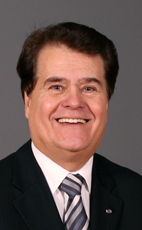
House of Commons photo

Crucial Fact

  • His favourite word was health.

Last in Parliament March 2011, as Liberal MP for Pierrefonds—Dollard (Québec)

Lost his last election, in 2011, with 31% of the vote.

Statements in the House

Internet March 27th, 1996

Mr. Speaker, the Minister of Industry announced yesterday that our government was about to invest, in partnership with the private sector, some $15 million in order to connect all Canadian schools to the Internet.

This official announcement merely fulfils the commitments we clearly outlined in the throne speech and the last budget. By the end of 1997, this federal government project will allow students from across the country to communicate with one another and give them access to the vast pool of information known as the Internet.

The implementation of SchoolNet in all Canadian schools will be done as indicated in the budget speech, in co-operation with provincial and territorial governments. Through this announcement, our government confirms its intention to give Canada an information infrastructure that will enable it to assume real leadership at the global level.

Indian Affairs March 20th, 1996

Mr. Speaker, as I just said, this is an internal problem which concerns the band in Kanesatake. In fact, last year the department sent a letter to Hydro-Québec to advise it that it would stop paying these hydro bills, because this is an internal issue which must be settled by the Mohawks themselves.

Indian Affairs March 20th, 1996

Mr. Speaker, I thank the hon. member for his question. The allocation of houses to Mohawks in Kanesatake is going very well. Ten houses are still occupied illegally. Necessary action was taken and formal notices were sent to squatters on December 21, 1995.

This is an internal issue which concerns the community itself. The community has a management housing board which must make its own decisions.

Supply March 19th, 1996

Yes, congratulations.

Supply March 19th, 1996

Mr. Speaker, I want to thank the member for Anjou-Rivière-des-Prairies for his speech. I would like to make a comment because I do not want Canadians to be left with the impression, after what the member just said, that the present government is reducing the deficit on the back of workers and on the back of the most vulnerable people in our society.

When we took office in October 1993, the deficit for 1993-94 represented about 5.9 per cent of the GDP. For the fiscal year ending at the end of this month, we have brought the deficit down to approximately $32.7 billion, with a cushion for the finance minister. This will be about 4 per cent of the gross domestic product. For the coming year, we had predicted in our red book that the deficit would be down to 3 per cent of the GDP or around $24 billion and, furthermore, the finance minister has told us that, for the 1997-98 fiscal year, the deficit will be down to $17 billion or 2 per cent of the GDP.

I want to remind the member that, when we took office, government spending amounted to $120 billion and that it will be down to $109 billion for the coming year and possibly to $106 billion for 1997-98, which is a reduction of $14 billion or 12 per cent.

The member also talked extensively about tax havens in his speech and my question relates to that. According to the member, it seems that thousands and thousands of Canadians do business with other countries to avoid paying taxes here.

Can the member please tell me and tell the House how many Canadian corporations take advantage of tax havens, according to his research?

Supply March 19th, 1996

Mr. Speaker, I want to thank the hon. member for La Prairie. Two things in his speech struck me. First, what he said about pensions and second, what he said about the budget estimates.

The hon. member said that the government was going after the pensions of people who had contributed to them all their lives. The hon. member is surely aware that life expectancy among Canadians increased by three years over the last twenty years to reach 80 years for women and 79 for men. He probably also knows that in the next 15 years, baby boomers will reach retirement age.

My first question is this: What alternative can he propose to make sure that today's workers who will reach retirement age in the next 15 years can count on a fair and equitable pension plan? Does he suggest to raise right now the rate of contributions?

My second question is a matter of simple arithmetic. When comparing our situation with that of the European economic union, he said that the Minister of Finance was incorrect when he stated that our next deficit would be at 3 per cent of GDP, but that it would rather be at 5 per cent. Can he explain how he got that number?

Indian Affairs March 14th, 1996

Mr. Speaker, as to his supplementary, I will tell the hon. member that the public was consulted on 200 occasions-amply, I think-and now we must get on with things.

Indian Affairs March 14th, 1996

Mr. Speaker, I thank the member for his question.

There is of course no secret in any of that. For the past 20 years, the Government of Canada has been negotiating with the Nisga'a people. If there are any secrets, I do not know where they are being kept.

There was in principle an agreement with the governments of Canada and the Nisga'a in British Columbia which they are ready to sign and which we hope will go through.

Interprovincial Trade March 14th, 1996

Mr. Speaker, at the end of a conference on interprovincial trade, ministers representing federal and provincial governments seemed to agree to open government procurement to Canadian businesses in general.

The Quebec minister responsible for industry and commerce, Rita Dionne-Marsolais, puts a value of $100 billion a year on government procurement. According to the Canadian Chamber of Commerce, 1.9 million jobs, 470,000 of them in Quebec, are directly related to this major market. The minister, who was obviously satisfied when she returned from the conference, thinks that, unless there are unexpected circumstances, the agreement will come into force in 1997.

We are pleased to see that the Quebec government decided to take part in this conference and is ready to sign this agreement on the easing of interprovincial trade. That proves that Quebec has everything to gain from being a part of Canada.

Petitions March 13th, 1996

Mr. Speaker, I have the honour to present two petitions from people in my riding and the adjacent area, concerning the excise tax on gasoline.