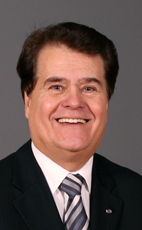
House of Commons photo

Crucial Fact

  • His favourite word was health.

Last in Parliament March 2011, as Liberal MP for Pierrefonds—Dollard (Québec)

Lost his last election, in 2011, with 31% of the vote.

Statements in the House

Integration Of People With Disabilities May 30th, 1996

Mr. Speaker, this week, we are called upon to take an active part in the many activities organized as part of National Access Awareness Week.

Even today, people with disabilities are faced with all sorts of barriers, both physical and social, which prevent them from playing an active role in our society.

The purpose of this week is to make us aware that much still remains to be done, despite the phenomenal progress made in recent years in this regard.

People with disabilities are full-fledged citizens. Our attitudes and treatment of them as a society must not be a greater handicap to them than their disability. We must therefore continue to be vigilant, so that they can enjoy the same advantages and rights as any other Canada citizen.

PHARmaCEUTICAL RESEARCH May 28th, 1996

Mr. Speaker, on May 16, the 1996 Galien Canada Prize, the highest honour for pharmaceutical research in Canada, was awarded to Hoechst Marion Roussel Canada, of Laval, for the research and clinical studies the company has conducted to determine the effectiveness and safety of the drug known as Sabril.

Research plays a leading role in our society, as it helps improve our quality of life while at the same time increasing our life expectancy and, just as important, reducing treatment costs.

Thanks to pharmaceutical companies, their breakthroughs and their entrepreneurship, Canada can be said to be a leader in pharmaceutical research.

I am proud to associate myself with all Canadians and Quebecers in congratulating the entire staff at Hoechst Marion Roussel Canada and thanking them for their perseverance, determination and professionalism.

Deputy Premier Of Quebec May 15th, 1996

Mr. Speaker, yesterday, Quebec Deputy Premier Bernard Landry described the Canadian government's behaviour as more authoritarian, intolerant and close-minded than the former totalitarian communist governments.

Such remarks are completely thoughtless, inappropriate and indicative of a total lack of knowledge of the global geopolitical reality.

This man who, when defeat became imminent, deserted his post as "second in command of the light brigade", leaving his commanding officer to die alone in action, should take note that our government recognizes, promotes and respects the democratic values of our society.

In light of the ongoing bloodshed in Chechnya, I ask that Bernard Landry withdraw forthwith his remarks, which misrepresent the Canadian federation and constitute a thinly veiled incitement to the taking of illegal means to effect Quebec's secession.

Employment Insurance Act May 14th, 1996

Mr. Speaker, I thank the hon. member for his question. He may surprised to learn that I am among the 75 per cent of Quebecers asking that responsibility over manpower training be handed over to Quebec. I am proud to be one of them and proud as well of this employment bill. That is why I urge opposition members to vote for this bill.

Regarding manpower training, that is exactly what the federal government intends to do within the next three years, as indicated in part II of Bill C-12. If the Quebec government wants these powers to be repatriated even faster, I submit that it should enter into negotiations with the Government of Canada, and I am sure that we will agree to negotiate and that these negotiations will certainly be carried out in good faith.

Employment Insurance Act May 14th, 1996

Mr. Speaker, this debate is proving to be about how the different parties in the House see the future.

It shows this government is putting even more tools in place to help Canadians get the jobs of today's economy as part of its commitment to a productive jobs strategy.

It shows we have found an appropriate middle course in this key labour market area between the unrealistic claims of the official opposition, and the narrow policies of the third party.

It shows this government is committed to a respect for, and partnerships with, other governments that will work far better than the old top-down solutions. We are determined to work with others to do more to put unemployed people back to work.

In my comments in this debate, I want to focus on what these factors mean in Quebec. There are two main issues: training and employment benefits and measures. I will address both.

The federal government understands that its strategy to foster economic growth and job creation depends on having a highly skilled, mobile and adaptable workforce. Employment insurance provides, through partnership with provinces and the private sector, a range of active employment measures to help unemployed Canadians find and keep work.

We want them to have access to effective re-employment measures-ones that get people jobs quickly. Ones that reduce future demands on income benefits under employment insurance.

The goal is to provide practical, proven measures that will help Canadians get back to work quickly, and keep working. The old system is not good enough in today's economy. Quebec shares these interests. On November 27, 1995, the Prime Minister stated our intention with complete clarity.

Let me remind the House of his words when he spoke about employment insurance. "The Government of Canada will propose an approach that respects provincial jurisdiction and responsibilities in the fields of education and labour market training. Accordingly, the government of Canada will withdraw from labour market training, apprenticeship programs, co-operative education programs and workplace based training. It will no longer purchase training courses, either directly or indirectly, from provincial establishments, either public or private".

Our government repeated this commitment in the throne speech of February 27. It promised once more that it would gradually withdraw from this sector within three years, so that there will be a smooth transition for all those involved. I fact, we will bring that process to a conclusion much sooner if this is what the provinces want.

This was not a hollow commitment. It is backed up by the approach to active employment benefits in Bill C-12. To hear some hon. members talk, one would think they still do not know this. One would think they had not read the bill. Let me help them.

For example, this bill expressly limits the federal capacity to implement the skills loans and grants employment benefits to those provinces in which that government agrees. If Quebec says no, then there would be no such activity for employment insurance clients in Quebec.

Part II of Bill C-12 also commits the government of Canada to work in concert with Quebec and other provincial governments on the design, implementation and evaluation of employment measures for employment insurance clients. Those measures include wage subsidies, earnings supplements, self employment assistance and job creation partnerships. We want to develop flexible new arrangements for the delivery of employment benefits.

That flexibility extends to the use of provincial programs to assist employment insurance clients. What does this mean? Quite simply, it means that the Quebec government could deliver any or all of these employment benefits to employment insurance clients. It could do so through its own existing programs, with support from the federal government, as long as those programs meet the objectives set out in part II of this bill and are broadly similar to the measures outlined in the legislation.

Federal guidelines will be followed in the deveopment and implementation of the employment measures: harmonization of programs to prevent overlap and duplication, programs that reduce dependency on income benefits, and emphasis on personal responsibility, co-operation and partnership, flexibility to allow local decision-making, and a framework for evaluating results.

The key, of course, is results, that is getting Canadians back to work quickly.

We believe that our approach based on partnership with provinces will ensure that every dollar spent, is spent in a way that is linked to local labour market priorities. We believe it will ensure value for the money we spend to help our clients improve their employability.

In Quebec, as elsewhere, we are determined to translate these commitments and objectives into results. This government is doing so by negotiating a series of labour market agreements with provincial governments. These arrangements could vary from province to province to meet local circumstances and needs.

We are putting turf wars behind us-and concentrating on getting Canadians back to work. And, let us be very clear about this, the federal government has responsibilities. It cannot ignore them.

It has a responsibility to the millions of workers and employers accross Canada who fund the employment insurance program and who share the risks of unemployment in a way that works for Quebecers' advantage.

It has a responsibility to manage this program in the best interests of the Canadian economy and a labour market with national elements and needs. It has a responsibility to this House to be able to track and provide it the information it needs on activities under this act.

It has a responsibility to ensure that every dollar that is earmarked for the employment benefits of employment insurance clients is used for precisely that purpose and used effectively.

In general, the conditions that I have mentioned are simply ones that recognize that EI contributors from across this country are entitled to expect results and to get their money's worth.

New agreements would ensure more effective help for the unemployed, reduce overlap and duplication and promote coherence and harmonization in federal and provincial programs.

Let me quote Mr. Ghislain Dufour on this issue: "In this regard, our federation of employers welcomes the reform proposals to harmonize federal and provincial programs and to allow provinces to make administrative arrangements with the federal government in order to administer these programs fully".

Mr. Dufour recognizes this is a good opportunity for both levels of government. Part II respects the legitimate constitutional jurisdictions of each government, and is fair and reasonable.

The door is open to an agreement that can move both governments closer to our shared goal of better employment opportunities for people in Quebec. Bill C-12 will put that process fully in motion. I urge the members of the official opposition to support this opportunity.

Employment Insurance Act May 14th, 1996

Mr. Speaker, to begin with, I have a comment on what the hon. member across the floor has just said.

I would like to comment on employment insurance and women. The bill before the House this afternoon is one which eliminates the 15 hour-week gimmick. In order to avoid having to contribute to unemployment insurance, certain employers keep their part time employees under 15 hours a week.

The new system, based on hours worked, will eliminate that invisible limit. In the new system as well, employers will have fewer reasons to limit their part time workers' hours, because all hours worked will be insurable under the system.

It must be remembered also that women make up the bulk of such workers, 69 per cent in fact. When it comes to women and employment insurance, we wanted to extend the protection offered to all part time workers. It must also be kept in mind that of the 270,000 women working part time in Canada, only 204,000 will be entitled to a refund of their contributions.

It is also worth mentioning that many women in this country hold down more than one job. They do so simply because they are not eligible for employment insurance, since they work fewer than 15 hours a week.

Another important point is that the monies paid out in employment insurance support measures will assist more than 180,000 women here in this country to find work.

My question is as follows. The hon. member opposite has made a comment about this bill being regressive in nature, and about its

creating joblessness. Does he not recognize that this bill represents a certain equity toward women?

The Late Dr. Gustave Gingras May 14th, 1996

Mr. Speaker, I rise today to point out the extraordinary contribution made by a great man of international renown, Dr. Gustave Gingras, who passed away last week.

A native of Montreal, Dr. Gingras founded the Institut de réadaptation de Montréal in 1949 and acted as its director general until 1977. Because of his reputation, people from all over the globe sought his advice. His expertise in planning rehabilitation policies was greatly appreciated.

He was awarded many prizes, including the Order of Canada, the Most Venerable Order of the Hospital of St. John of Jerusalem, the Canadian Centennial Medal, the Silver Medal International, the B'nai Brith Humanitarian Award and the Medal of Merit of South Vietnam. In 1982, he became a Queen's Honourable Physician.

Among other works, he wrote Combats pour la survie and cowrote Human Rights for the Physically Handicapped and Aged .

The nation has just lost an eminent citizen. To his wife and to all his family, I wish to express my most sincere condolences.

Raising The Irving Whale May 8th, 1996

Mr. Speaker, a number of socio-economic and environmental groups, as well as professional fishermen, have formed a major coalition to condemn the alarmist and inappropriate comments of the Quebec environment and wildlife minister.

Last week, at a press conference on the raising of the Irving Whale , the minister mentioned various alarmist scenarios, including the possible contamination of snow crab stocks, to justify his opposition to the project.

The minister should remember that a security perimeter has been in place around the wreck for over ten years to prevent any contamination risk.

At a time when the fishing and tourism season is getting into full swing in the Magdalen islands, the PQ minister would be well advised to avoid fearmongering, for such comments can only hurt economic activity in the region.

Indian Affairs May 3rd, 1996

Mr. Speaker, I thank the hon. member for his question. Last November, the Lake Barriere community chose an interim band council by petition. This interim band council was given the mandate by the community to write down the band's custom for the purpose of ratifying it. Once ratified, the custom would be used to elect new leaders.

But a group opposed to this interim band council has control over the road to the reservation, which is the reason why the school was closed. Considering the continuing stalemate, the dissenting group asked for the help of a mediator, which the interim band council also agreed to on April 25. I can announce today to the House that both parties have agreed on the choice of a mediator, whose role will be essentially to work with band members to develop an electoral code.

Francophones Outside Quebec May 1st, 1996

Mr. Speaker, it seems that, this week, opposition parties are trying to outdo each other with racist and discriminatory statements.

After a Reformer made totally unacceptable comments about black people and homosexuals, the Bloc member for Québec-Est is now trying to win the prize for bigotry.

While commenting the report tabled yesterday by the commissioner of official languages, the Bloc member compared French speaking people outside Quebec to paraplegics in wheelchairs with only two wheels.

The intolerant and discriminatory comments of the Bloc member are an insult to French speaking Canadians outside Quebec and to physically disabled persons.

If the Bloc member and the Reformer had the least bit of respect for Canadians, they would make a formal apology.