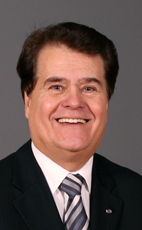
House of Commons photo

Crucial Fact

  • His favourite word was health.

Last in Parliament March 2011, as Liberal MP for Pierrefonds—Dollard (Québec)

Lost his last election, in 2011, with 31% of the vote.

Statements in the House

Gun Control April 30th, 1996

Mr. Speaker, a terrible human drama, the senseless murder of police officer André Lalonde, has shocked all of Quebec. A member of the Montreal Urban Community's police force for 29 years, Mr. Lalonde was barely two months short of a well-deserved retirement. Today, his wife and two children must go on without him.

In the face of such a horrifying act, we must insist that our legal system deal fairly but firmly with the murderer of officer Lalonde. Our government has already shown its determination to fight violence and crime by passing the gun control bill last year. There will be other measures to complement the initiatives of our government, in order to assure Canadians that other families will not have to go through the suffering that the members of the Lalonde family are going through today.

I join with their friends and relatives in offering my deepest condolences.

Budget Implementation Act, 1996 April 25th, 1996

Mr. Speaker, I have a comment and a question for the hon. member for Anjou-Rivière-des-Prairies.

My comments concerns the GST. As the hon. member indicated, the GST has been harmonized in Quebec; the federal government and the Quebec government had agreed to phase in harmonization over a six-year period. What the member did not tell this House however it that Quebec would not have qualified for adjustment assistance since revenues resulting from harmonization alone have increased in Quebec. Harmonization has generated additional revenue for Quebec, while Ontario, Alberta and British Columbia do not qualify.

We will recall that the premier of Quebec, the hon. Lucien Bouchard, was a member of the cabinet that instituted the GST and that he was the one who advocated harmonizing Quebec's sales tax without any financial compensation.

It is also important to note that the federal government is still paying Quebec for administering the tax on its behalf. In recent years, payments averaging $100 million a year were made. Also, Quebec like the other provinces regularly receives adjustment assistance from Ottawa, including stabilization payments, supply management envelopes and regional development funding. In many cases, Quebec receives much more than the other provinces.

My question is as follows. In his remarks, the hon. member for Anjou-Rivière-des-Prairies mentioned Bill C-12, which he described as regressive legislation. He used the word regressive. I would like to know if it is regressive to move from a system based on the number of weeks worked to one based on the number of worked hours in a bill on employment. Let me explain. Who works 15 hours or less in Quebec and Canada? The most disadvantaged members of our society, those who cannot find permanent employment, generally women. Under the old system, people could hold two jobs and work 30 or 40 hours per week during 30 years without ever qualifying for employment benefits.

If the hon. member could give me an answer, I would like to know if legislation that gives 500,000 workers, including 125,000 in Quebec alone, access to employment insurance can be called regressive.

I would also like to know if raising employment benefits by 18 per cent for every family household in Quebec and Canada earning less than $26,000 and helping the most disadvantaged members of our society can be called restrictive or regressive measures?

Budget Implementation Act, 1996 April 25th, 1996

Mr. Speaker, I would like to inform you that I will be sharing my time with the hon. member for Carleton-Charlotte.

Mr. Speaker, the 1996 budget follows through on the government's commitment to reduce the deficit in a sustained fashion. However, we should not forget that balancing the budget must never be the sole objective.

Improving public finances should always be a means to reach the greater goal of lowering interest rates, creating jobs and ensuring Canada's prosperity and future. It must also allow us to continue to work on other priorities and issues which are dear to Canadians.

It goes without saying that one of the top priorities is to maintain Canada's social program network. These programs have made Canada one of the most envied countries in the world. To reach that goal, as the Prime Minister promised, we must propose a long term funding framework for health services and social programs that will grow, while also being stable, predictable and sustainable. To that end, the 1996 budget provides for the setting up, over a period of five years, of a funding framework for the Canada health and social transfer.

This transfer, which was introduced in the 1995 budget, is the most important federal initiative to provide financial assistance to the provinces regarding health care, post-secondary education and social assistance.

Under the Canada health and social transfer, provinces enjoy increased flexibility in designing and managing their own programs, while medicare and other social measures are being preserved.

Since these transfers to the provinces represent a sizeable proportion of total federal spending, we cannot improve public finances without reducing them, as we did in the case of all other expenditure items. This is why funding will be reduced in 1996-97 and in 1997-98.

Following consultations with the provinces, the 1996 budget now expands the scope of the Canada health and social transfer, which will not undergo additional cuts. We have established a five year funding mechanism under which transfers will increase and the cash portion will be stabilized, to eventually increase over the years.

It is important to note that federal equalization payments to the poorest provinces, which also help fund social programs, will keep on increasing. The new mechanism is based on four fundamental principles: maintaining health care and social programs; re-establishing the increase in transfer payments and stabilizing the cash portion; guaranteeing stable and foreseeable funding to the provinces; providing the provinces with more comparable funding.

Our action plan takes these principles into account. Allow me to review its main proposed elements. The funding level for the CHST announced last year for 1996-97 and 1997-98 will remain stable, which means that appropriations will amount to $25.1 billion in 1997-98 and will be made up of tax points and cash in roughly equal proportion.

The 1996 budget provides for five year legislated funding of the CHST over fiscals 1998-99 to 2002-03.

During the first two years of the implementation of the new mechanism, appropriations will remain at $25.1 billion. Since the provinces' tax points will increase, the cash portion paid by the federal government will decrease somewhat. However, total funding, cash and tax points combined, will remain stable. It is obvious that as a result of the CHST, global entitlements will never diminish. Funding will not be cut.

In fact, during the three last years of this framework, total transfer entitlements will grow each and every year at an increasing rate, according to a formula tied to economic growth. This means that, by the end of the five-year period, overall CHST entitlements should exceed those of 1997-98 by $2.3 billion. For the first time since the reduction plan was initiated in the mid-1980s, a federal government will be taking steps to make these transfers grow faster.

Moreover, under this framework, the cash portion of the CHST is guaranteed never to fall below $11 billion. In fact, by the end of the five-year period, it should begin to grow. For greater safety, the cash floor within the transfer will be guaranteed by legislation to make absolutely sure that cash transfers will never be under $11 billion during this time frame.

The budget also provides for a new allocation scheme reducing disparities caused for a large part by the ceiling imposed by the Conservatives to tranfers to three provinces under the Canada assistance plan.

Finally, the new allocation scheme will be implemented gradually over five years. In theory, each province's entitlement will be adjusted periodically based on its share of the CHST and its relative demographic weight within the country. By the year 2002-03, any disparity in per capita financing will have been reduced by half.

Of course, this is a compromise solution and no single allocation scheme will satisfy all the provinces. We believe however that this is a reasonable compromise and that the five-year phasing in of the

new allocation scheme will give provinces a chance to adjust and to plan with greater certainty.

To conclude, budget proposals regarding the CHST clearly show that the federal government is doing its share to ensure the future of the Canadian health system and social security net and to build a renewed social and economic union. The provinces will continue to decide how they want to allocate federal transfers between these priorities.

Finally, the government is taking steps to ensure that social programs remain within the financial capability of the nation and meet the needs of Canadians in the future.

Petitions April 25th, 1996

Mr. Speaker, pursuant to Standing Order 36, I have the honour to present a petition signed by people in and around my riding.

The petitioners call for an indivisible Canada, whose boundaries and those of its provinces, territories and territorial waters must not be modified.

Partnership April 23rd, 1996

Mr. Speaker, most papers announced this morning that the members of the Parti Quebecois will soon be asked to vote on a change to their party's political agenda to formally include the notion of partnership.

Picking up again the highlights of the May 12 agreement, the Parti Quebecois would come back with its myth of partnership after separation. Perhaps the new leader of the PQ does not remember that, on October 30, a majority of Quebecers voted against this project.

When will separatists in Quebec accept to respect the democratically expressed will of their fellow citizens and give up this separation idea which is leading nowhere?

What Quebec needs is not a premier who perpetuates political and economical instability, but someone who would work to eliminate it.

International Monetary Fund April 18th, 1996

Mr. Speaker, the International Monetary Fund expects that the growth of the Canadian economy should continue to improve in the next two years, reaching an annual rate of 2.9 per cent in 1997.

Among the G-7 countries, only Japan would outmatch this performance. So, Canada's economic situation has greatly improved since our government was elected.

The IMF also points out, and I quote: "Following the October referendum in Quebec, the level of confidence improved and interest rates went down significantly."

The people of Quebec and Canada had long felt what the IMF is telling us. Quebec separation has extremely negative impacts on the economy. It is high time for the PQ to put this option aside if it really wants to contribute to the economic recovery.

Expro Of Valleyfield April 17th, 1996

Mr. Speaker, earlier this week, Expro Chemical Products of Valleyfield signed a major contract with the U.S. firm OEA Inc. The value of this contract lies not only in the amount of money Expro will receive but mainly in its new mandate.

This company, which used to specialize in the manufacturing of explosives used mostly for defence purposes, has just been awarded its first contract for a civilian application. Expro is now responsible for supplying a propellent used in the air bag release mechanism for 1997 American car models.

This is a great example of the sense of innovation and initiative that drives Canadian businesses. Expro's example shows it is possible to convert defence industries to civilian and peaceful uses.

Pharmaceutical Industry April 16th, 1996

Mr. Speaker, I would like to draw the attention of this House to a fine example of the co-operative attitude among the various business communities in Canada.

On March 19, the Chamber of Commerce of Metropolitan Montreal and the Board of Trade of Metropolitan Toronto took a common stance on enhancing drug patent protection.

In fact, this position was clearly set out in a document outlining the formula for success-supporting the economic growth of the Canadian pharmaceutical industry. We welcome the fact that the two main boards of trade in the country have joined forces on such important matters, which helps promote Canadian unity while at the same time helping to maintain jobs or create new ones.

Congratulations to the officers of both organizations for their remarkable open-mindedness and sense of initiative.

International Development March 29th, 1996

Mr. Speaker, the cities of Montreal and Quebec signed yesterday a co-operation project with the city of Beirut, in Lebanon. One of the objectives of this 18-month project is to rebuild the land registration system of the Lebanese capital. The project, valued at $387,000, will be funded by the Canadian International Development Agency.

This co-operation agreement will allow students from the Faculté d'aménagement urbain at Montreal University to work on the implementation a system of urban management, urban planning and local self-financing for the City of Beirut.

The Government of Canada is pleased to be associated with this project, which highlights Canadian expertise in the area of urban development, while helping one of the great French speaking capitals of the world.

Mirabel International Airport March 28th, 1996

Mr. Speaker, at a time when calls for solidarity and cohesion are heard on the issue of Montreal airports, the Bloc Quebecois is displaying its political expediency and adding to the confusion about the future of Mirabel.

Yesterday, the Leader of the Opposition once again displayed his poor knowledge of political issues in Quebec when he referred to, and I quote: "the more recent decision to build Mirabel airport, which did considerable harm to Montreal's air traffic".

How can the member for Roberval condemn Mirabel in such a way, claiming that it has harmed Montreal's economy, when members from his own caucus have publicly expressed themselves in favour of the survival of Mirabel airport? Are we to understand from the Bloc leader's remarks that, as usual, the statement he made yesterday is simply a way to pave the way to the decision his leader, Lucien Bouchard, is preparing to announce?