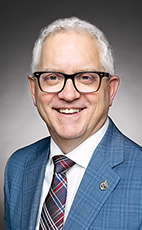
Madam Speaker, I knew entering federal politics would mean participating in many very important debates in the House, but speaking on matters of life and death brings that to a whole new level. As someone who comes from a small city in northern Saskatchewan and now has the privilege of representing the entire northern 52% of Saskatchewan, I hope to bring somewhat of a unique perspective to this debate.
As we stand here in Ottawa and debate this legislation, there are several communities in my riding dealing with very high suicide rates. Makwa Sahgaiehcan First Nation, a community of about a thousand people, has over 100 community members currently on suicide watch.
There are long-term care home and palliative care shortages across the country, but this is even more true in northern and remote communities. We need to consider what message we, as legislators, are sending to these vulnerable communities when we go way beyond the Supreme Court of Canada's Carter decision by removing safeguards that would protect Canada's most vulnerable.
The government is now seeking to play an active role rather than a passive role in the end of Canadians' lives. I find this extremely troubling and implore my colleagues on the other side of the aisle to allow the necessary time to consider the truly long-term ramifications of the legislation and to listen to all the voices speaking out on it. This does not need to be done with unnecessary hurry.
There are two main topics I want to address when it comes to Bill C-7. Number one is the impact passing the legislation will have on indigenous communities, and number two is the importance of safeguards to protect Canada's most vulnerable.
I do not stand here pretending for one moment to speak on behalf of indigenous people in Canada. However, over my lifetime I have developed relationships with many first nations and Métis people in northern Saskatchewan and over the year I have discussed this issue of assisted dying with many of them. There is a great worry among the leadership of these nations that legitimizing suicide in our culture will have grave impacts on their younger generations as well as those who are nearing the end of their lives.
These concerns were actually raised during debate in the last Parliament by Liberal MP Robert-Falcon Ouellette during his speech on what was then Bill C-14. He said:
In the indigenous world view, everything is interconnected. It is holistic, meaning that when a change is made in one place, the impact will be felt elsewhere, and the two cannot be separated. In the western world view, often we compartmentalize things. We believe that we can play, that we can control certain situations, that we can effect change here and not see change in other places. Above all, we have come to believe ourselves able to predict and control all, to control the future. This does not mean, though, that we should not take action.
The impact of this bill on people in Toronto may be very different than on the people in Nunavik or Attawapiskat. Our role as parliamentarians is to place ourselves in the moccasins of others, to place ourselves outside of our own experiences, to see the world through another cosmology and other world view, and to see the impact that our decisions may have on others.
We are making profound changes in concepts surrounding life, which cannot be undone in the future. In the indigenous tradition and philosophy, we are required to think seven generations into the future. If I am wrong and there is no connection between Attawapiskat and physician-assisted dying or suicide, if the average person does not see a connection and communities do not see a greater stress, then I will gladly say I was wrong; but if there is an impact, which is caused by the valorization of suicide, then what?
Mr. Ouellette then goes on to share a very personal and difficult story of hardship he and his siblings faced as young children, which led him to nearly take his own life. He goes on to say:
If in my life I had seen, or I had known, that my grandmother had somehow used physician-assisted dying or physician-assisted suicide, or others in my family had completed the irreparable act, then it would have made it much more difficult for me to continue.
We might not think the impact will be there, but we do not know. We assume we know these things. We are deciding the future of a few for the end of a few.
Speaking to CBC during the debate on Bill C-14, Senator Murray Sinclair shared similar views. He said:
From the indigenous perspective, ending one’s own life was not encouraged, in fact it was discouraged and there are teachings in my community, Ojibwa teachings, around whether or not you will be able to travel to the spirit world in the proper way or a ceremony could be done for you if you make the decision to end your life without good reason.
In speaking to his colleagues in the Senate, Senator Sinclair, speaking about younger people, said:
It will not take much for a young, vulnerable person to believe that their situation is intolerable to them and, therefore, we need to ensure the message we send to the Canadian public with this legislation is that this is not a right that should be easily exercised or that we are embracing.
First nations people in northern Saskatchewan, Mr. Ouellette from Manitoba and Senator Murray Sinclair are not alone. Tyler White, chief executive officer for the Siksika Health Services, as well as Dr. Thomas Fung, a lead physician of the same nation, are sounding alarms in response to the legislation. During an interview with CTV, Mr. White said, “The expansion of MAID sends a contradictory message to our peoples that some individuals should receive suicide prevention, while others suicide assistance.”
In a letter shared with my office, Mr. White and Dr. Fung told the story of a patient who suffers from a lung disease that causes him to become easily short of breath, even when doing simple household tasks. This patient uses a walker but cannot walk for more than a couple of minutes without gasping for breath. While the man's condition is incurable, he could certainly have an improved quality of life if he had access to funding to support his home oxygen, but he was just out of the range of being approved for funding. Dr. Fung concluded by writing that under Bill C-7, this patient would have qualified for assisted death when it should be clear to all that there are other ways to relieve this man's suffering and improve his quality of life. Patients like Dr. Fung's deserve better.
In a country as developed and resourceful as Canada, we cannot allow ourselves to abandon people like this. Our health care system is the pride of many Canadians, but that is because of universality of access to life-saving treatments, not the universal admissibility to a physician-administered death.
I want to talk for a minute about the safeguards for vulnerable Canadians and how the legislation would fail to provide them. I am not a lawyer, but thankfully the Leader of the Opposition is. We are probably all glad that is the case, that I am not the lawyer. I was glad to be in the House during this speech on Bill C-7 this morning.
Leaning on his legal expertise, allow me to repeat some of what he said regarding previous litigation surrounding assisted death, because it struck me as very important. He said, “All of them talked about the role of the state in protecting the decisionally vulnerable, as they were called, people who could be pushed into end-of-life treatment because they felt they were a burden. This has been talked about since the 1990s, and this Attorney General is removing the safeguards from our regime. Every ounce of case law on the issue of assisted dying, euthanasia or assisted suicide talks about protecting those vulnerable.”
Speaking of protecting the vulnerable, the leader also said, “All major disability groups in Canada agree with the compassionate and reasonable position being presented by my Conservative colleagues. I am very proud of the advocacy we have shown. We have also been joined by legal scholars, indigenous leaders and people working with people with mental health issues.” I wholeheartedly echo the comments made by my hon. friend this morning and repeat the need for the government to step back from its repealing of the provisions that would ensure a 10-day waiting period, as well as two witnesses.
As a matter of fact, regarding the 10-day waiting period, a senior employee of the AFN shared on Twitter recently, “This ten day period literally saved a member of family’s life. MAID must be accessible but also account for clear and thoughtful consent. The Liberals should rethink this.”
In closing, I want to completely acknowledge that both sides of this debate are coming from a point of view of compassion. I understand that the government has approached the drafting of the legislation in good faith, but the reality is that it has fallen short of its duty to Canadians. That is why I will be voting against this dangerous bill and I hope that my colleagues on the other side of the aisle will reconsider their support for it as well.