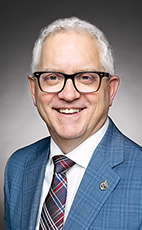
House of Commons photo

Crucial Fact

  • His favourite word was saskatchewan.

Last in Parliament April 2025, as Conservative MP for Desnethé—Missinippi—Churchill River (Saskatchewan)

Won his last election, in 2021, with 49% of the vote.

Statements in the House

Business of Supply December 3rd, 2020

Madam Speaker, I find myself a little bit surprised that I agree with the hon. member in this particular case. We have been working with many groups representing urban and indigenous people over the last 10 months and I fully agree.

In my comments in my speech, I talked much about getting the data, about trying to remove the jurisdictional quagmires that we find many of these people in. The government likes to point to the provinces and say that those people are their responsibility, so what we end up with is people falling through the cracks. We have been advocating for the data to ensure that these vulnerable people do not fall through the cracks. I 100% agree that applies to the distribution of vaccines as well.

Business of Supply December 3rd, 2020

Madam Speaker, I will be splitting my time with the member for Mégantic—L'Érable.

I am participating in this debate tonight from my hometown of Meadow Lake, Saskatchewan. Right next door to me is the Flying Dust First Nation, one of nine members of the Meadow Lake Tribal Council. On the east side of my riding is the Prince Albert Grand Council, which is comprised of 12 first nations. There are also many Métis communities across my northern Saskatchewan riding along with a huge agricultural sector and tourism.

The reason I highlight this is that all our communities, including the first nation and Métis communities in northern Saskatchewan, are looking to the government for a clear and competent vaccine plan, but they are not finding one.

The text of today's motion indicates that “a vaccine is essential to the health, safety, and economic security of every Canadian.” My constituents are now observing countries around the world as they detail their vaccine plans, with real tangible timelines, and are asking where Canada's plan is.

The Prime Minister naively announced on election night in 2015 “Canada is back.” Now we understand just how true those words were. Canada is indeed at the back of the line, behind one-third of the world population, in getting vaccines.

The attack from the Liberals on this is easily predicted, that we as Conservatives are playing politics. It may come as a shock to the Liberals, but as Canada's official opposition, it is indeed our job to push back, to hold government accountable and, in some cases, even oppose and criticize it. Without the great work of my colleagues in the Conservative Party, Canada and Canadians would be much worse off than they are today in the face of this pandemic.

What do I mean by that? In my role as shadow minister for indigenous services, at many times throughout this pandemic I have identified gaps and serious issues facing indigenous people. This began with many indigenous businesses not being able to access the government's wage subsidy program because of the way it was structured. After weeks of fighting, finally the government modified its program and allowed these businesses to access the wage subsidy.

Next was the issue of elections on first nations. As Canada was dealing with the first wave of this pandemic, elections were scheduled to occur, while many first nations were developing public health measures to ensure their people were kept safe. As members can imagine, contrary to what the Liberals clearly want, the height of a pandemic is no time to hold an election. Therefore, I, with the help of many, pushed the minister and his department to find a solution. They did. They found the ability to delay these elections in regulations created under the Indian Act.

A few months into the pandemic, I was made aware of a major gap in the government's CEBA loan program, thanks to the excellent advocacy of Tabatha Bull of the Canadian Council for Aboriginal Business, Shannin Metatawabin of the National Aboriginal Capital Corporations Association and many others. Indigenous businesses do not often use traditional banking systems. Instead, they make use of the many aboriginal financial institutions, AFIs, across Canada. Alongside many stakeholders, we advocated for the government to create the emergency loan program administered through NACCA. It was eventually announced at the end of April, but still businesses could not access it until over two months later.

Let us not forget that it was the Conservative Party that first raised the idea of closing our borders to international travellers. Our concerns were met with scoffs and suggestions of racism from the health minister. Then what happened? The government eventually listened and closed our borders.

In addition to that, it was our party that fought the government to investigate rapid tests after countries around the world started to introduce them for use. The Liberals at the time, which I predict they will again do today, accused us of being too partisan. What happened? Within weeks of us raising it, the government started looking into and approving rapid tests.

It is clear that if it were not for our strong, principled opposition, Canadians would be far worse off than they are today in the face of the second wave of this pandemic. Here we are today once again identifying a major gap in the government's handling of the pandemic, hoping to receive all-party support and finally receive some semblance of a plan from the Liberals.

Getting back to the motion, the Conservatives, and I believe all Canadians, want to know how each type of vaccine will be safely delivered to Canada, stored and distributed to Canadians; the data on which each vaccine type will be first deployed in Canada and the rate of vaccinations anticipated by month; any intended federal guidance with respect to the deployment of the vaccine by priority group, such as front-line health workers and seniors; and, finally, the plan for distribution of the vaccine to indigenous communities, members of the Canadian Armed Forces and veterans.

For the remainder of my time, I want to focus on the importance of a plan for rural and remote indigenous communities, urban indigenous people and indigenous businesses.

During the first wave of the pandemic, indigenous people experienced far lower positive and mortality rates for COVID-19 because of strong local leadership. While the Liberals were playing politics about closing borders, many first nations did exactly that and were able to control who came into their communities in order to keep their people safe.

It is no secret that there are many unsafe living conditions in many of these indigenous communities across our country. In the face of such adversity, indigenous people weathered the first wave better than any other demographic across the country.

As Canada has experienced the second wave, indigenous communities are now dealing with increased COVID fatigue, leading to people to let their guard down and sometimes make poor decisions, thus increasing the risk to their families and communities. With no plan from the government on when these communities may receive a vaccine, how it will be transported to them and how many doses they will be provided, the leadership in these communities cannot provide hope that this will soon be over. This is precisely why we need a plan from the government.

Eight months ago, I raised the issue of collecting accurate and comprehensive data on urban indigenous people with the Minister of Indigenous Services. The purpose of this would be to reduce jurisdictional wrangling. Unfortunately, as we saw last week, instead of action, the minister decided to point the finger at the provinces and municipalities. Without accurate and comprehensive data on urban indigenous people, how can the government plan to vaccine this vulnerable population and learn from this pandemic?

My office has been in close contact with the Aboriginal Friendship Centres of Saskatchewan as well as its national organization. These groups have been providing much of the care for urban indigenous populations throughout the pandemic and they also have been advocating for better data so they can continue to provide these high-quality services. Without a plan that includes answers on the how, when and who, these organizations are left to fill the gap on which the government should be providing leadership.

An issue that has become near and dear to me, as I have served in the capacity as shadow minister over the past year, is indigenous businesses. I strongly believe that without true economic reconciliation, Canada's relationship with indigenous people will continue to be one of dependence. We need to put our effort and focus on supporting indigenous entrepreneurs who remain so connected to their nations and allow them to reinvest in their communities to provide real and lasting positive outcomes. That means the Liberals making good on their promise of a 5% procurement target for indigenous businesses.

The government cannot continue to operate in silos. This need to be a whole-of-government approach across all departments. Out of all the contracts awarded to businesses across Canada to produce PPE, the fact that indigenous businesses made up less than 1% is unacceptable, especially when hundreds of indigenous businesses lined up to be providers.

Indigenous businesses, like all businesses, need a level of certainty in order to successfully operate and make continued investments. As I pointed out, the government has done a poor job in supporting indigenous businesses throughout this pandemic and now, as these businesses are again looking for a plan, they are seeing a government with no plan.

In speaking with indigenous business stakeholders this week, we heard concerns regarding the lack of a mention of indigenous entrepreneurs in the fall economic statement. This has led them to be very disappointed and concerned with their ability to even survive a second wave, instead of focusing on the critical role they could be playing in the economic post-pandemic recovery.

That is why it is so important today that we pass this motion to provide these businesses and all Canadians some semblance of certainty during this difficult time.

Criminal Code December 2nd, 2020

Mr. Speaker, not knowing exactly what [Technical difficulty—Editor]

Criminal Code December 2nd, 2020

Mr. Speaker, if the member wants to get into a debate, maybe he should actually recognize where my riding is, which is in northern Saskatchewan, not in Ontario. Let us actually talk about practical—

Criminal Code December 2nd, 2020

Mr. Speaker, as I said, the examples he has outlined are a perfect example of the situation where that has happened in Ontario. It is imperative that we protect the beliefs and the choices physicians and health care providers want to make in their own journeys and their own professional practices.

Criminal Code December 2nd, 2020

Mr. Speaker, I will not go into specific examples, but I have talked to many physicians and health care providers and this is an issue for them. They do not want to be put in a place where they are going to be challenged and going to be before a court because of their beliefs. We have a fundamental right in our country for freedom of religion and a freedom of belief, and it should apply in this case as well.

Criminal Code December 2nd, 2020

Mr. Speaker, it is a pleasure tonight to speak to Bill C-7 at report stage, an act to amend the Criminal Code on medical assistance in dying.

My journey on this over the last while, as a new member of Parliament and listening to my constituents, has been one where I realized this is a very personal issue and brings out a very strong and emotional response from people on all sides of this issue. The stories are personal and impactful and people have very strong opinions on all matters to do with the bill.

The thing that has landed for me as I have considered this is that there are a few things we need to ensure are dealt with in the legislation. One, as we have heard many of my colleagues talk about, is the protection of the most vulnerable in our society. The second is the protection of the conscience rights of physicians and health professionals. To that effect, a number of amendments were introduced by my party at the committee stage, for great reason.

The first one talked about reinstating the 10-day reflection period when death was reasonably foreseeable. I was in the House last week and had the privilege of listening to some debate on this matter. It was a very moving experience for me as I listened to my colleague, the member for Flamborough—Glanbrook, share a very personal story in a question to a member. It was a very moving and impactful story.

He talked about the finality of the decision his daughter made when she chose to take her own life some years ago. He talked about how it was at a very low point in her life that she chose to take her own life. We talk about the removal of the 10-day reflection period, but when I heard that story, it personally moved me and caused me to say that it is so important that we protect people in their most vulnerable moments.

My colleague talked a few minutes ago about the idea of maintaining the requirement for two independent witnesses when death was foreseeable. As an accountant for many years, dealing with many legal and financial matters, there were so many things I did over my career that required the signatures of multiple witnesses. The matters I thought were important over all of those years were nowhere near the importance of determining life and death matters like we are talking about today. The requirement for two independent witnesses being reduced to one is appalling when I consider the matters I dealt with as a professional over the years, which required the signatures of at least two or multiple people.

The other point we have talked about over the last few weeks is ensuring physicians have expertise in a patient's condition. It is imperative that we maintain the ability for people to prove it and have multiple opinions. The extension of the reflection period when death is not reasonably foreseeable is another amendment the Conservatives believe is vital and important to this process.

Protecting vulnerable patients by requiring them to be the ones to first request information on medical assistance in dying is really important. It overwhelms me to think that a vulnerable member of our society could walk into a doctor's office or a health provider's office, while being at a low point and suffering from whatever ailment, and a health care professional or somebody in a position of trust initiating a conversation about medical assistance in dying. It is unconscionable.

The removal of that provision is not acceptable. For that reason, there is no way I would ever support this with those kinds of things still included in the bill.

As I mentioned earlier, there is the protecting of conscience rights for health care professionals. We need to respect the opinions, beliefs and rights of those people to maintain their values and beliefs and maintain the things they believe are important in their approach to their professional journey. It is imperative we protect those folks. The thing I have heard the most from people, along with the protecting vulnerable people, is protecting the conscience rights of health care professionals.

As we think about the process, any legislation that is introduced in Parliament requires a thorough review. Just like I talked about in the context of having the two independent witnesses, when we are talking about matters that are literally life and death, it is important that we ensure we have due process. There was the review that was supposed to be done.

We have a strong belief that this decision should have been appealed to the Supreme Court so we could get certainty in the framework. So many of these things did not get accomplished, as has been mentioned by a number of my colleagues and members today. This is somewhat as a result of the prorogation of Parliament and the fact that we missed a number of weeks of opportunity to debate legislation and deal with these important matters.

I want to reflect upon the witnesses and the testimony that was presented to the justice committee. We heard from numerous people and groups that advocated on behalf of people with disabilities. People are opposed to the bill and the rapid extension of the legislation that has been put before us compared to the former legislation, Bill C-14. It is shameful that we are rushing this. It is a matter of life and death. We are now rushing this to try to get it done before Christmas. We could have done so much more in the weeks past.

As Conservatives, we will continue to fight on behalf of the vulnerable in our society. We will continue to fight on behalf of all Canadians with disabilities. We will continue to ensure that their interests are protected and that they are protected as we move forward in this process.

I want to comment on the impact of this on indigenous people. As the shadow minister for indigenous services, I am always engaged in the lives of those folks. As I speak to my indigenous and first nations friends, they really struggle with this legislation. There is a spiritual element and spiritual being to a lot of indigenous folks. They struggle with the advancement of the legislation and how rapidly it is moving.

I could go on for a while about some of the inequities experienced by indigenous people. I could talk about some of the witnesses at the committee. They talked about the voices of indigenous people not being heard, even though the percentage of the indigenous population in the Northwest Territories, from Nunavut to some of the other communities is so high. Those voices were not heard and have not been heard.

I have a quote that states, “The Indigenous peoples of Canada, including those living with disabilities, do have a voice, however, the opportunity to speak to Bill C-7 has not been adequately conveyed or provided” to those groups.

I want to end with a letter from one of my constituents and I want to frame this carefully. This is from a gentleman and his wife who served for years as chaplains of the Salvation Army in my community. They have dealt with disadvantaged people for many years. They reached out to me early on in this process.

Their letter states:

“As two of your constituents, we are concerned about Bill C-7 and the changes to Canada's law on medical assistance in dying. Canadians living with disabilities and chronic ailments as well as other vulnerable people already have difficulty getting the support they need to live. Removing the end of life requirement from the MAID law puts these Canadians at even greater risk. We oppose changes to remove the safeguards for MAID law for those whose death is foreseeable, like the 10-day reflection period, the ability to consent at the time of death or the requirement for two independent witnesses. We urge you to fight for these safeguards. It is essential that the government protect vulnerable Canadians from abuse and harm. We urge you to call for a reintroduction of an end of life requirement in the MAID law.”

Agriculture and Agri-Food November 27th, 2020

Madam Speaker, Canadian farmers produce the highest-quality canola in the world. Health Canada recently announced it will make a decision on banning neonic insecticides in the next six months. The government, if it had consulted with canola producers, would know that neonics are strictly used as a seed treatment, are an essential tool in the production of canola and allow for a reduction in their reliance on foliar insecticides.

Will the minister commit to making decisions based on real science and consulting with Canadian canola producers?

Desnethé—Missinippi—Churchill River November 26th, 2020

Mr. Speaker, earlier this month, Saskatchewan held municipal elections. Local leaders play a vital role in providing critical services to our communities.

Today I would like to recognize some from my riding: Jim Krushelnitzky of Pierceland and Gordon Stomp from Air Ronge will not be returning as mayors, after serving their communities for decades.

A few of the newly elected leaders in my riding are: Mayors Colin Ratushniak of La Ronge, David Krawetz of Big River, Joe Fike of Goodsoil, Julie Baschuk of Air Ronge, and Reeve Harvey Harriott of the Rural Municipality of Meadow Lake.

Some returning mayors are: Merlin Seymour of Meadow Lake, Duane Favel of Île-à-la-Crosse, Nick Daigneault of Beauval, Rod Fisher of Debden, Bruce Fidler of Creighton and Carl Lentowicz of Denare Beach.

There are so many more I would like to honour, and I appreciate everyone who put their name forward. I am grateful for the opportunity to work with all of them on behalf of northern Saskatchewan.

Health November 25th, 2020

Mr. Speaker, the second wave is overwhelming many indigenous communities and they are concerned the government does not have a plan. Ensuring vulnerable populations and communities have access to a vaccine must be a priority.

The Prime Minister was slow on the border, slow to make up his mind on masks, slow to get rapid tests and now Canadians are worried these last-minute Liberals were too slow in securing vaccines.

When will the Prime Minister outline his plan to ensure indigenous communities have access to a vaccine?