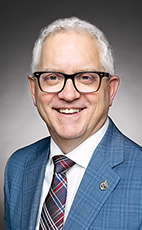
House of Commons photo

Crucial Fact

  • His favourite word was saskatchewan.

Last in Parliament April 2025, as Conservative MP for Desnethé—Missinippi—Churchill River (Saskatchewan)

Won his last election, in 2021, with 49% of the vote.

Statements in the House

Lobster Fishery Dispute in Nova Scotia October 19th, 2020

Mr. Speaker, earlier tonight, the member for Kamloops—Thompson—Cariboo eloquently stated that there is a history of failure on behalf of many governments on some of these issues, and I think she took ownership of that.

Let me point out for the member that it was under the Harper government that the apology for residential schools was enacted. It was under the Harper government that the Truth and Reconciliation Commission was founded. The calls to action that come from that, which are now being addressed and being implemented by many governments, are because of that initiative.

Let me also just say that we can continue to point to the failures of governments from the past, but the current government has been in power for five years. For the Liberals to simply keep pointing the finger at somebody prior to them is no longer a good excuse.

Lobster Fishery Dispute in Nova Scotia October 19th, 2020

Mr. Speaker, the reports of and the video showing conflict, including the burning of trucks and buildings, coming from Nova Scotia are indeed very disturbing. First nations people across Canada are justifiably angry at the actions or inaction from the Liberal government and its lack of leadership in directing the RCMP.

Let me be clear. While the government has, without question, failed to handle this crisis appropriately, violence, vandalism, assault, threats and intimidation tactics are wrong and are never justified. The safety of all Canadians must be the government's top priority. The Prime Minister and his government are not taking the concrete actions necessary to keep all Nova Scotians safe in their communities and to peacefully resolve this situation.

Senator Murray Sinclair, the former chair of the Truth and Reconciliation Commission, had this to say yesterday, “I'm disheartened by the fact that the government's leadership—the leadership of this country—is not stepping up to the plate.”

A month ago, the Leader of the Opposition raised this situation directly with the Prime Minister. He told us about that again tonight. He asked the Prime Minister to step in and de-escalate tensions, and find a solution. Chief Sack, who himself has been assaulted during these demonstrations, released a statement that the arson “illustrates the need for greater police presence in the region....I do believe with the proper police presence, however, this could have been avoided”.

During Oral Questions earlier today, my colleague from Lakeland, the shadow minister for public safety, asked the minister why it took him so long to act and to ensure the safety of the Mi'kmaq people. Why did it take a very serious act of arson for the government to act? This sort of after-the-fact crisis management seems to be the only way the government deals with issues. Why is it that almost all affected groups can agree that the path forward is open and honest dialogue, yet it is the path that the government seems unwilling to take?

I agree that this situation is in fact an emergency, but the fact that the ministers in the government have requested an emergency debate perfectly sums up the government's preference for symbolic measures rather than actions. In my meetings and discussions with indigenous people I deal with, what I am hearing is that they are tired of the government's talk. They need action. Instead of debating this in Ottawa today, participating in press conferences and repeating talking points here in the House, these ministers should be on the ground in Nova Scotia, talking to the people there.

Many people have compared this situation to others earlier in the year, however, the similarities begin and end with the lack of proactive leadership. These issues have been allowed to simmer over a long period of time, with groups from all sides calling for action and leadership from the government. Instead of early actions, what consistently happens is that these simmering issues become full-blown fires that result in political talking points, finger-pointing and crisis management, rather than respectful dialogue and peaceful negotiations.

What do we see in Nova Scotia at the moment? I know I am a long ways away, but here is what I am seeing. The Minister of Fisheries, Oceans and the Canadian Coast Guard, who lives in the same province that this emergency is taking place, is now holding press conferences and calling for late-night debates in an attempt to distract from the fact that she and her government have mishandled this issue for months.

Canadians are tired of this, and they are not buying it anymore. This is not a new issue. The Liberals have now sat on the government benches for five years. As a result of their failures, we now have seen people injured, property damaged and livelihoods challenged. Tensions between indigenous and non-indigenous fishermen are at an all-time high in this region.

I would never pretend to speak for first nations people, however, my experience growing up in northern Saskatchewan showed me that relationship-building is important and valued. It is something that I think all Canadians could learn from. That is why it is counterproductive for the Liberal ministers to be here in Ottawa debating this issue, rather than meeting with people on the ground, and developing real and authentic relationships, working towards actual solutions. The last thing this issue needs is more political debate. It needs actions.

In both Marshall decisions in 1999, the Supreme Court of Canada clearly affirmed the right of the Mi'kmaq to hunt, fish and gather in pursuit of a moderate livelihood arising out of the peace and friendship treaties of 1760 and 1761 with Britain. However, there were restrictions outlined by the court, and the Department of Fisheries and Oceans was to regulate.

First, this is where the term “moderate livelihood” is first introduced. In the Marshall decision, the Supreme Court of Canada wrote:

Catch limits that could reasonably be expected to produce a moderate livelihood for individual Mi’kmaq families at present-day standards can be established by regulation and enforced without violating the treaty right.

The Premier of Nova Scotia has now joined the call of many others for the government to seek a definition of present-day standards of “moderate livelihood”, and to give guidance to all of the parties. Premier McNeil stated, “This is only getting more entrenched...they need to be in the same room so everyone knows what each other is saying”. Instead of seeking this clarity, the government has decided to hold press conferences and late-night debates. Again, there is talk but little action.

Second, the Supreme Court of Canada outlined that the Department of Fisheries and Oceans has the responsibility of ensuring proper conservation. I quote:

The regulatory device of a closed season is at least in part directed at conservation of the resource. Conservation has always been recognized to be a justification of paramount importance to limit the exercise of treaty and aboriginal rights in the decisions of this Court cited in the majority decision of September 17, 1999, including Sparrow, supra, and Badger, supra. As acknowledged by the Native Council of Nova Scotia in opposition to the Coalition’s motion, “[c]onservation is clearly a first priority and the Aboriginal peoples accept this”.

The Minister of Fisheries, Oceans and the Canadian Coast Guard could have requested that her department undertake a study to determine whether the out-of-season fishing endangers lobster stocks and could have made those results public, but instead she and her colleagues chose to hold press conferences and late-night debates. Again, there is talk but little action.

Let me be clear. As I said when I began my comments tonight, while the government has, without question, failed to handle this crisis, violence, vandalism, assault, threats and intimidation tactics are always wrong and they are never justified. The safety of all Canadians must be the government's top priority. The Prime Minister and his government must take the concrete steps necessary to keep everybody in Nova Scotia safe in their communities and to resolve this situation in a peaceful manner.

Pitting groups against each other has only led to the current situation. This issue is not about indigenous versus non-indigenous. All Nova Scotians are being let down by a federal government that has failed to take action and has ignored the issue for five years, and now refuses to meet with all of the parties to come to a peaceful resolution. Make no mistake, the Liberal minister's request for an emergency debate is, as Toronto journalist Chris Selley put it, “jaw-droppingly cynical”. It is purely political and, as they have with all of their failures, all criticism by opposition parties will be labelled as petty partisanship.

In closing, I would hope that members on all sides of the House can agree that it is time the current Liberal government started showing leadership on this issue. It is time that the Liberals move on from the platitudes and empty promises and do the work that Canadians elected them to do.

Indigenous Affairs October 19th, 2020

Mr. Speaker, housing and health infrastructure on reserves across Canada leaves many first nations vulnerable to contracting and spreading COVID-19. The government likes to promote the fact that it has GeneXpert machines available, but it fails to mention that a shortage of cartridges means that only the most urgent cases can be tested in the communities. Other swabs are sent away, and it take days for the results to be returned.

Why did the government not act quickly to procure enough test cartridges to ensure that first nations, and indeed all Canadians, had access to these rapid tests?

Indigenous Affairs September 30th, 2020

Mr. Speaker, earlier this week it was reported that the government is no longer planning to meet its March 2021 target to eliminate long-term drinking advisories on first nations. As my colleagues can imagine, this has left many nations across Canada, including Ministikwan in my riding and Bearskin Lake first nation in northern Ontario, wondering whether indeed they are a priority for the government.

Can the Prime Minister tell us, if not in 2021, when will these long-term drinking water advisories actually be lifted?

Orange Shirt Day September 30th, 2020

Mr. Speaker, I rise today to recognize national Orange Shirt Day.

In 2008, then prime minister Stephen Harper apologized on behalf of the Canadian government for the residential school system and created the Truth and Reconciliation Commission of Canada, both important steps in the reconciliation relationship.

In 2013, Phyllis Webstad provided the inspiration for this day by recounting her impactful story as a six-year-old who had her brand new orange shirt taken away on her arrival at a residential school, never to be returned.

The importance of this day can be seen in Desnethé—Missinippi—Churchill River and across the rest of Canada, where students of all ages learn of the historic injustice of the residential school system. These discussions, questions and activities that students participate in will continue into the homes and around the supper tables of families across the nation, providing an opportunity for our younger generation to take a leadership role in reconciliation.

I hope all members will join me in recognizing that every child matters.

COVID-19 Response Measures Act September 29th, 2020

Mr. Speaker, I want to thank my colleague for her question, and I apologize but I will answer in English as I do not speak French yet. I am working on it.

I would agree 100 per cent with my colleague's comments. This is a massive change to the Labour Code. In many ways we are concerned about a conflict with provincial jurisdictions, employers, boards of trade and chambers of commerce. None of these people was engaged. None of these was consulted. This was put before us to pass in a very short time frame, under a bunch of pressure at the 11th hour.

I would 100 per cent agree that there are some really deep concerns when we talk about the WE scandal. One of the comments I have consistently made is I am afraid that all we are seeing is the tip of the iceberg. When we spend hundreds of billions of dollars in a short time frame, how many other WE scandals are under the surface?

COVID-19 Response Measures Act September 29th, 2020

Mr. Speaker, I appreciated the speech with the short question at the end.

First, let me make very clear, as I said in my comments, that any compassionate society and its leaders have a moral obligation and responsibility to care for those in need. However, from the stories I am hearing, the people in my riding are very concerned about the level of support that has been offered. When we talk $33 billion in one quarter, in excess of the lost wages, we have gone way beyond the goal of replacing income.

I have four kids, three of whom have spouses and one who has a significant other, and I have my first grandchild. That makes 11 of us. This current year of government spending, not including some of the new stuff that will happen over the coming months, means that my family of 11 people has taken on $110,000 of new debt. That terrifies me for my grandchildren.

COVID-19 Response Measures Act September 29th, 2020

Mr. Speaker, I will be splitting my time tonight with the member for Sherwood Park—Fort Saskatchewan.

In 2019, my pitch to voters in northern Saskatchewan was that I would take my experience as an accountant, a multi-term mayor and a Crown corporation chair to Ottawa and represent the people of northern Saskatchewan to the best of my ability. In my relatively short time of service I have said to many of those around me that if I had run my business like the current government governs, I would have been bankrupt a long time ago. If I had shown the same contempt for my elected council as the Liberal government has for the elected members of this House, I would have had a mutiny and would definitely not have survived multiple terms as mayor.

Over the past several months the Liberals have shown a pattern of leaving things until the midnight hour and then essentially holding Parliament hostage to get their legislation passed. We have seen four examples of this: one in March, two in April and one in July. When I wrote this, little did I know how true the midnight hour comment would be as we see this literally playing out tonight.

Here we are on September 29 and the government is looking for approval for over $50 billion in spending with very limited time to either scrutinize it or for us to offer suggestions for ways to improve it. Each time this happened the line always was, “We must do this quickly or else.” Each time it meant there was no time for scrutiny and we should just trust the Liberals as they know what is best for Canadians and they do not need feedback from Canada's elected representatives in this House because they have got this.

Announcing these proposed measures the day after shutting down Parliament and then waiting until after the CERB ended to introduce the legislation seems a little suspicious to me. We definitely do not need any committee work on this; after all, committees are a bit of a thorn in the side of the Prime Minister, are they not? I do not know if members see a pattern here, but I do.

There is a second pattern here that is not just about this but about timing as well. There is a pattern where a lack of oversight and transparency is desired by the government, and it goes back further than the pandemic. In my very first experience as an MP, I was asked to participate in a committee of the whole proceeding on December 9, 2019, when we were asked to scrutinize over $4.9 million in a mere four hours. My first reaction was, “Seriously?” In my role as the mayor of my little city, we spent many hours and even days scrutinizing spending and I can assure members we were not dealing with numbers of this magnitude.

Let me fast forward a bit. I will never forget at the beginning of the pandemic when the government attempted to give itself unfettered powers to December 31, 2021, by slipping these powers into the very first emergency legislation. Members can call me naive if they would like, but I could not believe that any elected official would have the nerve to try and pull off something like this. I asked myself over and over in the days following who was crass enough to think that this was somehow a good idea and that it would fly.

The Liberals clearly have an issue with any kind of openness and transparency. As the old saying goes, actions speak louder than words. May I be so bold as to suggest that a bit more scrutiny may have actually prevented some of the scandals we are seeing. May I be so bold as to suggest that a little more consultation up front and a better parliamentary process might have led to, for example, indigenous businesses being included in the original business supports, like CEWS and CEBA, instead of being added only as an afterthought when they were left out of the original legislation. This is the relationship the Prime Minister likes to repeatedly say is the most important one to his government. If that is in fact so, why did it take weeks of pressure and lobbying to have indigenous-owned limited partnerships included in CEWS? Why did it take months for indigenous businesses to have access to a version of CEBA when a little consultation would have clearly identified that the original version would not work for them as they do not utilize traditional banks.

The same point could be made about many small businesses and farmers as well. A little consultation would have easily determined that there was going to be a significant problem preventing many of them from accessing CEBA. This literally took months to resolve, leaving many fearing for their ability to survive.

Yesterday, my colleague, the member for Thornhill, shared some very wise words in his speech. I think they are worth repeating, so I will quote one paragraph. He said:

The COVID crisis is not just a health crisis. COVID has taken a terrible toll on our Canadian economy, as it has on economies around the world. Canada today has the highest unemployment rate in the G7, despite having almost the highest spending in the G7. With the amendment to Bill...[C-4], now before us today, Canada's deficit and debt would soar to historic record new levels.

Yesterday, I asked the people of my riding a question on social media. I asked what I should say to the government when I had an opportunity to speak today. Their number one answer was, “What is the plan for all the spending?” They then added that when someone takes out a loan, the lender wants to know how it will be paid back, along with other criteria. It is an interesting concept, that of a plan. What a novel concept. The answer I am giving my constituents is that I do not believe there is a plan. There is no plan to ever balance the budget, let alone repay any of the debt incurred.

Former Saskatchewan NDP finance minister Janice MacKinnon co-chairs the C.D. Howe Institute's Fiscal and Tax Working Group with former Liberal finance minister John Manley. In a recent report, they urged the federal government to set limits on spending and ensure that when spending is approved, it is truly necessary and contributes to Canada's longer-term productivity. That sounds like a plan.

In a recent Globe and Mail article, economics reporter David Parkinson shared some very interesting thoughts with us. He talked about the misery that was the second quarter of 2020. He talked about the lost quarter. He then referenced an 11.5% plunge in gross domestic product, which is the worst quarter-to-quarter decline ever.

Millions of Canadians are out of work, more than double the pre-pandemic unemployment rate. However, in the midst of all this, Canadians' incomes actually grew. Details contained in the last quarterly gross domestic product report revealed that household disposable income in Canada surged by 11% in the second quarter. That obviously led to the question of where this surprising income explosion came from. It certainly was not wages, because they tumbled by almost 9%. The answer is that federal government crisis income supports more than filled that income hole.

The employment compensation in our country was reduced by $21 billion, but disposable income went up by $54 billion in government transfers. That is astounding. This tells us that the government response has gone way beyond the goal of simply replacing lost income.

Let me be really clear: Some will take my comments to mean that I do not believe that some of the extraordinary emergency funding was needed, and continues to be needed to support Canadians in their time of need. Nothing could be further from the truth. Any compassionate and just society has a moral obligation to help people in a time of need.

However, I am a little bit dismayed by the lack of transparency and accountability displayed by the government. I am dismayed by the unacceptable snub of Parliament, and by the time lost during the unnecessary shutdown for all to consider debate and more reasonably determine some outcomes. I am dismayed by the constant rush to ram legislation through the House when in fact the rush is simply one of partisan, self-serving survival.

Finally, I am dismayed by the lack of a plan. What is the plan for our future that I can take back and share with the residents of Northern Saskatchewan?

Proceedings on the Bill Entitled an Act Relating to Certain Measures in Response to COVID-19 September 28th, 2020

Mr. Speaker, several times over the last seven months the government has left to the very last minute the introduction of legislation to provide supports for people. Does it seem appropriate to leave everything until the last minute and then in essence hold Parliament hostage to get the results it is looking for?

Indigenous Affairs September 25th, 2020

Mr. Speaker, during the pandemic, I have heard many stories of how the government has left out or left behind indigenous businesses. CEBA and CEWS are just two examples.

Last week, I attended a recovery forum hosted by the Canadian Council for Aboriginal Business. Many there expressed frustration resulting from the government's failure to meet a target of 5% procurement for indigenous-owned businesses.

When will the government allow indigenous entrepreneurs to share in Canada's prosperity?