
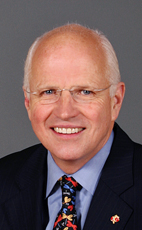
House of Commons photo

Crucial Fact

  • His favourite word was veterans.

Last in Parliament March 2011, as Conservative MP for New Brunswick Southwest (New Brunswick)

Won his last election, in 2008, with 58% of the vote.

Statements in the House

Supply October 28th, 2004

Mr. Speaker, I thank the Bloc for bringing the motion to the floor of the House of Commons. It is very timely because the area of equalization is a hot topic in the country, particularly in Atlantic Canada.

So people in the listening audience can get their heads around the issue of equalization, it is a program that we developed in the country many years ago. It states that the wealth of the country should be shared by all provinces, rich and poor alike. It levels the playing field in terms of fairness and delivery of government programs and quality of life. That is the short explanation.

We depend on the generosity of those provinces that are doing better, and we congratulate them. There is a level of generosity in our country. That is what differentiates us from the United States of America. For example, if one is living in Mississippi, a poor state, one will always be poor. There is not the same level of generosity within that country as we have in Canada.

We recognize the importance of the equalization program. We want to see it continued, and our leader has stated that. During the last election is where the Prime Minister got himself in trouble. We are saying that revenues generated from the offshore oil and gas resources should be allowed to stay in Newfoundland and Labrador and Nova Scotia. It should not be clawed back by the Government of Canada in the equalization formula. In other words, we do not want to keep those poorer provinces in poverty in perpetuity.

I will quote from a document my leader put out. It said, “One of the conditions the Prime Minister wants is that Newfoundland and Labrador would have to commit to a cap”. In other words, it only can have the money if it promises to remain a have not province. He asked what I think is a legitimate question, which really goes to the heart of the debate. He asked, “Why does this government want the Atlantic provinces to share in the poverty and never in the prosperity?”

This debate is all about that. The Liberals are in an absolute state of denial. We know they are in trouble politically because they have said so themselves.

I want to go through some of what the members from Newfoundland have said and what some of the editorials have said.These editorials are coming out of Atlantic Canada. I will quote from an article in yesterday's Western Star , of Corner Brook, Newfoundland. The first paragraph starts off by saying:

There has been some speculation that Liberal MPs can kiss their seats goodbye in the next election if the Atlantic accord renegotiation falls through.

It has fallen through. The Prime Minister in the last election knew full well that the bottom had fallen out of his campaign and that the Liberals were in big trouble politically. In the dying days of his campaign the Prime Minister of Canada went to Newfoundland and Labrador and promised it 100% of all the revenue from its offshore resources.

Now that the election is over, the Prime Minister made another Liberal empty promise, which he is used to doing. His objective was achieved. He is still the Prime Minister of Canada and still residing at 24 Sussex Drive. He got exactly what he wanted. He did that knowing full well that he would come back to the House and go back to the premiers and renege on that promise. This issue is all about that.

Yesterday in the House we heard the member for St. John's East refer to his colleague from Newfoundland, who happens to be the Minister of National Revenue, as the Benedict Arnold of Newfoundland.

Supply October 28th, 2004

Mr. Speaker, I listened very closely to the member and he said that there is no limit to the taxing powers of any province. Who but a Liberal could say that? Think about it. There is no limit.

He is here trying to confuse the public, and I might say members of Parliament, on this nonsense of vertical and horizontal fiscal imbalance. Try to figure that one out. There is no logic to that argument at all. This is typical Liberal double-talk.

Double-talk coming from that side of the House is not an unparliamentary expression. It is a word that is acceptable in this place, simply because there is so much of it going on over there. We have become used to that kind of double-talk. That is exactly what this whole issue is about.

The Prime Minister, in the middle of an election, where the bottom had fallen out of his campaign, simply trotted across the country from one end to the other making any promise he had to. What was the reason? It was to stay in power and to win more seats, to sit at 24 Sussex Drive at the expense of anyone else, including the Canadian public.

This is the kind of nonsense that we get from a member of Parliament, who obviously as an individual is a very bright guy. However, imagine a man with that intelligence coming to this place singing from the Prime Minister's songbook. It is just unbelievable. He might as well go home and start knocking on doors.

Supply October 28th, 2004

Mr. Speaker, I rise on a point of order. I have been listening to my hon. colleague with great interest, but I think the folks back home and some members in the House are somewhat confused by his definition of horizontal and vertical tax structures. Would the member explain that a little more carefully because I want to respond to that in questions and comments?

Atlantic Canada Opportunities Agency October 22nd, 2004

Mr. Speaker, unfortunately, I am referring to the Liberal member of Parliament for Miramichi who says the agency is out of control and he wants to shut down the types of activities that the minister is engaged in.

I might remind the minister that Mr. Spector was the head of ACOA on the present government's watch and he has specifically accused former ministers like Mr. Dingwall. Does that ring a bell on the other side of the House? I am afraid it does. He was a Liberal minister of the agency.

What will the minister do to stop that type of cronyism?

Atlantic Canada Opportunities Agency October 22nd, 2004

Mr. Speaker, when Liberal MPs protest publicly about patronage and unfairness with ACOA funding, most of us would agree that the problem is real. Sadly, this minister continues to follow in his predecessor's footsteps. The types of cronyism and unbridled patronage the government pretends it wants to eliminate still exist.

My question for the minister is, what steps is he, his department, and the government taking to end that type of unbridled patronage?

Questions on the Order Paper October 20th, 2004

Mr. Speaker, in relation to the questions on the order paper, I want to bring to the attention of the House and the parliamentary secretary that I have had the same exact questions on the order paper, going on two Parliaments. In fact they date back to last year in regard to the aboriginal fisheries buyout program from DFO, which DFO sponsors.

There are a number of questions on there which the government should have answered before the last election, but chose not to do that. The government worked very hard to ensure that it did not have to answer them, hoping that I would not be back in my place in the House and hoping the questions would not be back. Surprise of all surprises: I am back and so are the questions.

I believe the government is obligated to answer those questions. They are very thoughtful in their presentation, well laid out and there is nothing complicated about them. I would like to know why the government's reluctance in answering the questions. It is completely unacceptable.

Income Tax Act May 13th, 2004

Yes, Mr. Speaker, I am aware of that. As the parliamentary secretary knows, that is sort of a band-aid solution to the problem. We are suggesting a solution that will be long-lasting and that will serve the needs of Campobello so that these interruptions do not occur as frequently as they do.

I am suggesting a recognition that the goods leaving Canada for Campobello Island are in fact Canada to Canada transportation needs, not Canada to the U.S. Somehow we cannot seem to get that through to the Americans. I am saying that our inspection process is the best in the world. Americans recognize that so let them put their money where their mouth is and accept our inspection process and allow those trucks to travel unencumbered to the United States.

The point that I often make with our officials is that if it is good enough for General Motors to General Motors, that is General Motors Canada versus General Motors United States, the same for Ford and Chrysler in terms of parts and shipment of cars, goods and services, it should be good for Canada to Canada.

I believe the solution that I propose is very workable without getting into the details. I am hoping the minister and her officials push that plan with their American counterparts for a long-lasting solution to this very irritating cross-border problem.

Income Tax Act May 13th, 2004

Mr. Speaker, as you well know, this is what we often refer to as the late show. I am glad you put me on notice that the late show would be early. I appreciate your generosity. In fact I guess this could be the last “late show” in the House if things happen as we expect over the next couple of days.

The reason we are here tonight, obviously, is to talk about an issue I raised with the Deputy Prime Minister a week or so ago in the House. It was the issue of island of Campobello. It is an interesting spot. In fact it is the only spot in Canada that we have to access through another country and that other country is the United States of America. We have to travel approximately 60 miles or so to get to another part of Canada. That creates unusual problems for that part of Canada. Campobello Island experiences problems that no other part of Canada experiences, simply because of transporting goods from one part of Canada to another.

The BSE crisis has created unusual problems for Campobello Island. Many products are held up at the border, and many products which contain beef products are held up at the border. In fact many of the shipments of food supplies to that island are held up unnecessarily.

In addition, the homeland security department in the United States of America has put in unusual practices which have to be performed to the letter of the law to allow shipments of goods and services to that island.

I brought this to the attention of the minister on January 29 in letter that outlined in detail the problems being experienced by the citizens of Campobello Island. If members will remember correctly, February 2 was the first day the House came back in session following the Christmas break.

I talked to the minister personally, on the floor of the House of Commons, in regard to Campobello Island. The minister, at the time, understood the problem. She said that she had received my letter and was interested enough to suggest that her officials would drop into my office to work out a solution to the problem.

After questions to the minister, those officials eventually did show up in my office and I outlined my plan for resolving this issue, in absence of a government plan, because the government had no plan. It is kind of a fix it up, patch it up, band-aid solution to some of these problems that interrupt the flow of people, goods and services to the island of Campobello. I believe my plan is workable and the minister's officials believe it is workable. As we speak, Canadian officials are meeting with our Washington counterparts to find a resolution to this, based on some of the ideas I have proposed.

The plan I suggested is simply this. Canadian officials, that is CCRA officials, often referred to as our customs officials, would inspect those shipments of goods going to Campobello Island and seal that truck. The Americans, Tom Ridge and the American Ambassador included, have suggested that the Canadian inspection system is good and that it works. If they believe that, I suggest they allow Canadian officials to inspect the loads and seal them at the border. That inspection seal would be recognized by the Americans and they could allow the transportation of goods unencumbered to the other part of Canada called Campobello.

I believe the process will work, and it will requires a level of cooperation by the Americans to ensure that it does. Let us see what happens. Let us give that process a chance.

Question No. 85 May 13th, 2004

Mr. Speaker, in all fairness, that 45 days means nothing. We are at least a week, maybe seven days from an election call, maybe less. That is irrelevant. We want those questions answered. Will the government do it between now and the election, yes or no? That is all we want to know.

Question No. 85 May 13th, 2004

Mr. Speaker, I rise on a point of order. I have been up on this point of order a few times.

It relates to questions on the aboriginal fisheries and the buyout of non-traditional fishing licences. The point that I make is that the parliamentary secretary gets up on his hind legs and suggests that because it was not starred, over 45 days is acceptable.

We know we are on the eve of an election. He knows full well that question will not be answered until after we go to the polls. I think the government, with its thousands of employees, could answer that question this afternoon. It is not complicated. We want those answers before we go to the polls. There is no statistical data to either support that program or reject it, and it has a huge impact on both traditional and non-traditional fishers.

I believe that--