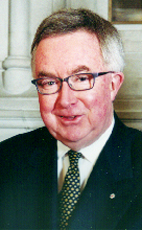
House of Commons photo

Crucial Fact

  • His favourite word was commons.

Last in Parliament May 2004, as Progressive Conservative MP for Calgary Centre (Alberta)

Won his last election, in 2000, with 46% of the vote.

Statements in the House

Supply March 20th, 2003

Mr. Speaker, to answer the question very specifically, I did not consult them but I am certainly aware of the diversity of opinions on the question of the interpretation of the resolution.

I am persuaded by the U.K. interpretation, which begins with resolution 678 passed in 1990 that authorized all necessary means, which is the euphemism in the United Nations for force. It was then suspended by resolution 687. Resolution 687 required certain conditions to be met and those conditions have not been met. Therefore Saddam Hussein is clearly in breach of that.

This brings us back to resolution 678 which authorizes the use of force and which resolution was referred to specifically in resolution 1441.

Next to the member for Okanagan--Coquihalla, I am the most prominent non-lawyer in the House of Commons and I do not pretend to argue the legality myself. There are a variety of views and one has to come to judgments about them. I believe that the argument made by the British and by others is a compelling argument that brings legitimacy to these actions.

Supply March 20th, 2003

Mr. Speaker, I will not argue legal opinions with the hon. member. He has far more experience in that regard than I do.

He raised two questions. My position has always been that I would support action within the context of the United Nations. I made very clear in my remarks today that, on the question of the interpretation of the resolutions of the United Nations in 1990 and again resolution 1441, I believe the action that has been taken by the United States, by the United Kingdom and by others is legitimate under the United Nations. I would support the legitimacy of that action.

With respect to the question of reconstruction, this is a very important issue. It is important on two fronts. First, there is a question as to whether or not we should leave the pooling together of what has been torn apart to the superpower that was principally responsible for the tearing apart. I think that superpowers have unusual capacities but reconciliation is not one of them. We need to have an instrument that can carry out reconciliation. I would like to see that done by the United Nations.

With respect to motives, I am concerned about some of the thinking that exists in the pentagon with respect to the re-creation of society along American values in the Middle East. I believe that is a very risky undertaking and certainly I would not want Canada to sign on blindly to that sort of notion.

However, in order for there to be an alternative to the pentagon as the instrument of reconstruction, then some respected nation has to start the process right now to put the United Nations in a position to authorize reconstruction under United Nations auspices. It does not have that power now. Nobody is seeking to do it. It is an ideal role for Canada and we should be on it right now.

Supply March 20th, 2003

Mr. Speaker, on the contrary. I believe there are certain obligations in international affairs and, when one has to take a tough decision affecting another country, one has to have the courage to go and tell it.

When we took the tough decision regarding the United States not to accept the strategic defence initiative, we did not have a deputy minister phone the ambassador. We talked to the president directly. I talked to the secretary of state directly. That is what courage is about. That is not what happened in this case.

The hon. member, who pays very close attention to these matters, misunderstood what I was saying about the coalition of terror, and that was probably my fault. What I was saying was that the actions that have been taken, without assigning blame for who took them, has broken the consensus in the coalition of terror and we need to restore it. Canada has the unique role, I believe, of restoring the sense of that coalition as it does in NATO and elsewhere. That at least is what I intended to say.

The major point I want to make has to do with whether or not the action that has been taken by the United Kingdom, the United States and by others is an action that is within the authority of the United Nations. I believe it is.

I asked the Government of Canada to publish its own legal opinions, which it did not. I have noted that the foreign minister has said that the question of legitimacy does not matter. I think the question of legitimacy matters profoundly. I think this is an issue, and others can disagree, but I believe, as the British government and as others do, that this action is in fact consistent with a combination of resolutions that were taken by the United Nations and it is, therefore, a legitimate action under the United Nations.

Consequently, the Prime Minister is wrong to say that he alone is defending the United Nations. I think in fact he is stepping aside from an action that is legitimate under the United Nations.

Supply March 20th, 2003

Mr. Speaker, it is with some regret that I rise to address the only issue all parliamentarians wish to avoid during their political career.

Last night, the first bombs were dropped on Iraq. Diplomacy has failed, and we are now caught in a war that the whole world wanted to avoid. I regret the military invasion now under way. I regret that the United Nations was unable to bridge the gap.

But now we are before a fait accompli, and Canada must turn to the future.

Whenever a major international issue arises we must ask, what are Canada's interests here and how are they best served?

The conduct of the Canadian government on Iraq has severely damaged three of our most important interests. The most evident damage is that the government has gone out of its way to offend the foreign country on which the lives of our citizens most depend.

It is not wrong to disagree with the United States.

As foreign minister, I disagreed with them directly and openly on “star wars”, on Nicaragua, on South Africa, on our sovereignty in our north, on human rights, and other issues.

What is wrong is to deliberately insult the United States in the process, both by the intemperate statement of ministers and senior officials and by the Prime Minister's simple lack of courage in not calling the president himself to advise that Canada, in the Prime Minister's signature phrase, “would not participate” in dealing with a regime we know is deadly.

That was simply bad manners. One consequence is that ordinary Canadians will pay a high price for a long time on softwood, on wheat, and on other economic issues. They will pay a high price in discrimination, harassment, and suspicion along our most important border.

The government's carelessness has harmed two other fundamental Canadian interests. We were once known as a country that acted on principle, not just on polls or domestic popularity.

War is always inhuman. The real issue with this war is whether it is legitimate in international law. As the member for Winnipeg--Transcona and others indicated, serious scholars disagree on that issue.

In the absence of formal legal opinions from Canada's government--I asked but it would not provide them--I believe that existing Security Council resolutions give the legitimacy of the United Nations to this intervention. I accept the considered view of the government of the United Kingdom that the combination of resolutions 678, 687 and 1441 provide the authority required. However, for the Government of Canada the question of principle does not matter.

The foreign minister says, and repeats, that for moral, principled Canada “it is not a matter of determining whether military action is legitimate or otherwise”. What if we had said that about Tiananmen Square or about South Africa, or about human rights? Canada was once a country that set the highest standard of respecting international law, but the government does not care whether the action is legal or illegal. We have blown away one of Canada's most important and distinctive credentials.

Finally, in two world wars, and in Korea, and from Lester Pearson forward in diplomacy, Canada was a country which others could count on for international leadership. When Suez devastated the existing international order, Canada led in the creation of peacekeeping. When relations between the United States and Europe were strained and divided, Canada led in the creation of the North Atlantic Treaty Organization. We led in the Rio conference on the environment. We led in official development assistance. We led on South Africa. We took our place at the Organization of American States. We led in trade negotiations. We led in the gulf. That leadership gave us a status and an influence well beyond our power. However, the government does not lead and Canada pays the price.

Our military spending is a dangerous joke. Our foreign aid has been cut by the government to nearly the lowest levels in the developed world. We have become, on international issues, the invisible country.

The Prime Minister chose his words quite carefully in his statement Monday. He said, “Canada will not participate”. His Canada does not participate. It sits on the sidelines without even a view as to whether a major intervention is legal or not. When it comes to pulling together what war has torn apart, the Prime Minister wants to wait for the bombs to drop. He wants to wait for more Iraqis to be killed before he takes any action on the reconstruction of Iraq.

We know that as a result of the tensions of the last two months, NATO is torn and the next meeting of the G-8 is in doubt. The United Nations and the Security Council are divided. The coalition against terrorism has been shaken. All of those are essential to Canada. Yet Canada is doing nothing to repair the damage. Canada, under the government, “will not participate”. Lester Pearson would hang his head in shame.

I believe the United States and Britain should have given the UN inspectors more time. I believe the Prime Minister of Canada should have intervened directly with the presidents of France and the United States as former Prime Minister Mulroney did so effectively in the gulf war. I believe the reconstruction of Iraq is too important to leave to a Pentagon that wants to experiment with transplanting American values throughout the Middle East.

Most urgently, I believe Canada has a unique opportunity to shape the outcome of the drama by taking the lead right now to ensure the United Nations and not any single country has primary responsibility for the sensitive work of reconstruction. Reconstruction is more than building roads and dams. It involves bringing together different people and respecting those differences. It involves having the reputation of someone who can be trusted to respect differences.

There is only one organization now mounting to deal with reconstruction and it is the Pentagon of the United States. That is not adequate. The United Nations must be given the power to do that. It does not have that power now. Canada should be acting now to ensure that there is a consensus in the United Nations to allow a Security Council resolution that would establish the United Nations as the instrument of reconstruction in Iraq and wherever else devastation occurs.

Let us get on with that future. Let us stop, if I may speak to the motion of the Bloc, pretending that this conflict was in the motion's words “initiated by the United States”.

War is regrettable, but the United States did not initiate these actions.

One man is responsible for today's events. One man has defied the international community for over a decade. One man carries the burden of the suffering of his nation. That is Saddam Hussein.

That is where I believe my colleagues in the Bloc Québécois went terribly wrong. Their motion points the finger at the wrong man and lays the blame squarely at the wrong doorstep. Their motion would tie Canada's hands should a cornered Saddam Hussein do the unthinkable.

Let us stop pretending that Saddam Hussein is a victim.

Remember the Kurds he killed. Remember his war with Iran. Remember his invasion of Kuwait. Remember his slaughter of his own people. Remember his stark and steady defiance of the resolutions of the United Nations. Let us remember that blame is a game for the sidelines. Historically on international issues Canadians made hard judgments so we could act in the arena where history is decided.

The government's simple lack of courage and refusal to take hard decisions has meant we have had very little influence on the war. Let us now not squander our opportunity to help shape the reconstruction and the peace.

Points of Order March 19th, 2003

Mr. Speaker, I understand the games that are being played here. I applaud the ingenuity of both the member for Winnipeg—Transcona and, if I may say so, the loquacity of the Chair on this matter.

However, I would regard this as an intrusion in the affairs of another legislature which we would profoundly resent were it to occur from a provincial House.

Consequently, if a motion of that kind were put, I would deny unanimous consent.

Iraq March 19th, 2003

Mr. Speaker, that is some progress from yesterday.

On Monday afternoon the Prime Minister finally announced a policy on Iraq. Monday night the foreign minister said “that is Canada's policy at this time”.

Yesterday the minister said “Our position has to reflect the reality on the ground at any one time”. That can only mean that the government is prepared to change its policy again.

Will the Prime Minister tell the House if there are circumstances in which Canada would change the position the Prime Minister stated on Monday and, if not, then why is the foreign minister saying that this is a policy only for this moment, this time?

Iraq March 19th, 2003

Mr. Speaker, in the 1995 referendum campaign in Quebec, the Prime Minister said “don't worry, don't prepare, wait”, and then he nearly lost the country.

Yesterday, with a war hours away, this head-in-the-sand Prime Minister said “before working on reconstruction wait for the war to start”. Other countries are not waiting. The Canadian Red Cross is not waiting.

How many bombs must fall? How many Iraqis must die before Canada uses our undoubted influence to put the United Nations in a position to lead any reconstruction efforts?

Points of Order March 18th, 2003

Mr. Speaker, am I then correct in assuming that it would be appropriate in the future for members of the opposition to put questions to ministers with respect to their former portfolios?

Points of Order March 18th, 2003

Mr. Speaker, I wonder if you could satisfy my curiosity as to why in question period a question put to the Minister of Health was answered by the former minister of health.

Iraq March 18th, 2003

Mr. Speaker, there was a time when Canada had a policy to do something other than wait for others to lead.

Last night, Sir, Canada's position on Iraq changed again. The foreign affairs minister said, and I quote him precisely, “...at this time we do not believe that the use of force would be appropriate without a clear indication from the Security Council itself...”. Why did the minister say “at this time”? Are there circumstances in which the Prime Minister would change the position he outlined yesterday?