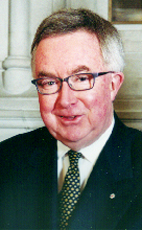
House of Commons photo

Crucial Fact

  • His favourite word was commons.

Last in Parliament May 2004, as Progressive Conservative MP for Calgary Centre (Alberta)

Won his last election, in 2000, with 46% of the vote.

Statements in the House

Iraq March 18th, 2003

Mr. Speaker, Canada's policy on the war is to stand aside, but we cannot stand aside from putting back together what war will tear apart. I hope the Prime Minister would agree that the work of reconstruction in Iraq and its neighbours would be best coordinated by the United Nations and not another country, but the UN would need specific new authority from the Security Council to undertake reconstruction.

Will the Prime Minister put his officials to work now on helping prepare a resolution for the Security Council so the United Nations can establish a reconstruction program which other nations could join?

Situation in Iraq March 17th, 2003

Mr. Speaker, I will be sharing my time tonight with the member for Cumberland--Colchester.

The world is on the edge of a war that could have terrible consequences within and beyond Iraq. Of course, one question is, what will Canada do? The larger question is, what will the world do about a brutal regime in Iraq, about a United Nations that is deeply divided, about the threat of weapons of mass destruction?

For his part the Prime Minister today said, “Canada will not participate”. That is certainly his trademark in this world.

Canada has not participated in building a relationship with the United States that would have allowed us to counsel prudence on the president. We have abandoned that role and left it to Britain. Canada has not participated in any serious way in bridging the differences across the Atlantic, a role that caused us to be one of the creators of NATO and which we have now abandoned. Canada has not participated in any significant way in sending troops to Iraq; in fact by sending our scant troops to Afghanistan, we made it impossible to participate in any conflict in Iraq. At the United Nations we waited so long before lobbing in a last minute compromise resolution that it was doomed before the first phone call to the White House.

Let us look very carefully at what the Prime Minister said today when he spelled out his latest version of Canada's position, which is not to participate. He did not talk about international law. He did not talk about the havoc that could be caused if Saddam Hussein unleashed his weapons of mass destruction. He did not talk about the suffering of the Iraqi people. He did not talk about the reconstruction of the region after a conflict that could be horrible. All he said was, “If military action proceeds without a new resolution of the Security Council, Canada will not participate”.

The issue for him is not legality. It is not justice. It is not what is right or what is wrong. It is only a procedural issue. There is not a new resolution, so Canada will stand aside.

The Prime Minister does not even argue that a new resolution is needed. Yet for governments that take these questions seriously, that is a major question. Tomorrow the British government will publish a considered legal opinion which I expect will argue that existing resolutions already give the United Nations the authority it needs to act against Saddam Hussein.

Does Canada have a different view? When the Prime Minister decided that the role of this country would be to stand aside, did he ask the legal opinion of the experts in international law who work for Canada? I asked him that in the House of Commons today and he would not answer. If he asked them, why does he refuse to publish their advice? I suspect that this decision was taken not on the basis of international law, not on the basis of international principle, but on polling done for the Liberal Party in Canada that said, surprise, surprise, war is unpopular.

Of course war is unpopular. So are weapons of mass destruction. So are terrorist attacks on the World Trade Center and the Pentagon. But if everyone stands aside, then those evils prevail.

I personally do not believe there is a direct link between al-Qaeda and the Saddam Hussein regime. Certainly none has been proven. However I recognize that what al-Qaeda did with hijacked aircraft Saddam could do, and has done, with his weapons of mass destruction. For more than a decade he has treated the United Nations resolutions with contempt. Let us be clear, if the Bush administration had not forced the issue he would still be ignoring those resolutions. There would have been no inspections, no chance of removing those weapons peacefully.

I believe it would have been wiser to allow more time for the inspectors to carry out their work. I hoped the Security Council would have found a way forward. I wish Canada had played a larger role and had intervened much earlier, but that did not happen so the question is, what do we do now? The legality of any intervention is key.

Canada's legacy, if I may use that word, is to support international law. Are interventions in Iraq legal? If they are, we should support them. If they are not, we should not. Did the Prime Minister ever ask? Will he publish the opinion of Canada as Britain and other nations publish their opinions?

The next step is for Canada to begin immediately to prepare to put back together whatever Saddam Hussein and his weapons, and a war, might tear apart.

The question of reconstruction is an area of Canada's natural and quite exceptional strengths. We should be spelling out the ways in which we will help rebuild the region again. The British are ahead of us here, too. They have already set out detailed proposals as to how they would help in dealing with reconstruction of the region.

We should be leading other countries which are good at mediation and reconstruction. We should be talking to the Nordics. We should be talking to Japan. We should be talking to countries that have lived through similar experiences, like South Africa. We should be taking initiatives and we are taking none. Canada does not participate under this government.

The United States has set up a reconstruction proposal. Again, let us be frank. That task is better handled by countries and by agencies who are not superpowers. A reconstruction team needs to be built and Canada must play a leading role in building it.

I look forward to an opportunity to expand on that theme later but I want now to pass my time to my colleague from Cumberland—Colchester.

Points of Order March 17th, 2003

Mr. Speaker, I hope the Prime Minister might delay his retreat for just a moment.

The House welcomed, finally, some clarity from the Prime Minister on the government's attitude toward Iraq, but surely, Sir, a statement of that importance should have been given by the Prime Minister on motions or in a formal statement to this House rather than being smuggled into question period in the way that he did it.

Iraq March 17th, 2003

So, Mr. Speaker, international law does not matter. That is consistent with this government.

Today the Wall Street Journal has outlined a United States plan for rebuilding Iraq after a conflict. The American plan would sideline United Nations agencies and rely heavily on U.S. companies. The Prime Minister would know that any initiative by the United Nations to reconstruct Iraq would require a new Security Council resolution. Is it the position of the Government of Canada that a reconstruction of Iraq after any conflict should be left to the United States? Is the Government of Canada proposing any alternative plan and would the Prime Minister tell us what that plan is?

Iraq March 17th, 2003

Mr. Speaker, I listened very carefully to the Prime Minister. He said that Canada would support action only if it was justified by a Security Council resolution. He would know that some in Britain and elsewhere argue that that authority exists in both 1441 or earlier resolutions.

Canada would have secured a legal opinion as to whether such an attack is justified in international law. Has the government secured such a legal opinion and does the government believe that such an attack would be justified in international law?

Points of Order February 28th, 2003

Mr. Speaker, the Minister of Transport in his capacity as acting prime minister referred to documents which he said had respect to a blind management agreement entered into by the former government. He knows that he has the authority of the prime minister of that former government to lay upon table documents which might otherwise be unavailable to the House that pertain to that particular matter. I think it would be in the interest of debate in the House that if the hon. minister has documents that prove his case he table them now in the House of Commons.

Points of Order February 28th, 2003

Mr. Speaker, the Minister of Transport will know that there is a world of difference between a statement outside the House saying something might have happened and the document that I requested saying it did happen.

If the Minister of Transport believes that he has a document which proves his case, let him not rely on testimony from outside the House; let him have the courage to come to this Parliament and lay upon the table the document itself.

Foreign Affairs February 28th, 2003

Mr. Speaker, the minister knows that last allegation is false. But if he believes it is true, he could always table the documents on the floor of the House of Commons that prove its veracity.

I have a question for the foreign minister.

The New York Times reports this morning that the Pentagon is preparing contingency plans for a possible U.S. attack on nuclear power stations in North Korea.

Can the foreign minister confirm that the Government of Canada has information to that effect? Will he indicate whether the Government of Canada is aware of such plans? Will he outline what Canada's position will be?

Ethics February 28th, 2003

Mr. Speaker, the ethics counsellor has assumed the role of scheduling assistant to the member for LaSalle—Émard. Yet, under the law, as the law is, that ethics counsellor reports only to the Prime Minister. The code stipulates that the Prime Minister has a personal responsibility to ensure that ministers obey the code.

The member for LaSalle—Émard had regular meetings with his giant shipping company.

Did the ethics counsellor provide regular and detailed briefings to the Prime Minister on those meetings? If not, how did the Prime Minister honour his personal obligation to enforce the--

Ethics February 27th, 2003

What I am asking, Mr. Speaker, is that they publish documents they have so the public can be advised of just what was going on, what the former minister of finance knew and when he knew it. The ethics counsellor has said that the purchase of three new ships for the Jawa power company in Indonesia could have put Canada Steamship Lines at risk. He said that purchase justified briefing the then minister of finance.

In March 2002, Canada Steamship Lines bought three other ships, this time for its Great Lakes operations. Could the acting Prime Minister tell the House whether the former minister of finance received a briefing as a result of this three-ship purchase as well?