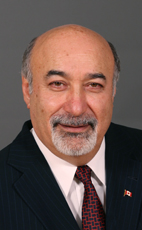
House of Commons photo

Crucial Fact

  • His favourite word was billion.

Last in Parliament March 2011, as Liberal MP for Scarborough Centre (Ontario)

Lost his last election, in 2011, with 32% of the vote.

Statements in the House

Income Trusts May 16th, 2007

Mr. Speaker, the member is right. It is shameful. Even members of the Conservative Party are saying it is shameful. It just goes to show that they finally saw the light.

Nancy Hughes Anthony, the president of the Canadian Chamber of Commerce, whom that party supports and we support as well, had this to say:

The proposal appears to be driven by revenue enhancement rather than a desire to build a competitive advantage.

Let me explain that. When she says revenue enhancement, the Conservatives promised they were going to give a one per cent reduction in the GST. They knew right away almost $6 billion would be eliminated from the revenue.

I have said before and I will say again there is a price for civility and it is called tax. A friend of mine said, “I do not want to pay taxes anymore. I am tired of it”. I said, “Great, do not pay taxes, but do not ask for the services that the nation provides. Do not ask for military support. Do not ask for security. Do not ask for moneys toward health. Do not ask for money for infrastructure”.

Last week the member for Peterborough, he too finally saw the light. He read from page 23 of our red book and finally he completed the sentence about our promise to eliminate the GST. He was right, but what those members failed to say was that in the last 13 years we had promised to eliminate the GST and replace it with an equally revenue generating tax. The member was not there at that time. I was, when we offered to the provinces to harmonize it. The Maritimes did. If Mr. Harris and Mr. Klein at that time had wished, it would have been a done deal.

There is so much to say on this file and it just goes on and on.

I was just asked how to build Canada's economy. Let me answer the member from the Conservative Party. When we inherited the mess they left, the Conservatives' blunders, a $43 billion deficit and a debt that was going out of whack, our country was being described as a third world, bankrupt banana republic. We did not complain. We just went to work. We did not raise taxes. We lowered taxes. We created the longest uninterrupted period of growth in the history of our country. More employment was created under the Liberal government than at any other time in the history of our country.

The Conservative Party has finally heard that 91% of the people do not wish to see these types of policies implemented. I would just remind those members that two out of three Canadians did not vote for that party.

I am glad they are changing their minds. I am glad they did on the interest deductibility and hopefully, they will see that our proposal is the right way to go.

Income Trusts May 16th, 2007

moved:

That, in the opinion of the House, in relation to the proposed tax on distributions from publicly traded income trusts or publicly traded partnerships, other than those that only hold passive real estate investments, the government should repeal its planned 31.5 per cent tax regime and replace it with an immediate 10 per cent tax to be paid by such entities with the revenue to be shared equitably with provincial governments provided that the tax would be refundable to investors who are Canadian residents in order to: (a) minimize the loss of savings to Canadians who invested in income trusts; (b) preserve the strengths of the income trust sector; (c) create tax fairness by eliminating any tax leakage caused by the income trust sector; and (d) create neutrality by eliminating any incentive to convert from a corporation to an income trust purely for tax purposes.

Mr. Speaker, as each one of us in this hon. chamber stands to debate this motion, I hope that we do not try to distort what the motion is really saying.

As the leader of the Liberal Party, the member for Saint-Laurent—Cartierville, indicated in his presentation last week, there are two segments to this initiative on behalf of the Liberal Party. When the idiotic and not thought out initiative was suggested by the Minister of Finance, the member for Markham—Unionville immediately commented. As has been said by many people who are not politicians, the member for Markham--Unionville is a recognized economist, a person who in his private life worked in the financial sector, and he could best understand this issue.

All of us have made every effort to understand it. As it is unravelling, not only we as parliamentarians recognize the faults in the finance minister's initiative and the new Conservative government, but average Canadians from coast to coast to coast have picked up on it. I thank the media, because the media have done an admirable job in bringing the facts forward.

People within the industry, representatives of various organizations that I will refer to in a moment, not just within Canada but outside Canada as well, are saying that we are often described as a member of the global community. We are international partners in our responsibility to create a safe society for people to live in both here and abroad. One example is the important mission in Afghanistan which our men and women in the Canadian Forces are undertaking. We have to ensure that the finances of nations are stabilized in order to create the level playing field that we have been encouraging.

Just last week when the Minister of Finance was asked a question he replied that the government wants to create fairness and a level playing field. On the interest deductibility issue, it seemed really odd to us how he was going to create a level playing field when other countries had the same provision for their corporate sectors, and yet it was being taken away from Canadians thus creating an unbalanced playing field for us to work on.

It is not just in this Parliament that this issue has come before us. There was a discussion and an inquiry on this issue in the last Parliament when there was also a minority government. There was talk about looking at what we could do, whether we should change it or leave it alone, et cetera. The member for Scarborough—Guildwood, who formerly was the parliamentary secretary to the minister of finance, provided his input. I also applaud the member for Halton who has been on top of this issue right from day one. He has been very forthcoming with respect to his comments and his information gathering.

I will talk about the last Parliament for a moment. In all fairness, Canadians who are watching us today should be reminded of what happened so they can appreciate what is happening here today.

When this initiative was undertaken in the last Parliament, the Liberal government of the day was looking at it, there is no question. Inevitably it was decided that we would not do anything with the income trust file. That was publicly known. Canadians were concerned at that time, and I do not blame them. They said, “They said they were going to do it and now they are saying they are not going to do it”. Canadians felt a bit uncomfortable and rightfully so.

The leader of the opposition at that time, the right hon. Prime Minister today, made a commitment that should the Conservatives be successful in securing government, they would not do anything. They would leave it as it is. In the Prime Minister's own words which I quoted last week, he said, “We guarantee you we will not touch this file”, to the seniors especially, whom I talked about last week, and to corporate Canada, which I do not like to refer to as such because it is not what I believe it is; I would refer to it as working Canada, to employed Canada, because it affects people's jobs as well. Based on that commitment during the campaign, Canadians felt comfortable that they had a firm commitment. That is campaigning.

We fast forward a little and the Conservatives assume the role of the new Conservative minority government and lo and behold, to our surprise the Minister of Finance, the former minister of finance for Ontario, and we all know the devastation of Ontario under the finance minister, came up with this bright idea out of the blue. The important thing for me, on behalf of my constituents and the seniors with whom I have been speaking, that the Conservatives in essence reneged on a firm campaign commitment.

I am pleased today, after the initiatives of the Liberal Party, that the interest deductibility issue has been addressed, bringing us back again to a level playing field. Finally the finance minister, the Prime Minister, the new Conservative Party as a whole saw the light that it was indeed wrong, that it would hurt Canadian companies and that it would not permit them to compete fairly as other countries and their organizations would have been able to do. I am pleased that they saw the light. It just goes to show that the will of the people and their message does get through in this Parliament.

I would like to quote some distinguished people on how they felt about the government's initiatives on income trusts. Allan Lanthier, a retired senior partner of Ernst and Young and the immediate past chairman of the Canadian Tax Foundation said it is “the single most misguided proposal I have out of Ottawa in 35 years”.

We have stood in the House many times applauding and congratulating various organizations, our firefighters, our military, our police and the teaching profession as well. Today, as young as we get, we always remember our teachers. I recently had the opportunity to celebrate the 100th anniversary of the high school I attended, Riverdale Collegiate Institute in Toronto. The first thing I did was to thank all those teachers for the years they taught us well.

Claude Lamoureux of the Ontario Teachers' Pension Plan board, said the following:

This is unbelievable. I do not know who in finance looked at this. I cannot believe any sensible person would do this.

Another individual who always comments post-budget is Mr. Thomas d'Aquino, president and chief executive of the Canadian Council of Chief Executives. Somebody like him is getting input from corporate Canada, or business Canada, whatever one calls it. This is what he had to say:

--we are worried that the change announced in the budget may seriously undermine the competitiveness of Canada's homegrown champions--the companies that are most active and most successful in building global businesses from head offices in Canadian communities. It may also damage Canada's standing as an international centre for financial services.

We can imagine the kind of effects that this policy would have had not just on Canada's competitiveness but right down to the families, to the households, to people's inability to educate their children, to pay their mortgages, to seniors.

Business of Supply May 10th, 2007

Mr. Speaker, like a large-mouthed bass, the member took my bait, because what the member for St. Catharines said when asking me a question before was half of the sentence. It is in the record where he said that the Liberals promised in the red book to scrap the GST, period.

I want to thank him because it is the first time since the 1993 election that a member from that party finally completed the sentence as it is on record, in the newspapers, in the media and in the red book. He clearly stated that the Liberals would replace the GST with an equally revenue generating tax.

I want to ask the member for St. Catharines, without revenue, how would the Liberals have eliminated the deficit that we inherited from the Conservatives? How would the Liberals have lowered the debt? How would the Liberals have had money to invest in infrastructure, in health, in post-secondary education?

The large-mouthed bass took the bait and he finally clarified what we committed to in the red book of 1993, to replace the GST with an equally revenue generating tax, and not mislead Canadians by saying replace and scrap the GST, period.

I am glad he took the challenge, and I will take him on any time.

Business of Supply May 10th, 2007

Mr. Speaker, if the member noticed my comments were focused primarily on the impact on the lives of our seniors.

I said earlier today that we are talking about a segment of our society who are no longer income generators. They are dependent on what they have saved, what they have managed through proper channels so they could have a better life. For example, the Metcalfe family, which had been counting on $1,200 a month, is financially wiped out.

I agree with the member. I believe over a period of time we could have looked at ways and means of addressing this in the proper way so corporate Canada could also be in a position to sustain and adapt and protecting jobs.

Business of Supply May 10th, 2007

I put the challenge, and if I have anything to worry about, he can let his colleague take up the challenge. By all means, it is on the floor, and I made this public.

When this party came as the Reform Party, then the Alliance, then whatever, it keeps changing names every year, it said that it came to Parliament to represent the people. Over 91% of the people answered various questions, which I do not have time to list. On average of 80% do not agree. If the Conservatives believe that they are here to speak on behalf of their constituents, they should put their money where their mouths are and listen to the people.

Business of Supply May 10th, 2007

Mr. Speaker, before I answer the member, I will put a challenge to him on the GST. I am prepared to resign my seat, put my seat up against his, if that is what was said in the red book. I challenge him on that. Either he resigns or I resign. That is the challenge I put to him so we can clarify the issue of the GST.

The member from Hamilton said she would get rid of the GST or she would resign, and she did. Then she was re-elected. If the member wishes to take me up on that challenge, I put it publicly on the record.

Business of Supply May 10th, 2007

Mr. Speaker, I looked forward to participating in this debate only because following the debate throughout the day, I cannot help but start off by saying that there were certain comments made by the government benches, the NDP and the Bloc that were really, in my view, and I do not want to use the word “misleading”, sending the wrong kind of signals to Canadians as to what this motion, brought forward by the leader of the Liberal Party, the hon. member for Saint-Laurent—Cartierville, is all about.

For the record, I want to read the motion before I make my comments, so that Canadians out there understand what this Liberal team is trying to do. The opposition motion states:

That, in the opinion of the House, the government's mistaken policies with respect to interest non-deductibility--

And I underline that.

--and income trusts are making it increasingly difficult for Canadian businesses to succeed internationally, while making Canadian businesses increasingly vulnerable to foreign takeovers, thus putting Canadian jobs, head offices and investment at risk and contributing to a hollowing out of Canadian enterprise;

and this House calls upon the Prime Minister to instruct his Minister of Finance to resolve these dangers by withdrawing his interest non-deductibility proposal--

That is what it is all about.

--and entering into meaningful public consultations on appropriate measures to combat tax abuses,--

This is what the Conservatives are talking about, which is what they want, which was what was just mentioned by my colleague, the former speaker. It goes on:

--and by withdrawing his proposal to tax income trusts and replacing it with the Liberal alternative as summarized in the 14th Report of the Standing Committee on Finance, presented on February 28, 2007.

That is what we are debating today. We are not debating the HRDC boondoggle that was mentioned a minute ago, which sadly, those innuendoes of that day moved the government forward to create an inquiry that cost us millions of dollars to prove what, Mr. Speaker, and I know you remember this very well?

The result that came out was that $64,000 could not be allocated, but continuously, until this very day, attempts are made to mislead and camouflage that whole issue and mislead Canadians by calling it the $1 billion boondoggle. There was never a billion dollars lost.

I will not talk about that. I want to focus on this issue. What is puzzling here is this. Prior to the last election and during the campaign of the last election, the current Prime Minister, the then leader of the opposition, stood up and made all these wonderful promises because, yes, there was an initiative at that time.

There were comments from the Liberal government of the day to look at income trusts. We just did not react to it. We did not wake up one day and say that we would make these changes, especially when we addressed this area, which has an impact not only on corporate Canada but on the lives of many people, and more specifically, seniors who wisely invested so that they could have a better future in their golden years.

Seniors took confidence and accepted the word of the then leader of the opposition, the current Prime Minister of this so-called new Conservative government, and they felt comfortable.

There were many people I know who, on that issue and that issue alone, decided to cast their vote, and rightfully so. That is democracy. That was the most important issue for a certain segment of our society and they decided to vote because the Conservatives made a firm commitment that they would not tax income trusts.

It is all very well documented here, not innuendoes, and as I said earlier today in my questions and comments period, as did the member for Kings—Hants and other members, “Do not listen to what we have to say, here are comments from third parties, third party endorsements”.

They quoted Diane Francis, who is not necessarily a Liberal. They quoted Premier Danny Williams of Newfoundland and Labrador and the Premier of Nova Scotia, who today are saying, without any hesitation, that the government misled Canadians. It made a promise in terms of the Kelowna accord and today it reneged on it.

A similar commitment on the Conservative campaign was made with respect to income trusts. The current Prime Minister, for example, talked about fairness and protection. He stated:

The commitment...was not that we would have no taxes for Telus. It was not that we would have no taxes for BCE. It was not that we would have no taxes for foreign investors, or no taxes for major corporations. It was a commitment to protect the income of seniors.

I have had emails, letters and phone calls from seniors, who quote a $30,000 impact. One senior says that he has been impacted to that specific figure. The Prime Minister broke his commitment to the widow of a veteran. In writing he said that the moment the Conservatives assumed government, they would address the VIP program. He has gone back on the income trust commitment.

Think of it this way. Once that message was sent out, people are influenced, invest their savings and feel confident. All of sudden they have the rug pulled from under their feet. All of a sudden seniors are sending emails. As I said, I prefer not to make my own comments, but pass on the comments of other people.

Ton and Ethna Anderson say:

A broken promise is a broken promise. The current government broke its promise not to tax income trusts. These actions have seriously lessened our confidence in the government's ability to govern with honesty and integrity. Our investments and the investments of thousands of Canadians, especially seniors like us, have suffered greatly. We reject the government's claim that destroying existing trusts was necessary to prevent further conversions. We urge you to do whatever you can to get rid of the [Prime Minister] and the [Minister of Finance and to hold them accountable].

Here is another one. The Secretary of State (Multiculturalism and Canadian Identity) had a meeting in his constituency. Bill Fisher sent this and stated as follows:

We worked hard to elect a Conservative government, and we were rewarded with betrayal. [The Prime Minister] promised one thing and did another. That's a lie. A 35 billion-dollar lie. Calling manure a rose doesn't change the smell. [The Secretary of State (Multiculturalism and Canadian Identity)] spoke a lot of rose at the meeting, but few were fooled. He and [the Prime Minister] need to listen to Ralph Klein and recant, repent, and reimburse investors and seniors. You can't reward lying politicians by voting for them.

I assume Bill Fisher is from the minister's riding.

I have another one from the Martinson family. The letter states:

[The Prime Minister] conned people into thinking it was OK to invest in trusts then pulled the rug out from under us.

The government has successfully made it SOUND like it was NO TAX MONEY from businesses involved in the Income Trust structure and people seem to be buying this. I feel it is important that it be made clear to the Canadian public that Governments get lots of tax money due to Income Trusts.

It goes on and on.

I will close with another one from Elmer Sather from Surrey, B.C. He stated:

I am speechless, and in shock over how fast these Income Trusts are being taken over by foreigners.

I quoted this one last, though there are many others, only because the motion really deals with that.

It really has to do with a level playing field, of which the Minister of Finance said yesterday. This does not create a level playing field. Canada should not be the Boy Scouts of the world. If everybody out there internationally wishes to implement the same rules, what is good for the geese should be good for the gander and we must not, we should not weaken corporate Canada. After all, they create the jobs to create the revenue for a prosperous Canada.

Business of Supply May 10th, 2007

Mr. Speaker, the Mulroney Conservatives did not get the job done to sell out Canada and this new, so-called reformed, Conservative government will get the job done.

I have a couple of questions for the member. First, let me clarify that we on this side are not portraying doom and gloom. On the contrary, what we are saying is that a policy that exists internationally should not be taken away because it would create a uncompetitive edge for Canadian companies.

The member for Peterborough said, “13 months ago we made a courageous decision”. I want to remind the hon. member that just over 13 months the Conservatives did make a courageous decision, a decision I agree with, that it would not touch income trusts for the sake of seniors and the companies. By this courageous decision, I guess he meant that they had to renege on that decision.

I and all other members in this chamber have received e-mails, letters and phone calls from seniors. What is he going to say to seniors on the incomes lost and the lifestyles they planned that have now been taken away from them?

Business of Supply May 10th, 2007

Mr. Speaker, while listening to the member a thought which came to mind was that under the Mulroney government there was a sellout of Canada, but under the new Conservative government that has been accelerated.

I enjoyed very much how the member for Kings—Hants put it, in using third party, not necessarily endorsement, but qualifiers when referring to Diane Francis. It reminded me of what two Conservative premiers, Premier Williams of Newfoundland and Labrador and Premier Rodney MacDonald of Nova Scotia said in terms of reneging.

I want the member to explain the competitiveness aspect. Yesterday in the House of Commons the Minister of Finance was asked a question on this issue. His response was that they want to create a level playing field.

Would the member please elaborate on that a little more? From what I have heard and read in following the story, I cannot see it creating a level playing field. It seems to me that there are rules for others outside Canada and a policy being proposed that in essence is going to weaken Canadian companies. Could the member please clarify that? I do not see a level playing field as the Minister of Finance is saying.

Business of Supply May 10th, 2007

Mr. Speaker, during the election the Conservatives made a promise that they would not touch income trusts, as it was initially being proposed before the election. Now the Conservatives are trying to spin this promise that they went back on that they do not want to hurt the seniors and their incomes, but they want to address the corporation side of things.

I have a lot of seniors in my riding and in the emails and communiqués that I have received, it has impacted their way of life for the future. We have to keep in mind that these seniors today are not income generators and cannot work a couple of hours of overtime to offset it. They depend on a certain income to at least maintain the lifestyle that they dreamed of and now it is being taken away. Could the member please elaborate on the seniors aspect? The Conservatives are trying to misrepresent it again.