Mr. Speaker, I rise on a point of order. The hon. member indicated that a statement in one of my questions was inaccurate. The statement I made was quoted from a letter that the current--

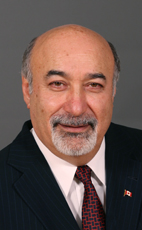 House of Commons photo
Lost his last election, in 2011, with 32% of the vote.
The Budget March 26th, 2007
Mr. Speaker, I rise on a point of order. The hon. member indicated that a statement in one of my questions was inaccurate. The statement I made was quoted from a letter that the current--
The Budget March 26th, 2007
Mr. Speaker, the member talked about the environment. He represents a riding in Ontario.
Given that the Liberal government had an agreement with the province of Ontario, the Canada-Ontario agreement for $6.9 billion in transfers and that was cancelled, how is he going to justify that to his residents? His leader has stated, and it is on paper in a letter, that carbon dioxide is good for us. Does the member agree with that statement and how can he talk about the environment?
Greek Independence Day March 26th, 2007
Mr. Speaker, this past Sunday, March 25, Canadians of Hellenic descent celebrated their 186th anniversary of the liberation of Greece from the Ottoman Empire.
In 1821, after 400 years of oppression from the Ottoman Empire, the Hellenes, through the leadership of people such as Theodoros Kolokotronis, Palaion Patron Germanos, Melas, Karaiskakis, Miaoulis and many others, fought bravely so that once again they could live as free people.
Historic battles, such as the battle of Souli, and heroes like Lord Byron of England, collectively all made supreme sacrifices, for what? For a spirit called Hellenism, but more so, they fought for freedom, for liberty, for justice and the rule of law.
In 1821, the birthplace of democracy was once again liberated.
It is, therefore, my hope, as we move into this new millennium, that tensions of the past are put to rest so that Greece and Turkey can focus on nurturing the positive energies of their people leading to a prosperous and peaceful future.
[Member spoke in Greek as follows:]
Zito to eikosi enna.
Canadian Forces March 26th, 2007
Mr. Speaker, this is what I am trying to get into by way of constructive exchange.
An old Gaelic proverb goes as follows, “There is no greater fraud than a promise not kept”. I do not want to go in that direction. I want to respect the debate, honour our veterans and support them. I again thank the member for Renfrew—Nipissing—Pembroke for bringing forward this motion to the House. This motion is not meant to hit below the belt but if my colleagues across the way wish to do that, I can go in that direction. However, I choose not to. I will rise above that.
We have no greater obligation than to honour the great sacrifice made by our men and women in the past and in the present.
Years ago when a veteran died, the widow would receive six months of benefits. I will use my mother who is a widow as an example. After six months, does the grass stop growing or does the snow stop falling? Surely to God, we could extend the benefits we said to ourselves, and we did. Today we need to add another element, which is the direction in which I encourage my colleagues to take during the debate.
I commend the member for the good work she is always doing, not only on behalf of her riding and on behalf of CFB Petawawa, but for all our men and women.
Canadian Forces March 26th, 2007
Mr. Speaker, before I begin my remarks, I want to acknowledge the motion put forward by the member for Renfrew—Nipissing—Pembroke. I say this because we served together on the defence committee and she truly and genuinely cares, as does, I believe, every member in this House. She also has CFB Petawawa in her riding and we know of the losses that were there. I read the poem from the daughter of one of our lost soldiers and I was very moved.
I thank her also because she gives each party the opportunity to engage and express our views and to send the kind of signal that I believe she intends to send through this motion.
I felt very compelled to participate in this debate. As the son of a World War II veteran, I know what the men and women in the past and what these men and women today have gone through and are going through. We have no greater obligation, as elected representatives, than to address those needs and concerns.
However, before I go into that I want to touch a little upon the great history and the pride with which our men and women have served in the past, aside from the two major world war conflicts and others, post-World War II, our Canadian men and women have participated in some of the biggest missions the world has known.
For example, we had 1,007 troops in Egypt between the period of 1956 to 1976. We had almost 1,200 people in Cyprus and that mission was commenced in 1964. To this very day I think we have one or two Canadian troops there. In the Balkans, we had just over 2,400 people, a mission that started in 1992 and went to 1996. In Somalia, we had just over 1,400 people during the period of 1992 to 1993. Again in the Balkans, there were an additional 1,100 people on a mission that took place between 1996 and 1997. In Bosnia-Herzegovina, it began in 1997 and to this very day we are participating.
Those are big numbers for a relatively small nation such as Canada but a nation with a big heart and a great history.
When we talk about our men and women who are serving today, there is no greater responsibility, as the member and other members have pointed out, than to provide them with the equipment they need to do the work that we ask them to do. As the former chair of the defence committee and the current vice-chair, I can say that the committee has always worked cooperatively with one thought in mind: to do the right thing. Yes, we will spar and, yes, we will bring our views forward from different parties but at the end of the day I know we all speak from the same heart and we try to do the best we can.
Sometimes when we touch upon some of these issues, they might get a little bit sticky but, as the member for Sackville—Eastern Shore spoke about earlier today, we have a responsibility to the men and women who are serving us.
For example, it is hurtful for us and for Canadians as a whole when we put out information saying that nothing was done. Members know very well that is not the case. I know, for example, that between the periods of 1996 and 1997, 12 frigates were built and the Leopard tanks that are used today were provided by the previous government.
When General Hillier and the Minister of Defence appeared before the committee and talked about the $17 billion of moneys available for military procurement, I personally asked the general and the minister whether they were referring to $17 billion in new money, plus the $13.5 billion or $14 billion that the previous Liberal government put in the budget, for a total of $31 billion. The general was kind enough, as was the minister, if I may say, to acknowledge that no, it was primarily from the Liberal government.
How do we provide equipment? We do not go to the store and buy an airplane. We do not go to Wal-Mart and buy a tank. These things are planned, first and foremost, by the military and then a process is followed.
The committee went abroad and visited NATO headquarters. I will just touch upon Canadian pride. The men and women who are serving at NATO headquarters are performing senior responsibilities but they were not appointed. They competed for those positions and they won, which tells us that we rate at the top. All members of the committee were quite proud to see our men and women serving at NATO headquarters.
What did NATO tell us? They basically told us the process. We went to England to see how it did its exercise in terms of military procurement. We were learning, knowing very well that the money was there. Canada First Command under General Hillier was rolled out some years ago. I am pleased to say that the Liberal government of the day put the money there. We all know how difficult it was in the early nineties in terms of the country not having the funds available.
As the son of a war veteran, I also want to touch upon the very important issue of our veterans. Given that our country today has been blessed with tens of billions of dollars in surpluses, surely to God we can allocate some money to meet their concerns.
The present Prime Minister, then the leader of the opposition, made a commitment in writing to Joyce Carter that he would address her issue. I know the VIP program came in under our administration but along the way things changed. For example, today we have the post-traumatic stress syndrome which we might not have been aware of 15 or 20 years ago. We are taking some strides to address that concern as well.
During the Liberal administration, we were asked to address compensation for merchant seamen. We did that but we could not snap our fingers and do it overnight. We had to do assessments.
The current Minister of Veterans Affairs appeared before the committee when I was chair. The member for Sackville—Eastern Shore touched upon the subject of veterans who had been exposed to agent orange and I am glad he did. The current Minister of Veterans Affairs said that his party would solve the problem when it formed government because it had the data. We were missing just a small piece of the puzzle but it has now been a year and a half and nothing has been done. I still get letters from veterans who were exposed to agent orange. If we do not do it now when there is over $14 billion in surplus, when are we going to do it?
Business of Supply March 22nd, 2007
Mr. Speaker, I rise on a point of order. If the parliamentary secretary takes too much time, it will prevent other members from asking questions as well so I ask for your--
Business of Supply March 22nd, 2007
Mr. Speaker, I listened very carefully to the passionate words of my colleague. He spoke about the Atlantic provinces and the Atlantic accord and how the government of today has literally reneged on that commitment.
He referred to Saskatchewan and British Columbia. I represent the Ontario riding of Scarborough Centre. What does he think about Ontario?
There was a commitment made under the former Liberal government for $6.5 billion. Ontario got a few crumbs, but has been silent on that. Does the member not think that we have been cheated as well?
The Budget March 20th, 2007
Mr. Speaker, it has not been well received because it is totally misleading. I will provide one example.
The Minister of Finance said a couple of weeks ago that his government provided the largest tax relief program in the history of our country: $20 billion over two years. I will remind everybody that in 2000 we provided, as the hon. member clearly pointed out, $100 billion in tax relief over five years. If we do our math again, that works out to $20 billion a year. I do believe I was taught that $20 billion is much higher than $10 billion, which is what the government provided.
This is what frustrates most Canadians. It is like what Danny Williams said: the government has literally misled us, us being the veterans, for example, and everybody. There is too much camouflage in the budget to make it believable.
The Budget March 20th, 2007
Mr. Speaker, I think the question put to me was that I did not support the firefighters. I challenge the hon. member to prove that. If he proves that I did not, I will be prepared to withdraw, because that was a very inaccurate statement that he made and he knows it very well.
Why am I going to vote? I am not voting against this budget. I am not going to vote for this budget on one issue because we see it as a whole. It is for the same reason that when we provided tax relief and money for health services under the Romanow report that those members voted against it. It is by the same reasoning, much as I outlined one program that I am very pleased with, that I cannot support the budget.
The Budget March 20th, 2007
Mr. Speaker, it is that rhetoric and these lies that have poisoned the Canadian people, because the hon. member knows very well--