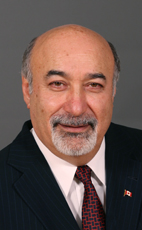
House of Commons photo

Crucial Fact

  • His favourite word was billion.

Last in Parliament March 2011, as Liberal MP for Scarborough Centre (Ontario)

Lost his last election, in 2011, with 32% of the vote.

Statements in the House

Business of Supply February 20th, 2007

Mr. Speaker, I listened very carefully to the member for Toronto—Danforth. He referred to a couple of points that I would like to touch upon. He talked about affordable housing, child care, and funding for post-secondary education.

As a former independent entrepreneur, I never believed that making a profit were dirty words. As a matter of fact, I was always trying to make a profit because it allowed me as the principal owner of a company to contribute to the system as best I could.

I know the hon. member cares. I grew up in the area he now represents. I often go to my riding of Scarborough Centre, and I just want to pass on to him some of the comments I have heard from people there and why they are upset. We had a deal on the table for child care. We had funding for post-secondary education and for affordable housing. Why did those members betray the nation and overthrow the government when those programs could have been implemented? Those members let Canadians down.

Criminal Code February 6th, 2007

Mr. Speaker, that is what it is all about. I am trying to work with the member to find means and ways to better safeguard Canadians, but again Conservatives will tell constituents everything they want to hear knowing that they cannot deliver. They have not been delivering on their promises. I am embarrassed that the member responded in the way he did. It is a shame.

Criminal Code February 6th, 2007

Mr. Speaker, the parliamentary secretary said this bill and this government want to make our streets safer and so on. I do not think there is a member in the chamber that does not wish the same thing. In as much as we all agree on the principle of the bill and it warrants serious consideration and support, the problem that I hear from my constituents over and over, and I am sure other members do as well, is that members with all good intent bring forth legislation, tighten the rules and so on, mandate after mandate. However, I know one famous football player whom I read about a year or so ago who was caught and charged driving under the influence of alcohol and he was let off the hook with a little slap.

I ask the parliamentary secretary if he or his government have any ideas? We can make the laws and improve them continuously, but how do we get them enforced? How do we get them complied with when police officers go out of their way and in harm's way to arrest people, put them through the system, and then find themselves before the courts and the next thing we know they are off with a slap on the hand and our constituents and taxpayers get frustrated? Does the parliamentary secretary and the government have any ideas how we can overcome that?

National Ethnic Press January 31st, 2007

Mr. Speaker, last Friday I attended the 30th anniversary of the National Ethnic Press of Canada celebration. Its president, Mr. Thomas Saras, and the organization dedicated the evening in recognition of our Canadian military on its proud history and commending members of the military on the excellent work they do both within Canada and on the international front.

The national ethnic press is a vitally important and essential media organization. Given the diversity of our country, it plays a vital role in informing Canadians from coast to coast to coast of all that is happening in our country and from all corners of the world. That is but one of many reasons that it deserves the government's support.

In closing, I want to take this opportunity to congratulate Mr. Thomas Saras, his entire executive and the national ethnic press for 30 successful years and wish them many more successful years in the future.

Softwood Lumber Products Export Charge Act, 2006 December 5th, 2006

Mr. Speaker, for the past year since this deal was put together we have been stuck on this figure of $5.1 billion or $5.2 billion. Does my colleague not agree that if this money was set a year ago, there should be some interest that would have accumulated by now? Does the member find it interesting that the figure is not changing? If he does not want us to forfeit our sovereignty with respect to the lumber industry, why is the New Democratic Party supporting this bill?

Softwood Lumber Products Export Charge Act, 2006 November 29th, 2006

Mr. Speaker, in those 25 seconds I want to talk about the deal. I have great respect for the member, but I believe he is being intellectually dishonest with the wording he is using. He said “a deal”. There was a proposal under the Liberal government. We in our wisdom saw that it was wrong and did not even propose it. We did not have a deal. The Conservative Party had a bad deal and it accepted it.

Softwood Lumber Products Export Charge Act, 2006 November 29th, 2006

Apologize for what? We have nothing for which we should apologize. It was a bad deal then and we did not accept it, and it is a bad deal today.

The parliamentary secretary should read the report. I am sure she has not read it because her question tells me that she has total ignorance of what happened in committee. It was confirmed by the member for Burnaby—Douglas when he said, “We were on the verge”. Industry testimony is on the record. All the people that the parliamentary secretary referred to are on the record.

The Liberal government chose in its wisdom to do two things. First, it decided to support the industry with financial support, but unfortunately the government fell. Second, it chose to walk away from that proposal of $3 billion because it was a really bad deal as is the Conservative deal.

We did not muzzle the industry. We did not tell the industry that if it did not accept the $3 billion deal, we would penalize it. We made the decision, unilaterally, because it was a bad deal for Canada, a bad deal for the industry and we said we would not take it.

Softwood Lumber Products Export Charge Act, 2006 November 29th, 2006

Mr. Speaker, in a constructive way, the parliamentary secretary does not have a clue what she is talking about. If there had been a deal for $3 billion, we did not want it because we knew it was a bad deal. If we thought it was a good deal, we would have accepted it.

Softwood Lumber Products Export Charge Act, 2006 November 29th, 2006

Mr. Speaker, I spoke earlier to Bill C-24 and I could not help, as this debate is closing, but to take the 10 minutes that I am accorded to add my voice to this most difficult situation. I want to use this opportunity to tell Canadians some of the facts that occurred. We come to this honourable chamber to deal with facts and not innuendoes.

When we sit in this honourable chamber, we sometimes say things that are not accurate. I do not want to use the words “not truthful” because that is unparliamentary language, but members say things that are not accurate. Yet, we walk out of the chamber feeling pretty comfortable. I choose not to take that position, but to take this opportunity as the debate closes on Bill C-24 to put some facts on the table.

As the member for Burnaby—Douglas concluded his remarks he said that we were on the verge. I assume he meant we were on the verge in final arbitration to once again have a ruling in Canada's favour.

I had the privilege, if I may say, to chair the committee that addressed this issue. As I mentioned in the past and I will take the opportunity once again, the entire industry literally came before the committee and gave testimony. Members from the Bloc spoke about this earlier. Let me put on the record who attended. The committee heard from the Québec Forest Industry Council; the BC Lumber Trade Council, mentioned by the New Democratic representative who just spoke; Canfor Corporation; West Fraser Timber Co. Ltd.; and Weyerhaeuser Company. We are talking about all the industry representatives.

What did they tell us in committee? They thanked us for the support that the Liberal government had been providing throughout this ordeal. They were here to tell us that they needed our financial assistance and government support because they knew they were going to win and they wanted to be there.

We do not just cut cheques. Obviously, there has to be a committee inquiry and we have to hear from witnesses. As a committee we have an obligation to summarize all the findings and make recommendations, which is exactly what we did. There were recommendations which are here in the report.

The parliamentary secretary and the member for Burnaby—Douglas were present. The member for Burnaby—New Westminster was also on the committee and knows very well the recommendations. He heard them firsthand. There were recommendations from the New Democratic Party that members from the Bloc approved. The recommendations from the Liberal government of the day included a provision to provide financial support.

Having said that, the response will be that I am still upset. No, I am not upset with what happened. Canadians spoke in the last election. Liberals respect the outcome and we have to work with it.

The member for Burnaby—Douglas said that we were on the verge. If we were on the verge, why did the Conservatives betray the lumber industry and overthrow the Liberal government prematurely when there was a commitment to have an election at some point in time as the then prime minister indicated? There is no question. I agree with the NDP and the Bloc Québécois that this is a bad deal.

When the Minister of Industry signed the agreement and members of the community and the industry did not agree, the new Conservative government, as it wishes to be called, turned around and said it had been muzzled to put this deal together and asked how to do it. This is how it put the deal together. It went to the players in the lumber industry and said that if they did not accept this deal, the government would tax them on top of it.

Let me quote from the newspaper. It says here, “Ottawa plans to tax holdouts”. In other words, if they do not accept the deal, the government will tax them on top of that. It does not matter that it has taken over $5 billion their money.

On the money, there is great concern. I challenge the parliamentary secretary, the Prime Minister and the Minister of Industry. I am hopeful that one day they will show us a cheque for over $4 billion. Quite frankly, the people I speak to and I hear from do not feel that money will come to Canada. That is a challenge I hope the they will pick up on and some day stand proudly, if they have that cheque, and say that they got our money back. I do not think that money is coming.

During the presentations, over and over again, we talked about the NAFTA dispute mechanism. We know very well there are some problems in it. When the deal was first put together, it was put together with the thought of that day. Along the way, things change, such as environments and conditions, and on an ongoing basis we try to refine and improve it.

Unfortunately, what has happened is that in the middle of the game, the Americans decided to change the rules. They are trying to punish us because we have developed a very efficient and cost effective product where we can put our lumber out to the international community and compete fair and square.

What I am upset about, as are many of my constituents, is they are going to hold over $1 billion of our money of which they say half a billion is going to go to supporting the Katrina fund. That is an honourable thing to do. However, as we know, parliamentarians and Canadians responded to the call of the Katrina disaster. We raised money. I do not think that was a wise decision. On the other hand, we do not know up to this very day where the half a billion dollars will go.

Would the parliamentary secretary get us some information on this? Canadians want to know where their money is going.

From the day the deal was supposedly made until now, it has been almost a year. If an average Canadian had over $5 billion in the bank, that would provide him or her with some interest. Is that interest coming to Canada, or is that interest going to stay in the United States of America? That is another question Canadians are asking.

The member earlier said that this was a great deal. Canadians are still asking what the deal is all about. Why is this deal so great? Is it great because we have been robbed of over $1 billion? Is it great because if conditions change overnight, the Americans can change the rules? Is it a great deal because it has already cost us jobs? I want to know what is so great about this deal so I can tell my constituents.

It does not affect me personally, coming from an urban riding such as Scarborough Centre, but it does affect the peripheral industries around me, whether it is housing, et cetera. Directly it does not affect employment in my riding, but it affects my province of Ontario as a whole. However, when it affects the province of Quebec and the province of British Columbia, rest assured it affects each and every Canadian, and I bring that to the attention of the Conservative Party and the Prime Minister.

I want to thank the member from New Westminster, who really did work hard on this file during committee, and the members from the Bloc. I am sad today because they do not reflect on what happened and what the recommendations were in that committee. They know very well, as the member for Burnaby—Douglas said, we were on the verge of putting this deal properly where it belonged.

Unfortunately, and I am not going to go into it, the government was no longer there. Here we are today, succumbing to the pressure of the Americans, giving up well over a billion dollars, and it is costing us jobs on top of that.

Softwood Lumber Products Export Charge Act, 2006 November 29th, 2006

Mr. Speaker, the parliamentary secretary said the Prime Minister delivered on a deal, but the truth of the matter is that he did not deliver on a deal. He simply caved in to American pressure.

I want to remind the member for the Bloc that I chaired the committee on international trade. The issue we focused on was softwood lumber. The members from the Bloc at that time agreed, given the presentation from the lumber industry. I have pointed out in my presentations in the past that representatives from his beautiful province of Quebec asked for financial support. The report, supported by the members from the Bloc and all, said to provide funding for final arbitration, which we felt we were going to win. Had it not been for the betrayal of the NDP and the Bloc Québécois, the funds were there to continue. Simply, it is important for Canadians to know this.