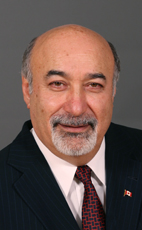
House of Commons photo

Crucial Fact

  • His favourite word was billion.

Last in Parliament March 2011, as Liberal MP for Scarborough Centre (Ontario)

Lost his last election, in 2011, with 32% of the vote.

Statements in the House

Business of Supply November 28th, 2006

Mr. Speaker, we are getting on the same page with the member for Surrey North. This is where the problem lies. We take our premiers seriously and when we come to the table we agree. That is what has happened and maybe this is a lesson for us to be looking to the future of how we put these negotiations with the provinces together.

The member talked about accountability. We go to the table. Mr. Romanow brought forth the most in-depth study and recommendations of which the former Liberal government, as stated publicly not only met but exceeded. The concern we have is that the premiers or the provinces are going to take these funds now over 10 years and we have to sit back. This is why I ask her again, does she believe that maybe the time has come for the federal government to update, revise, and clamp down on our relationship with how health care is delivered in Canada?

Business of Supply November 28th, 2006

Mr. Speaker, I want to make a comment and then I will ask the member for Surrey North a question. In the member's presentation she referred to the previous Liberal government having done nothing.

I thought that she was being a bit unfair. I know she was not a member of the chamber at that time. I want to remind the member that in 1996 the provinces came to the then Liberal government and asked for about $1.5 billion to shore up the health system. Let me assure the member that the Liberal government at that time went ahead and gave the provinces the money.

Then, in 1997 I believe it was, the national forum on health, after the study, came to the former Liberal government led by Prime Minister Chrétien and said that it needed about $2.5 billion to shore up our health system. I remind the member that at that time all the premiers gathered in Ottawa, and the prime minister and the Liberal government said that we would give them the money, providing they assured us and signed on the dotted line that the money would go strictly to health care.

Instead of $2.5 billion, the Liberal government having put its finances in the right direction, gave the provinces $3.5 billion. The only province that did not sign on was Quebec under Premier Lucien Bouchard. He only wanted the money to do what he wanted to do with it.

I remember Premier Harris from the Conservative Party in Ontario and Premier Klein from Alberta stood with Prime Minister Chrétien and applauded and appreciated the money. This money was going to take care of our health system.

The problem I had at that time was that Premier Harris took the money and spent about half a billion dollars, of which Ontario's share was $1.2 billion, and paid severance packages to nurses. Today we are still trying to replace those nurses.

The member talked about a national leadership role. I agree with her. Would the member agree that the time has come for us to standardize health care right across the country?

Points of Order November 8th, 2006

Mr. Speaker, I, too, in the heat of question period as the Prime Minister said, made a comment while the Minister of the Environment was speaking, referring to a hair salon.

I wish to withdraw those words. If they were offensive and offended anybody, I wish to apologize as well.

Business of Supply November 7th, 2006

Mr. Chair, with the CDS here I am quite shocked, because I heard the opposite during his presentation of how satisfied and pleased he was.

During the last Parliament, the Standing Committee on National Defence and Veterans Affairs was addressing the issue of agent orange. I will not take the time to quote what the minister said at that time but he made a commitment that should his party form government, which it now has, that his government would address this issue.

Is the Conservative government prepared to act on it immediately, not in a year and a half or two as the Minister of Veterans Affairs has said in the papers?

Business of Supply November 7th, 2006

Mr. Chair, in his opening presentation the minister talked about the Canada first strategy and outlined the strategy for the next 10 years. I do not understand. I want to ask him why he is considering reinventing the wheel. I am glad we have CDS here with us today because I recall in the last mandate this was, in essence, the plan. What is it that will be different over the next 10 years that he could tell us about to start the process all over again? We were led to believe, as a government and as a nation, that we must move forward to support our military.

Business of Supply November 7th, 2006

Mr. Chair, our understanding is that there is no competition.

Does the minister not realize that the cost to Canadians, because a lack of competition on almost everything the government purchased for the military, would cost us in excess of anywhere between 20% to 30% beyond? The 13 or so billion dollars will cost Canadians an additional $2.5 billion to $3 billion. This is according to Mr. Alan Williams who is currently ADM for acquisition.

Could the minister not open up the process for fair competition?

Business of Supply November 7th, 2006

Mr. Chair, I want to ask the minister why his department, as we understand, is in the process of buying, without any competition I would emphasize, a minimum of 50 trucks at a cost of $150 million. Could he explain to this House why this requirement of the trucks to have a 16-tonne capacity?

Canada Elections Act November 6th, 2006

Mr. Speaker, the member for Ottawa Centre continuously touched upon cynicism and citizens losing confidence. I agree with that. However, we have to get to the source.

I want to ask him if he would consider doing one thing. I read the member's literature, living here in Ottawa sometimes, that he sends around. I think we cause that. Would he consider, in his literature, being more transparent and less cynical because we are turning off the constituents.?

For example, in the last election, it is no wonder there was a lot of cynicism and people did not show up because your party reneged on commitments.

Canada Elections Act November 6th, 2006

Mr. Speaker, I listened very carefully to the member from the Bloc on Bill C-16 and a have a couple of questions.

First, this is a new proposal for federal elections as we well know. We also know that there are two provinces that are working with fixed election dates, British Columbia and Ontario.

Generally, in the pharmaceutical industry for example, when a new product comes out, it has to go through various trials and testings and then it is released to the general public. Even at that we sometimes hear years down the road that it has to pull it off the shelf because some things were unforeseen et cetera.

I could use another example. When the same sex marriage issue was unfolding across the country, it was not until after various provincial superior courts ruled that it came to us on the federal side and we then asked the Supreme Court of Canada for an opinion and followed it accordingly.

On Bill C-16, fixed elections dates, would it not be wise to see how it unfolds with the other provinces and as it unfolds see if there are any glitches and fine tuning that needs to be done before we just implement? As the pharmaceutical industry, for example, we may find that there are some problems and we have to backtrack.

They taught us in physics in school that we test first and then we implement. Would the member not consider waiting for the outcome of other provincial elections before we move forward on the federal side?

Business of Supply October 19th, 2006

Mr. Speaker, I have a quick question for the member for Winnipeg South. He said that his government will honour all signed agreements and contributions. Will the government honour the Kelowna accord, the Atlantic accord and the Kyoto accord? As for Danny Williams, will the government honour the agreement that was there and keep their commitments?