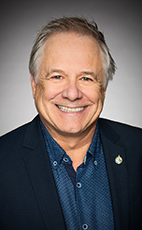
House of Commons photo

Crucial Fact

  • His favourite word was chair.

Last in Parliament April 2025, as Bloc MP for Rivière-des-Mille-Îles (Québec)

Lost his last election, in 2025, with 33% of the vote.

Statements in the House

Veterans Affairs April 1st, 2022

Madam Speaker, services for francophone veterans are getting worse instead of better.

An anglophone's application for disability benefits is processed in 20 weeks, but francophones are currently waiting 76 weeks. The wait time is six months longer now than it was in 2018.

The minister claims that all is well, however. The Standing Committee on Veterans Affairs wrote to ask him to explain why independent analysts paint a less rosy picture of the situation. We are still awaiting a response.

When will the minister be accountable to francophone veterans?

International Mother Language Day Act March 31st, 2022

Madam Speaker, this evening we are debating Bill S-214, an act to establish international mother language day. Specifically, the bill would designate February 21 of every year as international mother language day in Quebec and Canada. This bill originated in the Senate and was sponsored by Senator Mobina Jaffer, an independent senator from British Columbia. This bill is at second reading here in the lower chamber.

The Bloc Québécois very much supports Bill S‑214 because what it ultimately does is protect linguistic diversity on a global scale. This issue is an integral part of the Bloc Québécois's cultural and linguistic vision, which is why we support this bill.

I think it is worth repeating the prophetic words of well-known sovereignist Pierre Bourgualt who said, “when we defend French here in Quebec, we are defending all the languages of the world against the hegemony of one.”

Pierre Bourgault was a friend of my father, Antoine Desilets. He often stopped in at our house to have a drink. At the time, I was 8, 9 or ten years old, and my room was beside the kitchen. On the evenings when Pierre Bourgault came to visit my parents, I would leave my door ajar because I liked to hear him talk. I would do that until my mother came to my room and shut the door because it was time to go to sleep.

At the time, I did not understand much about this man's eloquent speeches on power, the economy, language or independence, but I was completely mesmerized by his voice. His diction was perfect and his vocabulary and syntax were exceptional. We listened intently, and despite my young age I would gulp down every word just like a thirsty man who discovers an oasis in the middle of the desert. In my opinion, there is no doubt that Pierre Bourgault was the greatest orator in the history of Quebec.

Very few members know it, but I myself have written a few books. For me, writing is the expression of a passion for this language. I suspect that my love of the French language was strongly inspired by the evenings spent secretly listening to Pierre Bourgault through the crack in the door to my room. As a photographer, my father played with light. As a result of my love of the French language, I learned to play with words.

Whenever he spoke, Pierre Bourgault always, or frequently, made the connection between Quebec's quest for independence and our national language, the mother tongue of our people, French. The only thing a people must do to ensure its cultural vitality and freedom is protect, care for and cherish its mother tongue. What better way to convey the identity and culture of a people, any people? My leader, a trained anthropologist, will have a lot to say about this.

What would the Basque independence movement be without Euskera? What would Catalonia's independence movement be without Catalan? What would Quebec's independence movement be without French?

A few years ago, a columnist for The Economist, who was anglophone, obviously, wrote, and I quote: “Forget Chinese or Hindi. If you want to learn a language which is truly global, learn French”.

Despite being a minority in America, Quebeckers, along with Canadian francophones and Acadians, are lucky to speak French because it is indeed an international language. French is in fact the fifth most common language in the world based on number of speakers, and it is the only language besides English that is spoken on all five continents. French is recognized as an official language in 29 countries. According to the Observatoire de la langue française, in 2022, 321 million people in 112 countries and territories are capable of expressing themselves in French.

The nice thing about that statistic is that French is not necessarily all those people's mother tongue. For many, those born in the Americas, the Caribbean, Africa, the Middle East and Oceania, French is a second or even a third language.

French is not a hegemonic language. It is widespread and a major contributor to the richness of the great human cultural mosaic. We all benefit from the bridges built between the peoples of the world. Cultural exchanges bring people together and are a force for peace in a world where universal peace has obviously not yet been achieved.

For cultural exchanges to be possible and fruitful, the different cultures need to be thriving. They need to be robust, and the transfer of knowledge, the passing on of memories, traditions and heritage from generation to generation must not be obstructed by the imposition of a single culture, a culture of globalization.

I am extremely proud of my mother tongue. I know that this pride is shared by my fellow Quebeckers. However, I cannot—we cannot—continue to ignore the elephant in the room. In Quebec, French is in decline at every level.

In 1996, 81.5% of Quebeckers reported French as their mother tongue. In 2016, it was 78%. Statistics Canada predicts that number will drop to 70% by 2036. We will therefore have gone from 81.5% in 1996 to 70% in 2036.

On the Island of Montreal, the percentage of people whose mother tongue is French dropped from 53.4% in 1996 to 48% recently. It is clear that within 15 years, there will be as many people in Montreal with a mother tongue other than English or French as with French as their first language.

I concede that people's mother tongue is not the only indicator of a language's vitality, but French is the only official language of Quebec, and it should not be declining.

Earlier this month, the Liberal Party introduced its new version of the reform of the Official Languages Act, in which it completely disregards the Bloc Québécois's requests. We support some of the provisions in that act, notably the one concerning the promotion of French in the other Canadian provinces, but we are very disappointed by the rest of the bill.

Only a Quebec language law such as Bill 101 should apply in Quebec. The idea of entrusting the fate of our national language to another nation is totally inconceivable and ridiculous. This is especially true when that other nation overwhelmingly denies visas to francophone foreign students, dithers and drags B.C.'s francophones through the courts, supports and tolerates people like the CEO of Air Canada, and pledges not to take away any of Quebec's seats in the House of Commons, only to turn around and ultimately diminish its political weight.

To sum up, I will repeat that the Bloc Québécois is in favour of the bill to establish international mother language day. When the Bloc Québécois fights in the House to defend and preserve French, it is protecting all languages from the hegemony of one.

Business of Supply March 31st, 2022

Madam Speaker, I thank my colleague for his speech.

I would like him to comment on the fact that the Liberal government plans to increase oil production by 200,000 barrels in the very near term and gas production by 100,000 barrels.

Given that we all think that is incompatible with our desire to move away from fossil fuel production, what are his thoughts on increasing fossil fuel production like this?

Veterans March 25th, 2022

Madam Speaker, the minister supplied the Standing Committee on Veterans Affairs with numbers suggesting that processing times for applications in French were down by 10%.

The independent analysts, however, say it is worse than ever and that francophones are now waiting 76 weeks. Witnesses have even told us that government officials advise veterans to submit their applications in English because the situation is so bad. That is how the federal government treats francophones.

Will the minister explain why his numbers are being challenged and why francophones are being treated so poorly?

Veterans March 25th, 2022

Madam Speaker, Ottawa says it wants to protect French, but the way it treats francophone veterans is a joke. In 2018, it took 19 weeks to process a disability benefits claim submitted in English, but it took 52 weeks to process the same claim in French.

It is now 2022, and where are we at? This week, the Library of Parliament's independent analysts revealed that wait times are the same for anglophones, while for francophones, they are now, believe it or not, 76 weeks—

Business of Supply March 24th, 2022

Madam Speaker, I thank my hon. colleague for his presentation.

We are talking about lifting health measures. I am a bit apprehensive about this, because we are currently experiencing a significant rise in cases of the notorious subvariant of omicron. It is not only happening in Quebec. It is very much the case in Europe, as well as in Canada. I am concerned for this reason, but also because the National Institute of Excellence in Health and Social Services is forecasting a relatively significant increase in hospitalizations.

My colleague has studied in the medical field, so I am hoping he can reassure me. It seems to me that we need to exercise caution and act wisely right now.

Saint-Eustache Hospital March 22nd, 2022

Mr. Speaker, I want to acknowledge the 60th anniversary of the Saint-Eustache hospital, which is located in the heart of my riding, Rivière-des-Mille-Îles.

On March 9, 1962, this institution opened its doors. At the time it was called the Deux-Montagnes General Hospital. Over six decades and through multiple expansions, its dedicated and skilled staff have welcomed more than 300,000 people from the Lower Laurentians. This hospital has not only witnessed the changes in my region since the Quiet Revolution, but also played a key role in its development.

The population of the Lower Laurentians has nearly doubled in 30 years. Today, and for a while now, the hospital's funding needs remain critical. That is why Ottawa must immediately increase health transfers from 22% to 35%, as the Bloc Québécois, the National Assembly of Quebec and all the provinces have been calling for.

Until then, I want to express my gratitude to the hospital's staff and say how much I admire them. Thank you and happy anniversary.

Arab Heritage Month Act March 3rd, 2022

Mr. Speaker, first of all, I would like to point out that all my thoughts and all the thoughts of the Bloc Québécois members are with Ukraine and the Ukrainians at this difficult time.

I will be speaking today to Bill C‑232, an act respecting Arab Heritage Month. This bill was introduced by the member for Ottawa South, and it is at second reading stage. More specifically, Bill C–232 proposes that the month of April become Arab Heritage Month in Quebec and Canada. The Bloc Québécois is pleased to celebrate the Arab community's extraordinary contribution to Quebec society. Last year, we passed a motion to have Irish Heritage Month begin on March 1. I had the honour of celebrating that month with various members of the House.

The Bloc Québécois does support the bill. Nevertheless, perhaps some of my colleagues, like me, find that we know very little about the importance of Arab communities in Quebec and Canada. I propose clarifying a few things first.

What exactly does “Arab” mean?

The term can cause some confusion because it refers to the people of the Arabian peninsula, to people who speak Arabic and to people of Arab culture. Arab language and culture are not exclusive to Arabia, however; they extend from the Persian Gulf to the Atlantic Ocean via the Near East and the Maghreb. Historically, the spread of Arab language and culture is due to Arab conquests that occurred from the seventh century on after the birth of Islam. Not all inhabitants of the Maghreb are of Arab language and culture. Exceptions include the Berbers.

It would be wrong to define our Arab communities solely on the basis of their language, their country of origin or their religion, because what we are talking about here is a civilization. The west would never have had a Renaissance if the Arabs, during the golden age of Islam, had not transmitted and advanced the precious knowledge of the Greeks, which had been either forgotten or forbidden during the Middle Ages. From mathematics and philosophy to medicine, astrology and literature, this civilization's historic contribution to the human race is monumental. Today, Arab civilization continues to enrich our societies, including Quebec society.

Since the Arab world was largely colonized by France in the 19th and 20th centuries, the French language took on a prominent role. French is the first or second language of tens of millions of people from the Maghreb and the Middle East. The French language is just one of the things we have in common, because Quebec, as I said, has deep economic, political and cultural ties with the Arab countries.

I could mention, as an example, the co-operation agreement between the Quebec government and the Algerian government in the field of education and training. Quebeckers and Canadians of Arab origin form a sizable demographic in our population. As the preamble to Bill C‑232 points out, Canada is now home to over one million Arab Canadians. We are still waiting for the updated figures for 2021, since the number I just mentioned is from 2016.

There is, however, something that bothers me about the preamble to Bill C-232. By referring to Canadians of Arab origin and Arab Canadian communities, the bill presents a portrait of the Arab populations in Quebec and Canada that is not entirely consistent with reality, in my opinion. It seems to suggest that the Arab diaspora forms a uniform community across Canada. Am I surprised? No, I am not.

This is a typical example of the Canadian multicultural vision, which tends to consider Canada's population as a vast cultural mosaic, which would not be influenced by the existence of nations. However, there are nations. There is the Quebec nation, which has a different approach to the integration of its immigrants and cultural minorities than Canada does.

In Quebec, we believe in interculturalism, a model for living together where the equality of cultures is indissociable from francisation and secularization. With their knowledge of French, Arab immigrants integrate extremely well in Quebec.

Immigration may be a federal jurisdiction, but Quebec's explicit desire, expressed since the Quiet Revolution, to strengthen its ties to the countries of the Maghreb and to obviously promote francophone immigration cannot be ignored. Language is very important.

Immigrant populations are settling in Canada. Quebec is integrated into Canadian society, that is to say the English Canadian majority. At the same time, immigrant populations that settle in Quebec are integrated into Quebec society, that is to say the francophone majority.

It is obvious that the integration is different depending on whether immigrants come to Quebec or to Canada. That is why we believe that the terms “Arab Canadians” and “Arab Canadian communities” are misnomers.

Furthermore, in 2016, 368,730 people in Quebec identified as being of Arab ethnic origin. Of these, 91.8% spoke French, while 44% spoke it most often at home. Therefore, a vast proportion, or almost half of people of Arab origin living in Canada are Quebeckers and Arab Quebeckers, not, in my view, Arab Canadians.

I would like to use my personal experience to illustrate this point. During the last election campaign, I had the honour and pleasure of being invited to the Centre communautaire des Basses‑Laurentides, near my riding, for a political debate. This is a Muslim community centre. We spoke about language, secularism and sovereignty. I was not expecting it, but that is what I discussed with about thirty people.

I should also mention that during the election campaign a few months ago, I met with Bishop Tabet, an influential Lebanese Maronite bishop, and this meeting really stuck with me. Bishop Tabet is an extraordinarily sensitive man who is incredibly perceptive about the Quebec reality. He gave an incredibly candid speech on the historical ties between Quebec and Lebanon. It was clear to me that this man has an abiding love for Quebeckers.

I learned a lot from these people I met, and the connections I made will no doubt continue in the future.

I want to dedicate the end of my speech to all Arab Quebeckers. I thank them for enhancing the francophonie and contributing to the development of Quebec society. On April 1, I hope to be able to contribute to what will be known as Arab heritage month.

Business of Supply March 3rd, 2022

Madam Speaker, I would like to thank my colleague. He gave a very moving, compassionate speech. He spoke at length about Ukraine, what that country is going through, and what Ukrainians are experiencing. I think it touched everyone in the House.

However, besides the war in Ukraine, today’s motion also involves natural gas pipelines, which my colleague alluded to at the very end.

One thing I totally disagree with in his speech is the anticipated shortage. OPEC is prepared to increase production, so there will be no oil shortage. Of course, there is a risk of a natural gas shortage in Germany and Italy, but that risk is minor.

How can Canada become an exporting country when we know that, according to estimates, it would take about 10 years to build the infrastructure that would allow us to export oil and gas to Europe?

Business of Supply March 3rd, 2022

Madam Speaker, just in the title of the motion alone there is a rather odd combination of things. There is something not quite right about the idea of conflating western Canadian oil with the war in Ukraine.

I will take this opportunity to ask a question that may not be very good either. You are six months away from a convention to elect a new Conservative Party leader. Do you not believe that this kind of topic will cause even more division among Conservatives?