
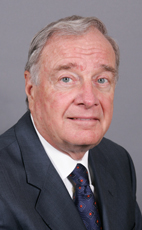
House of Commons photo

Crucial Fact

  • His favourite word was tax.

Last in Parliament September 2008, as Liberal MP for LaSalle—Émard (Québec)

Won his last election, in 2006, with 48% of the vote.

Statements in the House

Federal Budget May 7th, 1996

Mr. Speaker, I certainly do agree with the hon. member that there are times when one should cite the province of Ontario. On the GST let me simply cite the premier of Ontario.

He said in 1994 that in terms of GST the manufacturers and the businesses in Ontario would save over a billion dollars by being able to deduct these costs they could not deduct at that time on the sales tax in Ontario. He also said it has been one of those areas of major competitive disadvantage that Ontario manufacturers have had. He went on to say that Ontario businesses have had it.

I repeated this last week but perhaps the hon. member forgot. The premier of Ontario said: "Stop the rhetoric, stop the politics, stop the finger pointing, get on with harmonization and simplification of the GST". That is what he said and he was right.

Federal Budget May 7th, 1996

Mr. Speaker, the government has made it very clear that it will proceed on a set of rolling two year targets because it is that procedure which has given us the success in deficit reduction that we have had, a success that has been recognized by markets around the world.

For the first time in an awful long time a Canadian government has not only consistently hit its deficit targets, it has beaten them, and we will continue to do it. It is too bad for the Reform Party because it has lost its agenda.

Goods And Services Tax May 7th, 1996

Mr. Speaker, the hon. member must understand that, whenever a minister speaks in this House, he speaks on behalf of the government. As a matter of fact, that is what I did just the other day, when the Deputy Prime Minister and member for Hamilton East gave her press conference. She has put the situation very clearly. Incidentally, I would like to report to the House that I spoke with the member for Hamilton East this morning; she is doing well and she will win the election.

Taxation May 7th, 1996

Mr. Speaker, the member knows full well what I said. There was a discussion by the finance ministers. There was general understanding around the table.

Let me ask the leader of the Reform Party something. In its most recent budget the Reform Party talked about cutting old age pensions. It talked about cutting health care. It did not talk about cutting taxes.

Why is the member raising it here and now if he was not prepared to advocate it himself?

Taxation May 7th, 1996

Mr. Speaker, the answer to this question remains the same as the last 10 times the leader of the Reform Party asked it. We have discussed this

extensively at the federal-provincial finance ministers meetings. There is a general agreement that it would be counterproductive for any one level of government to fill in tax room simply because of the negative effect it would have on the Canadian economy.

Let me remind the hon. member that not only in the last three budgets did the government not raise personal taxes, but in the last budget we very clearly nailed our colours to the mast. We did not raise corporate taxes, we did not raise excise taxes, we did not raise taxes at all, and we still kept bringing the deficit down.

Canada-U.S. Tax Treaty May 6th, 1996

Mr. Speaker, the problem lies in the American legislation. The Canadian government is certainly very concerned about this problem. There is no doubt that great injustices have been created for Canadians. We will continue to work on this, but it must be said that the Canadian government is in no position to compensate all Canadians affected by changes in foreign legislation.

Having said that, I think, as I said right at the beginning, that the question is quite relevant, and we continue to work on this problem.

Canada-U.S. Tax Treaty May 6th, 1996

Mr. Speaker, the hon. member's question is quite relevant. I should mention that the problem lies in a new interpretation of the American legislation.

As the hon. member has just pointed out, I met with Mr. Rubin in Washington about two weeks ago. We discussed this matter at length. We have still not found a solution, but the Americans are working on it, as the matter is in their hands.

Canada Pension Plan May 6th, 1996

Mr. Speaker, the hon. member may think that he has torn some incredible admission from the government.

This government, many months ago at a finance minister's meeting with the provinces, set out very clearly that premiums may have to go up, that there may have to be a change in the benefits.

It may well be that the member is only now coming to this conclusion, but it is one that most Canadians realized after the chief actuary issued his report some time ago on the CPP.

On the question of jobs, if members take a look at what is happening at the present time, over the course of the last three months nearly 135,000 new jobs have been created. Since this government was elected, well over 500,000 jobs have been created.

We are providing jobs in the new economy. We are providing jobs for young people. We are providing the kind of jobs that are permanent. That is what the statistics demonstrate.

Canada Pension Plan May 6th, 1996

Mr. Speaker, the reason the government set up, along with the provinces, the commission which is currently going across the country to examine the CPP is precisely to deal with the question of the survival of the CPP. How will the CPP be maintained? The government stands four square behind it, as in fact do the provinces.

At the same time, we are dealing with very real problems which have resulted from the inattention paid to them over the course of the last decade. It may well be that premiums will have to rise. It may well be that there will be changes in the benefits.

The government has said very clearly that it will not accept the recommendations of the Reform Party which would eventually lead to the evisceration of the Canada pension plan.

Banking Ombudsman May 6th, 1996

Mr. Speaker, as the hon. member knows, individual banks have, over the course of the last year, appointed ombudsmen, one per bank.

However, this morning Mr. Michael Lauber was named as the first Canadian banking ombudsman overseeing the entire system. The specific goal of the first Canadian banking ombudsman is to ensure that the banks live up to their responsibilities to the small business community.

Mr. Lauber, who is not a banker, will report to the government and to the Canadian public on the results of his activities every three months. We certainly welcome this initiative by the bank.

Perhaps I could take this occasion to congratulate all members of the industry committee. This appointment in no small way is due to their concerns and the constant attention they have paid to this issue.