
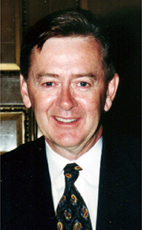
House of Commons photo

Crucial Fact

  • His favourite word was federal.

Last in Parliament May 2004, as Canadian Alliance MP for Calgary Southwest (Alberta)

Won his last election, in 2000, with 65% of the vote.

Statements in the House

Quebec Referendum September 28th, 1995

Mr. Speaker, the minister's contempt for this line of questioning is the same contempt she shows for the provinces.

The minister has unilaterally banned the use of lead shot. She is unilaterally banning the use of MMT and benzene as fuel additives. The minister is setting standards for greenhouse gas emissions without real consultation. The minister stopped all the harmonization talks and scuttled progress on transferring control of the inland fisheries to the provinces. The concerns of the provinces are met not with understanding but with the minister's reverse charm and recycled rat pack tactics.

Why does the minister stubbornly cling to the centralizing prejudices and policies of the seventies when decentralization is the watchword of the 1990s?

Quebec Referendum September 28th, 1995

They fear and resent the centralizing tendencies of a federal administration and of key ministers in that administration, and one of the worst offenders is the Minister of the Environment.

Recently she walked away from a groundbreaking agreement with the provinces on environmental management because somehow it conflicted with her view of centralized environmental management.

Will the environment minister get back to the negotiating table, conclude the environmental management agreement with the provinces, and demonstrate that decentralized federalism works better than centralized federalism?

Quebec Referendum September 28th, 1995

Mr. Speaker, some dissatisfied Quebecers are saying that they are tempted to vote yes in the Quebec referendum, not just because they want to separate from Canada but because they want to separate from an overcentralized federal government. They fear and resent the centralizing tendencies of the federal government-

Justice September 27th, 1995

Mr. Speaker, the minister refers to enacting rights. There is a growing conflict in the country between the rights of victims of crime and potential victims of crime and the rights of persons accused or convicted of crimes. In more and more cases the scales of justice are tipped on the side of violent criminals, sex offenders and murderers. This cannot be allowed to continue. When rights clash it is the rights of the victims that ought to prevail over the rights of the criminals.

My question to the minister is on rights since he raised the subject. When the rights of victims conflict with the rights of persons accused or convicted of crimes, what is he doing to ensure that it is the rights of the victims that prevail in Canadian law?

Justice September 27th, 1995

Mr. Speaker, if the minister had done all these wonderful things for the victims of violence there would not be hundreds of people on the lawns of Parliament today.

Victims of violence listen politely to these recitations from the minister of all the things he is supposedly doing, but their greater concern is with the things the government is not doing: the failure to repeal section 745 of the code; the failure to create a registry of sexual offenders by September, as the solicitor general promised; the refusal to include real victim compensation in Bill C-45; and the absence of a victims rights package in anything the minister has presented to the House.

Besides the cosmetic changes the minister has referred to, what more does he plan to do to change the justice system so that Canada's streets are safer from violent criminals, sex offenders and murderers?

Justice September 27th, 1995

Mr. Speaker, hundreds of Canadians have gathered on the lawns of Parliament Hill today and it is not over a concern with respect to the Quebec referendum or trade treaties that has brought them together.

It is a more fundamental concern about the safety of their children and their loved ones. These are ordinary folks and their demand is very simple. They want the government to do more to protect the lives and property of Canadians from criminals. They want the rights of victims to be placed above the rights of criminals.

What does the justice minister propose not to say but to do for Melanie Carpenter's father and all of the victims of violence who feel that in Canada the state, the law, the government, the parole board and the justice system have failed them in a tragic and fundamental way?

The Environment September 26th, 1995

Mr. Speaker, the environmental management fiasco is a symptom of a deeper problem with the government. There are too many old style ministers who cling to the obsolete notion that any change in federal-provincial relations is to be resisted if it includes any element of decentralization.

The Minister of Health resisted when we talked about decentralizing the financing of health care. The Minister of Human Resources Development resisted in his department and now the Minister of the Environment resists an agreement unless it makes Ottawa the centre of the universe.

My question is for the Prime Minister. Why does he not send a clear signal to all Canadians and all provinces that Ottawa is prepared to accept the principle of decentralization? Why does he not send it by removing those ministers who consistently obstruct the implementation?

The Environment September 26th, 1995

Mr. Speaker, of course we did not get an answer to the first question but we could see where it was headed.

There are two sides to this story and it is particularly important that the side of the provinces be known in the House. The Alberta government believes the minister deliberately scuttled the agreement because of an unfounded fear that somehow the federal government's role in the environment might be weakened, a fear of decentralization. This was despite the fact that every province was prepared to recognize in writing the need for a strong federal presence.

Why does the government consistently reject every provincial attempt to streamline government services, harmonize regulation and eliminate costly red tape if those attempts include any significant element of decentralization?

The Environment September 26th, 1995

Mr. Speaker, for two years the provinces and Ottawa through the Canadian Council of Ministers of the Environment have been discussing ways to harmonize environmental management in Canada. These talks have been progressing toward a framework agreement to rationalize responsibilities and eliminate costly overlap and duplication. But recently the federal Minister of the Environment pulled the plug on this process, refusing to proceed on an agreement that would have been a significant victory for the environment and for federal-provincial relations.

Will the Minister of the Environment table the draft environmental management framework agreement negotiated with the provinces and let the House and the people of Canada decide whether or not it should proceed?

Quebec Referendum September 21st, 1995

Mr. Speaker, all we have heard so far in response to these questions has been the traditional approach to managing national unity that has been carried on by often the same people for the last 32 years.

Where has that approach led? It has led to two failed constitutional agreements. It has led to two secession referendums in 15 years. It has led to fostering the development of two full blown separatist parties in the province of Quebec. The traditional approach to national unity has not worked.

That is why we need fresh thinking. The west's contribution is to bring resolution, clarity, toughness and a better vision.

Instead of ignoring these elements or worse yet labelling them as somehow disloyal to Canada, why does the Prime Minister not incorporate them into the federal government's strategy on the referendum?