
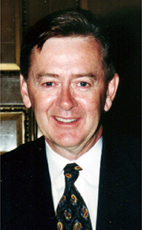
House of Commons photo

Crucial Fact

  • His favourite word was federal.

Last in Parliament May 2004, as Canadian Alliance MP for Calgary Southwest (Alberta)

Won his last election, in 2000, with 65% of the vote.

Statements in the House

Right Hon. John Diefenbaker September 18th, 1995

Mr. Speaker, I rise to join with other members in paying tribute today to the memory of John Diefenbaker on the 100th anniversary of his birth.

John Diefenbaker has been described today by the Prime Minister and others as a prairie populist, as a man with his roots in the common people who sought to give expression to their hopes, fears and dreams through the medium of politics and public policy.

As a student I once attended a huge rally which he addressed in Edmonton's Jubilee Auditorium. The place was packed and there was no place left to sit except at the press tables on the platform behind where he was speaking. I took out a notebook and disguised myself as a scribe and ended up sitting about 20 feet behind him while he addressed about 5,000 people packed into a building that would hold about 3,500.

As was his custom he had a large sheaf of papers on the podium. For the first 10 minutes he simply flipped through the pages touching lightly on a subject, assessing the feedback from the audience, moving lightly to another subject, touching lightly on it and assessing the feedback from it and so forth, until he had a fix on the concerns and the hopes of that audience.

These he returned to with a vengeance, speaking directly to their concerns and hopes with an accuracy and a vigour that defied imagination. He had a peculiar ability to read an audience very quickly and to relate quickly and forcibly to the hopes and fears of his fellow Canadians.

As a prairie populist John Diefenbaker was one of a select list of characters that cuts across party lines, including F. W. G. Haultain, the last great premier of the Northwest Territories; John Bracken and Henry Wisewood of the Progressives; William Aberhart, J. S. Woodsworth and Tommy Douglas. What set John Diefenbaker apart was that he was the only prairie populist in this century to become the Prime Minister of Canada.

Like all of us he had weaknesses as well as strengths. He had detractors as well as admirers and supporters. However there was one point on which he could not be faulted and that was on his love and commitment to Canada, "one Canada" to use his favourite phrase.

On behalf of my Reform colleagues, the people of Saskatchewan and the hundreds of thousands of Canadians who either loved him or hated him but were never indifferent to him, I pay tribute to John Diefenbaker and his commitment to one Canada, on the 100th anniversary of his birth.

Quebec Referendum September 18th, 1995

Mr. Speaker, I find the Prime Minister's answer adding to the ambiguity which as I said at the beginning Canadians do not want. He just said that the question was unclear and therefore the answer would be ambiguous. Then he said that the response to that question would be a clear answer.

The majority of the members of this House believe that a yes vote in the referendum means the separation of Quebec and an end to its participation in the Canadian union. The separatist members can talk about a new marriage or partnership but it will be a partnership without a partner, a marriage without a spouse and Quebec will find itself at home alone.

Will the Prime Minister therefore state unequivocally that a 50 per cent plus one yes in the referendum will mean, sadly, an end to Quebec's position in Canada and not a new and better union?

Quebec Referendum September 18th, 1995

Mr. Speaker, I have a simple supplementary in response to the Prime Minister's reply. If the question asked in the Quebec referendum is not clear and is ambiguous, is he prepared to ensure a clear question is put to Quebecers?

Quebec Referendum September 18th, 1995

Mr. Speaker, Canadians want this Quebec referendum to be decisive and conclusive. They do not want any confusion or ambiguity concerning the meaning of the vote, before or after.

Yet the Leader of the Opposition clouds the issue when he says that he is prepared to accept a yes vote as binding and conclusive but not a no vote, and the Prime Minister does not help things when he implies that he is prepared to accept a no vote as binding and conclusive but waffles on the meaning of a yes vote.

For the benefit of all Canadians including Quebecers who want clarity and certainty in interpreting the Quebec referendum, will the Prime Minister make clear that a yes vote means Quebec is on its way out, that a no vote means Quebec is in the federation for the long haul, and that 50 per cent plus one is the dividing line between those two positions?

Members Of Parliament Retiring Allowances Act June 22nd, 1995

Mr. Speaker, I would be pleased to remove this prop. I would only ask that members showed the same concern for ethics with respect to the issue that is shown-

Members Of Parliament Retiring Allowances Act June 22nd, 1995

Mr. Speaker, if I could ask you, on what basis do you regard this as a prop?

Government Policies June 22nd, 1995

Mr. Speaker, the Prime Minister will not fix the cabinet nor will he fix the budget. So let us turn to the government's administration of the democratic process of this House.

Yesterday the Prime Minister was confronted with the broken red book promise on free votes. In reply the Prime Minister protested that he let government MPs vote on certain amendments earlier in the week. The Prime Minister said he let them vote. The MP's right to vote in this House is not some privilege granted to him by the executive. It is a right that comes from the people and MPs have the right to exercise their vote without threats of punishment or discipline.

Will the Prime Minister end this session on a positive and democratic note by turning to the backbenchers in his own party and assuring them of their right to vote their constituents' wishes without fear of threats or punishment from the Prime Minister or the whip?

Government Policies June 22nd, 1995

Mr. Speaker, I would remind the captain of the Titanic it is a short step from being on top of the mountain to being over the hill.

Let me turn to the fiscal administration of the government. The Prime Minister has been strangely silent on the fact that Canadian exports fell in April for the third month, that wholesale trade has dropped sharply, that employment levels have been flat since November, that retail sales are stagnant and that housing starts are at their lowest point since 1982. It is quite apparent there was a gross deficiency in the fiscal planning of the government and that the finance minister did not go far enough fast enough in his budget. The chickens are coming home to roost.

My supplementary question is: Will the Prime Minister now direct the finance minister to present this House with a midcourse correction and have it ready when we reconvene this fall?

Government Policies June 22nd, 1995

Mr. Speaker, while Her Majesty's temporary opposition focuses on breaking up the country, our job here is to focus on issues essential to maintaining and advancing this country.

One of those issues is correcting deficiencies in the federal administration. The Minister of Canadian Heritage is lost in a cloud of conflict of interest. The defence minister is in the dark on Bosnia and Somalia. The minister of human resources has bungled social reform. The health minister has only band-aid solutions to health care. The minister of Indian affairs is sleep walking to a crisis in B.C. and the minister of public works is mired in patronage in Atlantic Canada.

Will the Prime Minister shuffle the chairs on the deck of the Titanic and relieve any or all of these ministers of their responsibilities over the summer?

Government Of Canada June 21st, 1995

Mr. Speaker, the government also promised freer voting in the House of Commons and a meaningful voice for backbenchers.

In the past few weeks, however, we have seen nothing from the government but a growing disregard for the democratic process: time allocation and closure, Liberal backbenchers being punished for voting the wishes of their constituents, and cabinet ministers who break conflict of interest guidelines being defended by the Prime Minister himself.

Will the Prime Minister reaffirm his red book promises of freer voting and greater MP power in the House by lifting the heavy hand of discipline from those MPs whose only crime was to respect their constituents' wishes?