
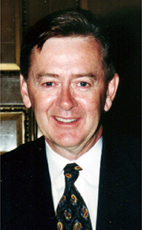
House of Commons photo

Crucial Fact

  • His favourite word was federal.

Last in Parliament May 2004, as Canadian Alliance MP for Calgary Southwest (Alberta)

Won his last election, in 2000, with 65% of the vote.

Statements in the House

Quebec Referendum September 21st, 1995

Mr. Speaker, I am sure that the Prime Minister is consulting, but I wonder whether he is hearing and absorbing the advice that he is getting.

For example, the vast majority of Reform MPs are from the west. What the west wants on this issue-and this has been discussed for some 10 years-is not only national unity but resolution of the issue, clarity in the federalist position, toughness in calling the separatists' bluff and a better and more decentralized federalism as an alternative to the status quo.

What is the Prime Minister doing to bring these elements into the federal government approach: the resolution, the clarity, the toughness and the better federalism that western Canadians and many other Canadians want?

Quebec Referendum September 21st, 1995

Mr. Speaker, there is not a federalist in the House who does not want to defeat the Bloc and its separatist allies in the referendum and bury this secession issue six feet deep.

If this is to happen it is going to require some fresher thinking and some bolder tactics than have been practised in the past by the traditional guardians of national unity.

My question is for the Prime Minister. To what extent is he consulting and involving federalists outside Quebec in improving the federal government's response to the referendum?

Quebec Referendum September 20th, 1995

Mr. Speaker, the separatists have been doing everything in their power to prove a no vote means more of the same and that Canada will never move off the status quo.

The Prime Minister can disprove that charge by seizing opportunities to respond to the demand for decentralization. Even today his health minister is in Victoria. She could advance the cause by simply agreeing to open up the Canada Health Act to permit the provinces greater flexibility in financing health care. Albertans want it. Ontarians want it. Quebecers want it. Canadians want it.

Is the Prime Minister willing to put some meaning into this phrase of flexible federalism and thus advance the no side by committing to amend the Canada Health Act?

Quebec Referendum September 20th, 1995

Mr. Speaker, we have heard all of that before, but it is not strong enough and clear enough to be a real asset to the no side. While many Quebecers will vote no because they reject separation, others will vote no only if they believe there is a groundswell of support for changing federalism in Canada.

There is such a groundswell and unlike Meech and Charlottetown it is coming from the bottom up, not the top down, and its key feature is a demand for real decentralization: greater control over health and social services by governments close to the people.

If the Prime Minister wants a no vote as badly as we do, a big no vote, will he do something concrete in the next 30 days to recognize the demand for decentralization throughout Canada, including Quebec?

Quebec Referendum September 20th, 1995

Mr. Speaker, in the referendum campaign Quebecers are being told by the separatists that a no vote means passively accepting federalism as it is, but many federalists, including 52 of us in the House, believe that no can mean both no to separation and no to the status quo, that no can be the word that opens the door to a changing federalism without amending the Constitution, without special deals, but with Quebec as part of the national family.

What is the Prime Minister going to do, besides doing nothing more vigorously, to make sure that when Quebecers vote no it means more than simply accepting the status quo?

Quebec Referendum September 19th, 1995

Mr. Speaker, we are asking for volume and cheering and we are still not there.

On September 12 the federal Unity Minister said: "Quebecers have the right to express themselves about the future of Quebec in Canada. We are a democratic country, so we will respect the vote". On the same day Daniel Johnson, the leader of the no forces in Quebec, when asked if he would accept a 50 plus 1 yes vote, said: "Yes, everyone will have to live with the result".

The federal unity minister and the leader of the no forces in Quebec have endeavoured to be clearer on the meaning of yes than the Prime Minister.

For the sake of national unity, we are not disagreeing about the goals, for the sake of making the issue crystal clear, will the Prime Minister get on side with the unity minister and with the leader of the no forces in Quebec by saying he agrees with them on the meaning of a yes vote?

Quebec Referendum September 19th, 1995

Mr. Speaker, I am committed to federalism with my head as well as my heart. My head tells me the only way Canada can lose this referendum is for some Quebecers to think they can vote yes for separation and avoid the consequences of that vote. They think they can vote for separation and still enjoy the benefits of federalism. That is why we asked the Prime Minister to make clear that yes means separation and only no means federalism.

I will again ask the Prime Minister sincerely, as we are not playing games here, why he is so reluctant to make that distinction crystal clear.

Quebec Referendum September 19th, 1995

If the Prime Minister wants to make comments about the loyalty of members to Canada let him direct them to the Leader of the Opposition, not the leader of the Reform Party. The difference is I am committed to federalism with my head as well as my heart. My head tells me-

Quebec Referendum September 19th, 1995

Mr. Speaker, for 25 years I have worked in the political wilderness of western Canada, working to build a better-

Quebec Referendum September 19th, 1995

Mr. Speaker, the Prime Minister has rightly accused the separatists of softening and confusing the referendum question in a vain attempt to guarantee a yes vote. This is obviously the separatist strategy and we denounce and deplore it. However, the Prime Minister is also sending out contradictory signals on the meaning of a yes vote that is hurting the federalist cause.

Last week the Prime Minister said that a yes vote would be a one way ticket to separation, but yesterday in question period the Prime Minister implied that the one way ticket might include the return fare.

Will the Prime Minister now make it perfectly clear to Quebecers that a yes vote means separation and not just a new round of bargaining with the federal government?