
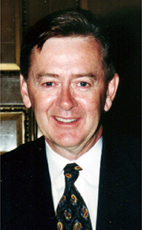
House of Commons photo

Crucial Fact

  • His favourite word was federal.

Last in Parliament May 2004, as Canadian Alliance MP for Calgary Southwest (Alberta)

Won his last election, in 2000, with 65% of the vote.

Statements in the House

The Budget February 13th, 1995

Mr. Speaker, in an interview over the weekend, the finance minister said that any tax hikes in this month's budget will be taken from the top first. What Canadians want is for the government to start at the top with spending cuts, not tax increases.

For example, the government is going to spend $12 million to build an office tower in Sault Ste. Marie, a city that already has one of the highest vacancy rates in the country.

Why does the finance minister continue to propose tax increases when there is still so much visible waste and inefficiency in government spending? Why not wring that inefficiency and waste out of the government before they wring more dollars out of taxpayers' pockets?

Social Programs February 8th, 1995

Mr. Speaker, the government has not yet provided any satisfactory explanation for the failure of the social program review. Surely one of the reasons is that the minister handed out millions and millions of dollars to liberal thinking special interest groups to lobby for the status quo and against spending reductions.

This is becoming the Achilles' heel of the government. The parole board has been weakened by patronage and special interest politics, as has the IRB and the social program review.

My question is for the Deputy Prime Minister. Instead of excusing and justifying patronage and special interest politics, when is the government going to acknowledge that it is this addiction which weakens the government's integrity and do something to correct it?

Social Programs February 8th, 1995

Mr. Speaker, the failure of the social program review has a direct impact on the spending in the budget.

As the government knows, over 60 per cent of its spending is in the social area. The budget cannot be balanced unless both social programs and social spending are substantially reformed.

Will the government not acknowledge that the primary reason the finance minister is now considering tax increases, which he was not doing two months ago, is because the human resources development minister failed to deliver on social programs and social spending?

In other words, will the government acknowledge that it is the taxpayers who are going to pay for the human resources development minister's failure?

Social Programs February 8th, 1995

Mr. Speaker, many months ago the Minister of Human Resources Development launched his much touted review of social programs. He promised to radically transform our social safety net to make it more efficient and restore hope to those entrapped within it. Now, months later and millions of dollars later, nothing. The minister has failed to deliver on any of his promises and his failure will cost Canadians dearly in the budget.

My question is for the Deputy Prime Minister. Given the government's failure in this regard, what plans does it now have to reform social programs and when can Canadians expect the results?

The Budget February 7th, 1995

Mr. Speaker, if you set your targets low enough, even the Conservatives can hit them.

The government seems to be finding ways of getting information to the money markets about the budget in order to prepare their reaction and calm their fears, but it is unprepared to provide the same information to this House and the Canadian people who have an even greater stake in the budget.

I am wondering whether the Prime Minister condones this double standard or whether he is willing to be as frank with the Canadian people as his finance minister is apparently willing to be frank with financial analysts.

Is the Prime Minister willing to tell the Canadian people today, yes or no, whether the government intends to increase taxes in the forthcoming budget? Be as frank with them as the minister is with the analysts.

The Budget February 7th, 1995

Mr. Speaker, I can understand why the finance minister wants to try to con the markets and outline his budget strategy to financial analysts. They are uncertain and worried about the government's fiscal direction. The Canadian people are also uncertain and worried about the government's fiscal direction and they need some reassurances.

How is it that the government can find ways to reassure financial analysts on the size of the budget deficit and spending cuts, but will not tell the Canadian people anything about pending tax increases? Why the double standard? It is their money.

The Budget February 7th, 1995

Mr. Speaker, yesterday the finance minister said it would be fruitless for Reformers to ask questions about the budget because he would not under any circumstances get into specifics. Yet representatives of the financial institutions seem to be learning a great deal about the budget from off the record conversations with government insiders. For example, Sherry Cooper, chief economist of Nesbitt Burns says that those in the know tell her the government will save $5.25 billion in spending reductions next year and $7 billion in 1996-97.

Will the minister provide the House with the list of institutions and others who have been provided with this type of information about the forthcoming budget and will he explain why he is not willing to provide the same details to this House and the Canadian people?

Security Intelligence Review Committee December 15th, 1994

Mr. Speaker, today's SIRC report on the Bristow affair highlights the inadequacies of checks and balances on CSIS. It is also clear that the mechanisms for monitoring the activities of CSIS are ineffectual. They are open to political manipulation by virtue of the patronage appointments to the Security Intelligence Review Committee.

Will the minister agree that the highly political and completely ineffectual Security Intelligence Review Committee should be done away with? Will he agree that the parliamentary subcommittee on national security should be made the watchdog of CSIS and should be given the teeth to do the job?

Security Intelligence Review Committee December 15th, 1994

Mr. Speaker, sections of the SIRC report read like a who's who of the Tory party. Their names are sprinkled throughout the report: Lewis, Jelinek, Dobbie, Segal, Sparrow, Campbell. Many of these people were reported to have had meetings with key players in the Bristow affair and were involved in smear campaigns against the Reform Party. Yet, in interview after interview with these former Tory politicians, SIRC avoided asking the key hard questions.

Will the Solicitor General agree that a committee like SIRC composed of political partisans investigating alleged improprieties by politicians makes a mockery of natural justice and discredits the internal security system in this country?

Security Intelligence Review Committee December 15th, 1994

Mr. Speaker, the SIRC report on the Bristow affair brought forward this morning is a whitewash. It does not adequately address the Reform Party's primary concern, namely that a paid agent of the former Progressive Conservative government allegedly tried to build links between Reform and extremist groups for the purposes of discrediting Reform in an election.

The Mulroney-Campbell administration may or may not have known what Grant Bristow was doing but they were certainly aware of his activities and they were in a position to use that information for political advantage.

Will the Solicitor General tell this House why SIRC did not more thoroughly investigate this particular concern and what he intends to do about it?