
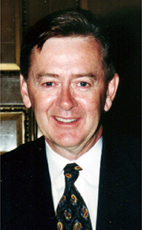
House of Commons photo

Crucial Fact

  • His favourite word was federal.

Last in Parliament May 2004, as Canadian Alliance MP for Calgary Southwest (Alberta)

Won his last election, in 2000, with 65% of the vote.

Statements in the House

Taxation December 14th, 1994

Mr. Speaker, the blunt truth of the matter is if the minister cuts spending the way he should, special interests in the country will squeal like stuck pigs. If he tries to fix the deficit with tax increases he will injure the economic interests and prospects of every man, woman and child in the country. He is going to take heat either way.

Why does he not take the political heat for doing the right thing rather than the wrong thing and declare that he will fight the deficit only through spending reductions? Why do you not take the heat, through you, Mr. Speaker, for doing the right thing rather than the wrong thing?

Taxation December 14th, 1994

Mr. Speaker, when the average Canadian is faced with a $200 a month increase in mortgage payments, he or she has only one real option and that is to cut spending in other areas of expenditure. When it comes to meeting increased mortgage payments on the national house we hear, to our dismay, that the ministry is now considering getting the money from tax increases on gasoline, on personal incomes and on corporate incomes.

Will the minister please tell us that these rumours are utterly unfounded, that there is no truth to the fact, and that he has no intention of taking more money out of taxpayers' pockets in order to meet his increased mortgage payments?

Taxation December 14th, 1994

Mr. Speaker, the Bank of Canada rate rose three quarters of a per cent yesterday to over 7 per cent, driving up consumer loan rates. Since April the interest rate increases have added about $200 a month to payments on a mortgage of $100,000.

As the finance minister knows, our national house is mortgaged to the tune of $542 billion, on which we make payments of approximately $3.3 billion a month in interest alone.

Could the minister tell us what impact these interest rate increases over the past year are having on the national mortgage? Could he give us a precise dollar figure on how much these interest rate increases are costing the federal treasury since the government took office?

Immigration And Refugee Board December 13th, 1994

Mr. Speaker, can the minister tell us which government officials negotiated the settlement with Mr. Schelew and what his own role was in those negotiations?

Immigration And Refugee Board December 13th, 1994

Mr. Speaker, my question was: Who negotiated the settlement with Mr. Schelew?

Immigration And Refugee Board December 13th, 1994

Mr. Speaker, over the past month the allegations of intimidation and artificially inflating refugee acceptance rates have been levelled at Michael Schelew and the Immigration and Refugee Board.

On November 21, Mr. Schelew was quoted as saying that he would not negotiate a severance package because he wanted exoneration. A judicial inquiry was ordered. It was called off because Mr. Schelew resigned with a $100,000 parting gift from the federal government.

Who negotiated and authorized this severance package? Will the minister make public the details of the negotiations which led to this 180 degree turn by Mr. Schelew?

Quebec December 8th, 1994

Mr. Speaker, for the first time in a year I actually think we are making progress in Question Period.

Section 7 of the proposed sovereignty bill states Quebec shall assume the obligations and enjoy the rights arising out of treaties to which Canada is party. This statement is not only presumptuous but also clearly unconstitutional.

The federal government has the sole role to negotiate and sign international treaties and many have their own provisions for who joins those treaties.

Is not section 7 of the proposed sovereignty act beyond the power of the Quebec government? If it is, should not the federal government say so now?

Quebec December 8th, 1994

Mr. Speaker, I appreciate the Prime Minister's answer. We had trouble getting that type of answer yesterday and the day before.

The Quebec government has also stated that in the event of a vote for sovereignty in the upcoming referendum, an economic association with Canada would be maintained. Again, the statement is completely presumptuous, without regard for the position which the government and the people of Canada might take on such an association.

Does the Prime Minister concur with the position that an automatic economic association between Canada and a separate Quebec should be assumed? If he does not, why does he not say so?

Quebec December 8th, 1994

Mr. Speaker, the federal government's reaction to Premier Parizeau's draft bill on Quebec sovereignty has been unfocused and even confusing.

The Prime Minister is quoted as saying his strategy is to win the referendum battle but he does not say which referendum, having dismissed Mr. Parizeau's referendum plan. The government seems very reluctant to comment on the illegality or legality of what is proposed or to point out specific flaws in the Parizeau plan.

Section 5 of the draft sovereignty bill states Quebec citizenship may be held concurrently with citizenship of Canada or any other country.

Does the Prime Minister accept this position, yes or no? If he does not, why does he not say so?

Supply December 8th, 1994

Madam Speaker, I thought I made myself clear as to what I consider democracy to be. The heart of it is the consent of the governed and democratic processes have to meet certain basic fundamental tests no matter where we talk about democracy in the world.

Those tests are as follows. They must conform to the rule of law. Second, they must ask real questions about the real issue, not indirect questions. Third, they must present all options and allow equal opportunity for all options. Fourth, the processes must result in getting the consent of the governed.