
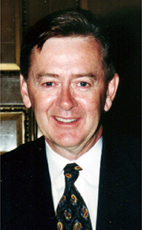
House of Commons photo

Crucial Fact

  • His favourite word was federal.

Last in Parliament May 2004, as Canadian Alliance MP for Calgary Southwest (Alberta)

Won his last election, in 2000, with 65% of the vote.

Statements in the House

Finance February 16th, 1995

Mr. Speaker, just a few hours ago Moody's bond rating service announced it will review Canada's foreign debt rating and also Canada's AAA domestic rating. Moody's is not only sending the government a wake-up call, it is ringing the alarm bell.

Will the Minister of Finance finally acknowledge that the markets are rejecting his deficit reduction targets as inadequate and that Canada's debt and deficit situation is much more serious than he or the Prime Minister has led us to believe?

Taxation February 15th, 1995

Mr. Speaker, the present premier of Ontario was chosen as citizen of the year in Buffalo, New York because his tax and spend policies drove so many companies across the line to Buffalo, New York.

Is it the aim of the finance minister to become citizen of the year in Panama by including tax increases in his next budget?

Taxation February 15th, 1995

Mr. Speaker, the Minister of Finance of all people must understand the impact of tax increases on the economy. If tax levels or other charges paid to governments are increased, one effect is to drive capital, jobs and companies out of the country.

Canada Steamships, for example, which is owned by prudent and patriotic people, has registered a number of its vessels under foreign flags of convenience to no doubt avoid paying astronomical registration charges, et cetera.

Does the minister not agree that there will be a flight of capital, companies, jobs and productive individuals out of Canada if they are the targets of tax increases in the next budget?

Taxation February 15th, 1995

Mr. Speaker, after weeks of telling this House that he could not reveal the contents of the budget, the finance minister appears to have spilled the beans to his provincial counterparts and the national media. He indicated yesterday that he intends to raise taxes on corporations and so-called better off Canadians.

At what levels of household income does one become a better off Canadian and therefore a target for a tax increase?

The Budget February 14th, 1995

Mr. Speaker, the Prime Minister's replies are hardly inspiring confidence. The provincial premiers have joined thousands of Canadians in saying no to tax increases, no to new taxes, and no to tax grabs in the name of tax equity.

As provinces like Alberta, New Brunswick and Saskatchewan reduce their deficits their citizens are looking for tax relief. The last thing they need to see is a tax grab by a fiscally irresponsible federal government.

What assurances could the Prime Minister give to the citizens of those provinces that their reward for practising fiscal responsibility is not going to be a tax grab by a fiscally irresponsible federal government?

The Budget February 14th, 1995

Mr. Speaker, yesterday Liberal Premier Clyde Wells of Newfoundland said that the best thing the federal government could do would be to stop direct spending in such areas as education, health and forestry. He argued that all these services could be better provided at less cost by the levels of government closest to the public.

Will the Prime Minister follow the Newfoundland premier's advice and give the provinces real control over these areas including appropriate tax points? In other words, will he make clear his government's philosophy on decentralization including the transfer of tax points to the provinces?

The Budget February 14th, 1995

Mr. Speaker, today the provincial finance ministers are meeting with the federal finance minister to discuss the federal budget.

At least half the provincial finance ministers are doing a better job at balancing their budgets than the federal government. One of their greatest concerns is that the federal government will simply offload its own debt problem on the backs of the provinces, particularly those that have managed their finances efficiently.

My question is for the Prime Minister. What assurances could he give to fiscally responsible provinces that their reward is not simply going to be an offloading of the federal debt?

The Budget February 13th, 1995

Mr. Speaker, if the ministers are going after waste and inefficiency with the vigour that the finance minister suggests, why do we continually, day after day, see these illustrations such as the office building in Sault Ste. Marie and the unnecessary computer expenditures?

If there has been this huge, deep, passionate commitment to eliminating waste, why do these instances continue to show themselves day after day after day?

The Budget February 13th, 1995

Mr. Speaker, I am sorry. The Department of Fisheries and Oceans and the department of public works are spending close to $10 million on unnecessary computer upgrades; over $15 million is earmarked for getting a fax machine on virtually every public servant's desk. That is $37 million in unnecessary expenditures right there.

My question is for finance minister. In the name of common sense and in the name of taxpayer relief, will the finance minister order an immediate freeze on such unnecessary capital expenditures until the budget is balanced?

The Budget February 13th, 1995

Mr. Speaker, this wringing of waste has a long way to go. Twelve million dollars for an office building in Sault Ste. Marie is just the tip of the iceberg. Many federal bureaucrats are trying to blow out their remaining budgets before the end of the fiscal year.

Both the department of furniture and oceans and the department of public works are spending $10 million on unnecessary computers-