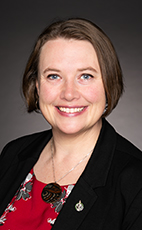
House of Commons photo

Crucial Fact

  • Her favourite word was veterans.

Last in Parliament April 2025, as NDP MP for North Island—Powell River (B.C.)

Won her last election, in 2021, with 40% of the vote.

Statements in the House

Fall Economic Statement Implementation Act, 2022 December 5th, 2022

Madam Speaker, just to clarify, in fact, the NDP offered an amendment to a motion that the Conservatives put forward in terms of the GST and the carbon tax.

Every province and territory in this country is not the same. I am from British Columbia, and our tax system for carbon pricing is overseen, rightfully, by the province. This is something our province decided when the B.C. Liberals were in power. I think they have a new name, but I do not know what it is yet. I apologize.

If we actually addressed the issue and had GST removed from home heating, it would mean that everyone would have some sort of relief, as opposed to a carbon tax, which would only focus on a few parts of Canada but not the whole of Canada. For me and for the NDP, when we do things, we want to make sure that everybody is included and nobody is left out.

Fall Economic Statement Implementation Act, 2022 December 5th, 2022

Madam Speaker, I always do my best to read people's minds. However, my response is simply that this is more than sad. This is an everyday reality for indigenous communities across this country. Until it is an everyday reality for every Canadian in this country, it is not going to stop.

I hope this government will actually get the resources into pockets and that we will also assist in searching for the bodies of these young people, of these women and girls. That is what we need to do, and I hope that the government does it.

Fall Economic Statement Implementation Act, 2022 December 5th, 2022

Mr. Speaker, I am very honoured every day to stand up in the House. Today, we are talking about the fall economic statement. Before I talk about that, I just want to take a moment at the beginning of my speech to recognize that the bodies of indigenous women have been found in Winnipeg and an alleged Winnipeg serial killer has been identified.

I think collectively in the House, and hopefully across all of Canada, we are sitting with the deep horror of that reality and what that means for all of us. It is shameful that we live in a country that still does not value indigenous women and girls and our LGBT community. We see it demonstrated repeatedly. I hope all of us are carrying this in our hearts and that we continue to carry it in our hearts and our minds every day until this stops.

Coming back to the fall economic statement, I want to talk about some of the concerns I have around this economic statement. We are all hearing from constituents who are struggling every day to afford the basic necessities in their lives. We hear about the increasing use of food banks. We also hear from so many families who are eating substantially less. Parents are acting like good parents and are not eating as much so their children can go to bed with full bellies. That is something that we should all be listening to.

We know that inflation is certainly a part of the problem. However, we also know that greed is a huge part of the problem as well. In my community, I hear from a lot of indigenous elders and they consistently tell me that greed is an illness. They have a lot of traditional ways of dealing with greed, because it is seen as a sickness that will hurt our communities at large. I wish that, in this place, we could also see it as a sickness that needs moderation. It needs systems in place to stop it.

We know that Loblaws has seen record profits. It is profit like it has not seen in well over five years. It is profit that is so substantial that we hear it is making $1 million extra a day. That concerns me greatly. As we are having this discussion, it is important that we recognize that this fall economic statement does not really substantively address that issue and I hope that it will soon.

We know that the Canadians for Tax Fairness have said that the costs from inflation are more than what is passed on to consumers. That means that inflation is passed on to consumers but more is added. In my opinion, that is simply greed. We need to address that issue so that we hold the people who sell us our food accountable.

I remember a constituent once told me, “Rachel, we are not consumers; we are Canadians.” Every day when I am in the House, I really try to remind myself of that as we look at our systems and recognize some of the challenges in them.

I also did not see a substantial enough increase for housing. I know that on November 25 in my riding in Campbell River, there was a conversation on housing. Many representatives from communities throughout my region were participating. I heard again and again, like I do so often, that housing is simply a crisis. If someone has a fixed income or a low income, it is getting harder to find a place to live. A lot of people are living outside. There is a lot of snow in my area, which is fairly rare, but it is having a huge impact.

We also know that a lot of seniors are couch surfing. When I get calls from people in their eighties who are moving from friend's house to friend's house and sleeping on couches, it just means there is something substantively wrong in this country. I want to remind Canadians that the federal government really has not been part of the housing strategy in this country since 1992. I appreciate that the government has put some money into it, but if we leave a wound festering like that for so long, it is really hard to fix it. That is what we are seeing here.

I want to thank the Campbell River Community Foundation and the Campbell River and District Coalition to End Homelessness for all of their work on this particular file. We heard from small communities and indigenous communities. They are left out. The federal funding is not working. Indigenous communities are not getting the supports they need from the government and it needs to be better.

I also have concerns that we are not talking about GST on home heating. We know that this would help. It is not the biggest help, but put together with a lot of things, it would help hard-working people across this country be able to pay for their heat when we hit the cold season.

We still have not seen a meaningful windfall tax. That is such a gap. We need to have more structures in place. Again we will hear from the government on this, but it has not fixed the problem. It has done a few tweaks, but it has not taken that comprehensive look at the fact that people are making a lot of profit off the labour of Canadians and they are not paying their fair share. Ultrawealthy people are hiring accountants who can help them pay very little, but everyday people are paying all of their taxes. That is wrong and we have to fix it.

There are a few things that I am very much in support of in this bill as well. I was excited to read about the Canada recovery dividend. This is something that the NDP has been asking for. It is temporary and maybe we do not want temporary, but it is there. It is a one-time tax of 15% of taxable income over $1 billion, so it is getting at some of those profits. The other thing we know is that in this country a lot of corporations, after the pandemic, have done extremely well very quickly. In fact, many of them are making more profit than before the pandemic. We need to question that, we need to understand it and we need to make sure that they pay their fair share.

This dividend would also increase corporate income tax on banks and life insurance groups by 1.5%. That is getting some of that windfall tax and putting it back into the coffers. It is making sure that people in our communities get things like appropriate housing, dental care and a bit of support to help with their rent when they pay way more than 30% of their income on rent.

Those things will make a difference, but we also know that the Parliamentary Budget Officer has been very clear that if this Canada recovery dividend were put on big box stores and the oil and gas sector, we would see an increase of revenue to Canada of about $4.3 billion. We need to question this. Again, I keep coming back to this and the NDP will continue to keep coming back. When we see groups of people and big corporations making significant profits when other people cannot even feed their families and other people are living on the streets, Canada has an obligation to address this issue. Therefore, these are some steps in the right direction, but we still need to see more.

There is another thing that I am in support of and I am looking forward to seeing finally implemented. I know the NDP has been fighting and talking about this for many years. It is the removal of the federal portion of interest on student loans. We spend a lot of time in the House talking about young people and about the fact that they do not have enough to buy a house and that they are struggling, sometimes with several jobs in a very changing economy, to address the needs that they have and to have a future that they can believe in.

This is one step. It is not the only step that should be taken on behalf of young people. The federal government has to do more, but it is something that really would support a lot of young people and allow them not to have that burden. They go to school so that they can contribute to their community and to their country. If they have to spend all of their time trying to find a way to pay off their loans, then they do not get to do the things that will make all of us as Canadians a lot more substantive and healthy.

In closing, I want to say that I will be supporting this bill. I believe fundamentally in the fact that people need dental care, and I am really excited to see that come out the door. We know that we still have work. I am really excited to see next year that seniors finally get dental care. I do not know about the rest of the MPs in this place, but I have had a lot of seniors come to my door and talk about the fact that they cannot afford basic dental care and what the impact of that is in terms of their health and well-being.

I look forward to answering any questions.

Fall Economic Statement Implementation Act, 2022 December 5th, 2022

Mr. Speaker, one of the concerns that I have in my riding, and I am wondering if the member has the same concern, is how many seniors are becoming homeless or unhoused within my region. It is quite concerning when I see some seniors in their seventies living in their vehicle or living rough in a tent in my communities. It is very concerning.

I just wonder if the member could speak to this, and if she agrees with the NDP that we should not have the OAS increased only for those aged 75-plus, but that in fact it should be for all seniors, so we can lift them out of poverty and make sure they have a safe home to live in.

Fall Economic Statement Implementation Act, 2022 December 5th, 2022

Mr. Speaker, one of the things that I felt was really missing in this fall economic statement was a serious and comprehensive investment in housing, specifically for smaller, rural and remote communities.

A few weeks ago, I was a part of a big dialogue in my region where the Campbell River Community Foundation and the Campbell River and District Coalition To End Homelessness brought together stakeholders from the whole region. Some of my smallest communities have a very specific need, and they have people who are living in substandard housing or they are out on the streets. When there is a population of 1,300 people to 4,000 people, one does not want to see that.

Could this member talk about the need for rural and remote communities to actually have funding resources and for the federal government to finally get into the game?

Questions Passed as Orders for Returns December 5th, 2022

With regard to the Post Living Differential (PLD) allowance offered by the Department of National Defence to Canadian Armed Forces (CAF) members, broken down by Canadian Forces bases, region and year in the past 10 years: (a) what is the amount of PLD allowance offered to members, in dollars and percentage of salary; (b) how many members receive the PLD allowance; (c) how many members do not receive the PLD allowance; (d) how many members are living in single versus family units; (e) when did the department last undertake a comprehensive review of the PLD levels; (f) are there plans to undertake a review of the PLD allowance; and (g) what criteria is used to determine whether the PLD allowance is offered or not?

Health December 2nd, 2022

Madam Speaker, the situation in our ERs is a disaster. People cannot get treatment or care when they need it. In my riding, the ERs at the hospitals in Port Hardy and Port McNeill have been forced to close regularly. Yesterday, a person even collapsed at the Port Hardy ER. They had gone for help and found it closed.

For years, the Liberals have underfunded health care and Canadians are now not able to even access it. When will the government act on the health care staffing crisis in rural communities and increase the Canada health transfer?

Housing December 2nd, 2022

Madam Speaker, I want to start by thanking all those helping with the warming centres across my riding. It is cold and snowy, and people need help. Housing is a human right, and Canada needs to start acting like it is. On November 25, a vital conversation on housing security was hosted by the Campbell River Community Foundation. I want to thank the co-sponsors: the Campbell River and district homelessness coalition, a coalition that brings stakeholders together to address homelessness; the City of Campbell River; Leith Wheeler Investment Counsel; Strathcona Regional District, BC Housing and CMHC.

People participated from many parts of my riding, and they all agreed that housing is a crisis everywhere. From Cortes to Port Hardy, to Gold River to Campbell River, to Powell River, every corner of our region is struggling. A clear challenge I heard was that small communities find the application processes leave them out, although their needs are so high.

Our innovative communities are doing so much, but Canada must finally step up to support housing in rural and remote communities. I am asking it to do so now.

Federal Framework on Autism Spectrum Disorder Act December 1st, 2022

Madam Speaker, I am honoured to speak to Bill S-203, respecting a federal framework on autism spectrum disorder.

Before I speak about this really important bill, I want to recognize that today is my grandson's birthday. I want to wish Dude a very happy birthday. I wish I could be with him. As so many of us in this place know, we miss a lot of important days. It is hard for me to miss his birthday today, so I just wanted to wish him all the best.

I want to give many thanks to the member for Edmonton—Wetaskiwin. I know about his advocacy. I have certainly seen this bill in this place before. I hope that we finally get it through. It is so important.

I think the basis of this is really about how we look at this whole country and make sure that everyone feels like they belong. One thing that is very clearly a challenge in a country as big as ours is that often different provinces and territories have different services that do not always meet the need. It is really important that when we look at this framework, we understand that by bringing everyone together. We want to see the best supports in place for those living with autism spectrum disorder and for those who love them the most.

Whenever one of our fellow members brings their human experience, their lived experience, to this place to say, as a person who lived through these realities, here is a way we can make life better for everyone, we should all pay attention. We should all listen and make sure that when we speak to this issue, we speak in a collective voice. I certainly hope that is what happens.

This really talks about having a national framework and making sure there is a timely and equitable process for people to access screening and diagnosis so that they are able to access the supports that are there. It is also so much about providing good financial supports. Often folks living within this group have challenges. There are extra needs. We want to make sure that people have the supports they need to do this well and that there is support for caregivers. There is nothing worse than seeing people who are working so hard giving all of that care and they burn out because we do not have the proper supports in place for them. We do not want to see that happen. We want there to be success where there should be success.

This also talks about having meaningful research and the resources there to provide that research so that those services are there. In that way, our communities can do better and we can provide an adequate service, community connection, so that people can succeed.

I often think about this. I think about how we can pay attention to what is happening to all of the people in our communities so that no one gets left behind. I think about how we can take the time to notice where those blocks are and remove those blocks so that we can have that wholesome support.

Public education is part of this framework. That is incredibly important. It is only with education that we draw so much more awareness and allow people to hold this information. It creates an environment of curiosity. That is really important. I cannot say enough from my perspective about how much we need to have curiosity so that when somebody is a bit different from us, instead of us being afraid, we really open doors, ask questions and learn how we can work with people in a more meaningful and profound way.

What we know based on so much research is that people in our communities have been left behind. It is shameful that in this country things fall apart. That really worries me.

I often think of Maya Angelou, who is a great hero of mine. She used to say that when we know better, we do better. That is why public education is important because, hopefully, the more we know, the more opportunity we can see, the more doors can be opened and the more inclusive our communities will become.

We also know that, if there is a co-occurring condition, it is even harder for families to be successful. There is a complexity, and added challenges, that we need to address, which is part of the reason this framework is so important. It brings people to the table to talk about the co-occurring conditions and what they mean going into the future. If we are going to provide and build communities that we can be proud of, a country that we can be proud of, we really need to make sure that that is done.

We know that resources around knowledge and research are desperately needed. We also know that rural and remote communities are often challenged to provide the services. This is a big concern for me. For myself, representing a rural and remote community, I see all too often that the services that are desperately needed across the board are just not there, and the people who are trying to provide those services are doing their very best. However, often when we look at service delivery, we forget that broad areas with lots of travel for service providers becomes very challenging, and asking families to travel big distances is another challenge.

We need to be looking at this. This is really important. I have spoken to people in my riding who deliver services, who work with families, and they talk about this repeatedly. They need more time. They need the right services in place. We need to find pathways so we are not sending families far away from home to get help because it just adds another burden. It is harder to get ahead. It is harder to do the everyday things of life. It is harder to maintain employment, sometimes, because of the high needs and care that are required.

I really hope that, when we look at this framework, we are really attentive to making sure that the needs that are out there are supported, regardless if people live in a more urban centre or in a more rural centre.

One of the things that is so important about this bill as well is that it talks about that coordinated effort, bringing all levels of government together to make sure we are not seeing overlap, and where there are gaps, identifying them and finding the resources to fill those gaps. This is so important.

I am grateful to be here to speak to this bill. In closing, I just want to say that the most important part for me, and I think we are almost there in this bill, is the concept of “nothing without us when it is about us”. I need to be very clear that is something the NDP will be making sure of. What we do not want to see happen is a framework put into place where people who are not living this every day, who are not supporting it every day, are having more of a say than those who are experiencing it.

The NDP will be supporting this bill. I look forward to seeing it finally getting through this place and out into the country so we can see better supports, and identify those key challenges, to building a better Canada for everyone.

Petitions December 1st, 2022

Mr. Speaker, I am here to present a petition on behalf of many constituents in my riding of North Island—Powell River who are very concerned about the foam from marine infrastructure and its increasing pollution of Canadian beaches.

Expanded polystyrene, commonly known as styrofoam, in the marine environment is very hazardous. They are concerned that it will cause significant harm to marine life, seafood resources and ecosystems. It is incredibly difficult to clean this debris from the shores. As members know, it breaks up into very small pieces, enters the system and is very hard to get out. The petitioners are calling for action to prohibit the use of expanded polystyrene in the marine environment.