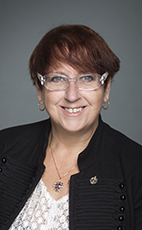
House of Commons photo

Crucial Fact

  • Her favourite word was languages.

Last in Parliament October 2019, as Conservative MP for Beauport—Côte-de-Beaupré—Île d’Orléans—Charlevoix (Québec)

Lost her last election, in 2019, with 30% of the vote.

Statements in the House

International Women's Week March 7th, 2008

Mr. Speaker, International Women's Week ends on March 8, which is International Women's Day.

Our government is working to support women's full participation in Canada's economic, social and democratic life, which will help achieve equality for all women.

Our government has taken real action to support women and their families. This week, we announced that five new women's shelters will be built. This will help fight violence against first nations women and families.

In addition, we have announced 14 more projects that will receive a total of $3.4 million in funding. For those of us on this side of the House, equality is not just a symbol; it is, first and foremost, our reason for being.

I would like to take this opportunity to personally salute all of the women in this House on this special day of ours.

Status of Women March 6th, 2008

Mr. Speaker, advancing women's equality means establishing a solid foundation for future generations. That is why, in the last budget, our government proposed the creation of an action plan for women.

Advancing the equality of women in Canada by improving their social and economic conditions and increasing their participation in Canadian democracy is this government's primary objective.

It is time to recognize that women have been making a huge contribution for a long time. Their contributions will probably change the face of our society, which will benefit us all.

This is what real action looks like. Here, we listen, we have dialogue, we take concrete action, while the Bloc Québécois talks and talks, but can never take any positive action.

We believe that equality is not just a symbol; it is our reason for being.

Business of Supply March 6th, 2008

Mr. Speaker, our record is this: our government grants $20 million a year to projects that have a direct impact on women and girls, which is a record for Status of Women Canada.

Furthermore, several Canadian government programs are directly related to women, such as the official languages minority communities program, the aboriginal peoples' program, particularly the national women's organizations component, the women's multiculturalism program, the Justice Canada crime prevention program, programs funded by Health Canada, and the Citizenship and Immigration Canada immigration settlement and adaptation program. We have several other programs.

Whenever we present a budget and we want input from women, the NDP always votes against those budgets.

Business of Supply March 6th, 2008

Mr. Speaker, as hon. members know, the court challenges program matter is before the courts and I will not answer that question.

Nonetheless, it always makes me laugh to see that the Bloc Québécois is now interested in official language minorities when we know full well that that very party has never lifted a finger for francophones outside Quebec. I do not owe the Bloc Québécois any explanation—especially when it comes to this.

Business of Supply March 6th, 2008

Mr. Speaker, as I have said, and I cannot say this enough, we are working to give funding directly to women in need, to all Canadian women across Canada, including women in Quebec. We want to deal directly with them.

We have proven a number of things. With all due respect to my colleague, it is by working directly with women that we understand their needs. And they need funding to be available.

Business of Supply March 6th, 2008

Mr. Speaker, I will be sharing my time with the member for St. Catharines.

I rise today on a motion introduced on this opposition day, to speak to a number of issues related to the status of women in Canada, and specifically to talk about what our government has accomplished.

Our government is taking the necessary steps to support projects that help improve women's lives.

I am happy to remind this House that in budget 2008, our government announced that we would develop an action plan to advance equality for women in Canada by improving their economic and social conditions and their participation in democratic life.

I am proud to say that we have made changes to Status of Women Canada to modernize the organization. We have updated the women's program, with special focus on the terms and conditions of that program.

The mandate of the women's program now reads as follows: “to advance the equality of women across Canada through the improvement of their economic and social conditions and their participation in democratic life”. The program supports projects that improve the status of women in key areas such as women's economic status and violence against women and girls.

Our government wants to achieve real results for Canadians by addressing situations and issues that they consider important. That is why our government streamlined operations at Status of Women Canada and its regional offices and increased their accountability.

How did we do that? We also allocated additional resources to the important work the organization is doing for Canadian women, their families and their communities.

My hon. colleagues in this House will recall that in 2007, our government gave $10 million in additional funding to Status of Women Canada for 2007-08 and put in place a new funding mechanism for the women's program.

In this way, our government increased the grants and contributions budget of the women's program by 76% to a record high of $20 million.

With this additional funding, Status of Women Canada is now better equipped to distribute grants and contributions under the women's program and get more results for women. We believe that money must be made available to groups that are helping women in their communities. That is what helped us streamline the women's program.

The women's program is operating much more efficiently and cost-effectively thanks to its four points of service. Through this program, we are funding projects that reach women right in their communities, where they need it most.

As a result of an initial call for proposals from the women's community fund within the women's program, $8 million over three years will fund 60 projects reaching more than 60,000 women across Canada. Here are a few examples of projects funded by the women's program.

Two weeks ago, in Iqaluit, I announced that the YWCA of Canada will create three points of service in Nunavut, the Northwest Territories and Yukon, where culturally appropriate health services will be offered, along with entrepreneurial job training, child care programs and programs for the prevention of violence against women and children in aboriginal and northern communities.

The organization Femmes Équité Atlantique will tackle the obstacles facing Acadian and francophone women aged 16 to 30 and over 50 living in minority language situations in the Maritimes.

The organization Groupe Femmes, Politique et Démocratie will offer leadership training to 600 women all over Quebec and mentor some 100 women in Quebec who wish to actively participate in the democratic process.

The Planned Parenthood Association of Edmonton will provide support and services in the area of reproductive and sexual health to some 100 immigrant and refugee women living in Edmonton.

Another call for proposals by the women's community fund met with unprecedented success. We received more than 300 proposals.

This overview confirms that the existing regional offices of Status of Women Canada ensure that implementation of the women's program is far-reaching and truly effective. Status of Women Canada is continuing to serve women throughout the country, in both rural and urban areas, from these four offices, which now operate at maximum efficiency. Electronic communications allow us to properly serve our clients.

Streamlining the operations of the women's program has resulted in much greater efficiency in many respects. A two-tiered application process is now in place. The women's program accepts general funding applications throughout the year. Specific calls for proposals are launched periodically.

We want to work together to improve the lives of Canadian women. This means that more projects and more funds must directly help women in their communities in an effective and responsible manner. In order to achieve this objective, we carefully reviewed all aspects of the work of Status of Women Canada.

Changes are not restricted to the women's program and regional offices. All Status of Women Canada operations were streamlined. Staff is concentrating on the clearly defined priorities of the organization—women's economic security and prosperity and the elimination of abuse—so that they may take full advantage of the funding we are providing.

I am pleased to point out that in the 2008 budget our government announced that we would soon be preparing an action plan to advance equality of women in Canada by improving their social and economic conditions and increasing their participation in democracy. That demonstrates true respect for Canadian women.

Official Languages February 29th, 2008

Mr. Speaker, our government is acting in the interests of official language communities and is ensuring the vitality of French and English in Canada.

A strategy to implement the next phase of the Action Plan for Official Languages is currently being developed. The amounts have not yet been reported because we are working on the second part of the plan. You will be informed in due course, Mr. Speaker, when it becomes available.

The Budget February 29th, 2008

Mr. Speaker, not only did our government increase the budget for the women's program by 76%, the biggest increase ever, but I am also pleased to say that in Budget 2008, our government confirmed that it will go ahead with the initiative by developing the first Status of Women action plan to advance equality of women in Canada by improving their social and economic conditions and increasing their participation in democracy.

We believe that equality is not just a symbol; it is our reason for being.

Status of Women in Nunavut February 29th, 2008

Mr. Speaker, last week, I had the opportunity to go to Iqaluit, Nunavut, to see the living conditions of women in the north.

I met with the minister responsible for the status of women in Nunavut, Leona Aglukkaq, who explained to me what challenges women in the territory are facing.

I attended a meeting where the Quillit Women's Council explained the work it does with these women and the limitations that come with the expanse and isolation of the territory. I also had the honour of visiting one of the support centres for battered women.

This trip also gave me the opportunity to announce $1.5 million project under the Status of Women Canada partnership program that will allow the YWCA to make a difference in the lives of these women who truly need it. This project is a perfect example of the kind of work Status of Women Canada does.

I am thankful to all the wonderful people I met there and I particularly want to pay tribute to all those women who have broken the silence on violence.

Status of Women February 28th, 2008

Mr. Speaker, our record on this side of the House is very good with regard to women's issues. The same will never be said of the Bloc. Our government is providing $20 million annually to projects that directly impact women and young girls—a record for Status of Women Canada. The Bloc has done nothing.