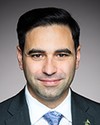
Thank you very much for that.
First, I do apologize; I have a chest cold. I have Sarah sitting beside me, so if my voice goes, I'll pass her the speech.
Before I begin, I want to offer my heartfelt condolences to the families and loved ones from Tumbler Ridge, Kitigan Zibi and Mistissini who have been facing unthinkable losses this week. We share in their sorrow.
Thank you to the House of Commons Standing Committee on Finance for inviting me to bring remarks on behalf of the Manitoba Métis Federation, the national government of the Red River Métis.
My name is David Chartrand. I have been elected eight times since 1997 to serve the Red River Métis citizens as their president. In that time, I have seen many federal budgets. Each has represented the economic reality of their moment in time. The hard reality of this moment has dictated the government's budget for 2026. The international order has moved away from co-operation amongst our traditional allies. Make no mistake: The need to respond and build certainty for our domestic security is essential. As with the legislation on major projects, my government is prepared to support our federal partners in this budget, but I cannot forget about the social realities of my people.
I am pleased to see that the balance of the urban, rural and northern housing program will be disbursed. However, the wait times on these allocations are long. We have completed our part of the work. We are shovel-ready on multiple housing projects. We are ready to build. We are waiting for Canada. MMF is already a proven success in housing. More than 1,469 Red River Métis families now own their own homes through the first-time homebuyer program. As a result, our citizens have infused $362 million into the economy. This is an extraordinary result over the past five years. In total, MMF manages 49 residential properties with a total of 152 units of affordable housing, including transitional housing units. This is MMF in action, helping our citizens confront the cost of living crisis today so that they will have an asset to carry them into the future.
The chair of this committee knows only too well the MMF investments into our community. Investments we have made in early learning and childhood education infrastructure have provided opportunities for parents to find their place in the economy, knowing their children have safe spaces to thrive. This is on top of the job creation that those investments create. It has also allowed us to contribute to the experience of the Ukrainian newcomer community in Manitoba, who understand only too well what a change in the international order has done.
MMF created the Ukrainian evacuee child care cohort to provide ELCC education opportunities for 25 Ukrainian citizens. The newcomers started their training in fall 2023, and by June 2025 were graduating from the program. All are now employed by my government. The success of this program has meant that a cohort of 30 Ukrainian students began their studies in April 2025. It is part of MMF ELCC's drive to grow the child care workforce and fill those necessary roles.
The success of our programs in housing and early learning and child care has been based on long-term agreements with Canada, which has allowed my government to make decisions based on long-term vision and planning. The nation-to-nation and government-to-government relationship is a proven model of success that supports this, and must be honoured regardless of who forms government. However, the future uncertainty of programs like urban programming for indigenous peoples carries risks for our youth. It takes away our ability to make the same long-term strategic decisions.
Additionally, we have 2,600 of our children in university. We provide $5,000 per year towards the costs of support, but each year the costs of this education will add up to $20,000 to $30,000 annually per student. This equates to about $78 million for the 2,600 students that we have to pay. Let me remind you that the statistics will show that the Métis students grow up in low-income households. Our people's forced history of going without means this is unattainable for our youth, or it will result in a heavy debt burden for them. We are still coping with the trauma of the sixties scoop, when thousands of our children were taken away. This destroyed families and communities. Our young people are still growing up with the impacts of generational poverty. Breaking the cycle is heavily dependent on their success in education. This cycle is resulting in our people being less visible in positions of influence in government, business and other careers.
We have made every effort to take ourselves through these cycles, but we need the tools to get our children where they need to go. We support space in the budget for major projects, in particular, the view that funding be tied to results, but the investments must lead to opportunities in education to build a skilled workforce. Our youth must have access to programming to provide them with the best start in life.
We have a responsibility to our young people. The time for investment is now—I mean now—so they will have the skills to participate in nation-building projects.
Following the federal promise to enact Métis-specific health legislation, we remain stuck in the same pattern of being caught in jurisdictional disputes between the provincial and federal governments. Too many of our people have died while waiting to be provided with the same services as any other Canadian taxpayer.
Do not forget that we are still waiting for Canada to follow through with our treaty, which I understand had first reading this morning, and for Canada to settle our land claim in section 31 of the Manitoba Act, 1870.
Concluding, these will ensure that we're at the national and international tables and not on anybody's menu.
Your partners in Confederation have been waiting 156 years for this day. I'm not here to ask for handouts or a hand-up. If you want to put something in our hands, give us a shovel, because Red River Métis are ready to do our part to continue to build this country. We ask for Canada to match our sense of urgency at this critical moment.
I welcome your questions.
Thank you.