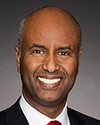
Mr. Chair, thank you for this invitation to appear with my colleague Rob Sinclair. I am here today following my recent appointment as Canada's Arctic ambassador and serving as Canada's senior Arctic official to the Arctic Council. It is an honour to follow in the footsteps of Her Excellency the Right Honourable Mary Simon, who from 1994 to 2004 was the first Inuk woman to serve in a similar role.
The Prime Minister announced my appointment at the Inuit-Crown partnership committee in Inuvik in July 2025. This Inuit-Crown partnership committee advances work on shared priority areas between Inuit and the federal government, so it was the perfect setting for this announcement.
I bring to this role deep experience acquired through living and working in Nunavut. I spent 11 years with Nunavut Tunngavik Inc., the territorial Inuit and rights holder organization where I focused on social and cultural development policy. That work brought me into regular contact with community-level organizations and their priorities, needs and aspirations. I also contributed to national-level work, including on the national Inuit committee on health under Inuit Tapiriit Kanatami.
I also worked for eight years with the Government of Nunavut, including time in the Department of Executive and Intergovernmental Affairs. In that role, I worked closely with Inuit organizations and the Government of Canada. I also had the honour of serving from 2018 to 2021 as principal secretary to Premier Joe Savikataaq, a role that involved frequent engagement with provinces, territories and the federal government. More recently, I worked at Qikiqtani Inuit Association, one of Nunavut's three regional Inuit associations, as the senior director of Inuit relations. That work included bilateral collaboration with Inuit in Greenland, exploring shared priorities between our communities in Nunavut and Greenland.
As shared by my colleague Rob Sinclair, the Minister of Foreign Affairs launched the Arctic foreign policy in December 2024 after months of meaningful and distinctions-based engagement with indigenous partners and territorial and provincial governments. Canada's Arctic foreign policy, which builds on and complements the Arctic and northern policy framework's international chapter, consists of four pillars: exercising our sovereignty, advancing Canada's interests through pragmatic diplomacy, asserting leadership on Arctic governance and multilateral challenges, and adopting a more inclusive approach to Arctic diplomacy. My role as Canada's Arctic ambassador is one of the priorities announced under the last pillar. Through this role, I will ensure that Canada's Arctic foreign policy remains connected to Canadians living in the north, including through my office in Iqaluit.
As Canada's Arctic ambassador, my top priority is to ensure that my role is co-developed in partnership with indigenous peoples and northerners, and that our diplomatic engagement reflects the voices and perspectives of those who live in the north. Over the coming months, I'll be engaging directly, both in person and virtually, to listen, learn and shape our approach together.
Last week I was thrilled to participate in my first international engagement at the Arctic Circle Assembly in Reykjavik. In addition to holding various bilateral meetings, I hosted a round table with Canadians, as a first step in my engagement process, to hear views from various stakeholders, including provincial and territorial governments, indigenous organizations, youth, business and NGOs, specifically to discuss my mandate.
As part of my engagement plan, I will travel across the three territories to meet with partners to exchange on my mandate, building on the formal and informal conversations I've already had so far.
I've scheduled a number of meetings with key stakeholders, and I'm looking forward to hearing their insights and priorities.
I also look forward to pursuing discussions at the Arctic security working group in Yellowknife in two weeks. My office will be compiling the feedback we receive through this process, and we will be sharing a summary with partners in the next few months. This is an important step in ensuring that our work reflects the voices and the perspectives of those who live in the north.
Since I started in my role only a few weeks ago, I sensed enthusiasm from Canadians, especially from northerners, in engaging with me to share their priorities related to the Arctic and the north. I've already benefited from hearing the perspectives of some northern and Arctic partners on matters that are of importance to them and how they see the role of my office. I have heard already about the importance of the relationship between partners and the Government of Canada on fronts such as maintaining strong relationships domestically, working together on areas of joint interest, the importance of a secure and sovereign Arctic, addressing critical infrastructure gaps and seeking opportunities for the expansion and diversification of the northern Arctic economies.
In conclusion, Mr. Chair, I want to thank the members of the committee for their attention and engagement regarding this important question. I'll be happy to answer questions related to my role.