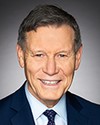
Evidence of meeting #34 for Natural Resources in the 45th Parliament, 1st session. (The original version is on Parliament’s site, as are the minutes.) The winning word was pipeline.

A recording is available from Parliament.

On the agenda

Members speaking

Before the committee

Tim Hodgson  Minister of Energy and Natural Resources
Sletto  Chief Executive Officer, Canada Energy Regulator
Moses  Vice President, Regulatory Affairs Branch and Chief Communications Officer, Canadian Nuclear Safety Commission
Orencsak  Deputy Minister, Department of Natural Resources
Hargrove  Assistant Deputy Minister, Canadian Forest Service, Department of Natural Resources

The Chair Liberal Terry Duguid

I call the meeting to order.

Welcome, everyone. It looks like we have a full house today, so I know we'll be on our best behaviour.

I'll give a special welcome to the students of Laurentides—Labelle and to Madame Gaudreau. I've served with her on committee. She's a terrific member of Parliament.

I hope that helps with your constituents, Madame Gaudreau. You have all-party support.

Let me start, as we always do, by acknowledging that we are meeting on the unceded territory of the Algonquin Anishinabeg Nation.

Welcome to meeting number 34 of the House of Commons Standing Committee on Natural Resources. Today's meeting is taking place in a hybrid format. We have one of our colleagues online.

Pursuant to Standing Order 81(4) and the motion adopted on Thursday, March 26, the committee is commencing its consideration of the main estimates of 2026-27, which were referred to the committee on Thursday, February 26.

Pursuant to Standing Order 81(5) and the motion adopted on Tuesday, February 24, the committee is commencing its consideration of the supplementary estimates (C), 2025-26, which were referred to the committee on Thursday, February 12.

Pursuant to the motion adopted on December 4, 2025, the committee shall resume its study of the management of Canadian Nuclear Laboratories by U.S. companies.

I know that was scintillating, colleagues. I got through it as quickly as I could.

Let me now welcome our witnesses.

I'll give a special welcome, of course, to the Honourable Tim Hodgson, Minister of Energy and Natural Resources.

We have just about the whole family from Natural Resources Canada with us today. Welcome. I have to name you, as you may be asked questions by members of Parliament.

We have Greg Orencsak, deputy minister; Jeff Labonté, associate deputy minister; Claudine Pagé, director general, minerals program branch, lands and minerals sector; Francis Brisson, assistant deputy minister and chief financial officer, corporate management and services sector; Frank Des Rosiers, assistant deputy minister, energy efficiency and technology sector; Glenn Hargrove, assistant deputy minister, Canadian forest service; Kimberly Lavoie, assistant deputy minister, Nòkwewashk; Drew Leyburne, assistant deputy minister, energy systems sector; and Erin O'Brien, assistant deputy minister, fuels sector.

I'll be introducing the others in the second round.

Minister, welcome. You have five minutes for your opening remarks.

3:35 p.m.

Markham—Thornhill Ontario

Liberal

Tim Hodgson LiberalMinister of Energy and Natural Resources

Thank you very much, Mr. Chair.

Good morning, everyone.

Thank you for the opportunity to appear here today.

I also want to note that we're meeting on the unceded territory of the Algonquin Anishinabe.

The main estimates that are being considered by the committee today are a blueprint for how we build energy security, strengthen our sovereignty and economy and ensure that every region of Canada can succeed, because we're living through a global rupture, an even more tumultuous time than when I last appeared before this committee. Since then, the conflict in the Middle East has driven up fuel prices around the world.

We have contributed to the IEA's largest ever oil stock release, and our government has acted to temporarily suspend the fuel excise tax on gasoline and diesel across Canada, bringing the total amount of taxes cut on a litre of gasoline to 28¢ since we were first elected.

To make Canada more energy-secure and less reliant on external factors, our government is also working to realize Canada's full potential in both clean and conventional energy. We're building big in electricity, in LNG and in nuclear to provide all Canadians with clean, reliable and affordable power.

At the same time, supply chains continue to shift. The global demand for energy and minerals is rising, and our allies are looking to Canada as a stable, responsible trading partner. To illustrate how we're responding to this need and diversifying Canadian exports beyond the United States, I would like to highlight a few examples contained in the estimates that respond to these issues with clarity and purpose.

First, this year's estimates include a total commitment of $2.3 billion to unlock the infrastructure, the technology and the processing capacity needed to turn Canada's critical mineral wealth into a long-term opportunity for this country. This will strengthen our economic security by fulfilling domestic defence, manufacturing and clean energy demands and getting minerals to new global markets.

Second, with over $392 million sought for the smart renewables and electrification pathways program, we are modernizing Canada's grid so that power remains affordable, clean and resilient.

We are also taking significant steps to further support our forest sector as it pivots to new products and markets, including with $157 million for our suite of forest sector transformation programs. With the conclusion of the Canadian forest sector transformation task force's mandate this past week, our government will be responding to its report by setting out our vision for the sector. I look forward to having more to say about our ambition to pivot and grow the forest sector in the coming weeks.

At the same time, our new government and National Resources Canada are collectively taking with the utmost seriousness fiscal responsibility and the Prime Minister's promise to spend less so we can invest more. That is why it is worth noting that, even as we deliver more for Canadians, for 2026-27, Natural Resources Canada's budget is seeking $4.8 billion in budgetary authorities, a decrease of 5% from last year.

All Canadians feel the urgency of this moment. Business as usual will not meet the scale of what workers and their families expect from us, given the challenges and opportunities we face. To make good on what we have promised to Canadians, we must be bold and move forward with purpose. Our new Liberal government's approach to energy and natural resources means we are thinking bigger, building smarter and moving faster as one country with one economy and one shared future.

I look forward to your questions. Thank you.

The Chair Liberal Terry Duguid

Thank you, Minister.

We're now going to open it up to questions and comments from members. We're going to start with Ms. Stubbs.

Ms. Stubbs, you have six minutes.

3:40 p.m.

Conservative

Shannon Stubbs Conservative Lakeland, AB

Thank you, Chair.

Thank you, Minister, for being here, and thank you to your officials for joining you here today.

Minister, when will the construction of your promised pipeline to the Pacific begin?

Tim Hodgson Liberal Markham—Thornhill, ON

To be clear, I believe you're referring to the pipeline to the Pacific that Alberta is proposing, so it's not our pipeline. It was being proposed by the Province of Alberta as a proponent.

What they have indicated is that they would be ready by July 1 to bring a proposal forward. At that time, we would be evaluating it. Of course, the proponent is the one who brings it forward. It's up to them to bring it forward at that point.

3:40 p.m.

Conservative

Shannon Stubbs Conservative Lakeland, AB

You've made the agreement to all Canadians that you want Canada to be an energy superpower. A pipeline to the Pacific is necessary to get beyond the U.S., so on what date will the Pacific pipeline start getting built?

Tim Hodgson Liberal Markham—Thornhill, ON

As I said, we don't build the pipelines. The proponents build the pipelines. It's up to the proponent to bring a proposal forward.

My understanding is that Alberta intends to meet its communicated—

3:40 p.m.

Conservative

Shannon Stubbs Conservative Lakeland, AB

As you know, the proponents who would build that pipeline have said you have to repeal anti-energy laws, regulations and policies for them to be able to build it. You said you want to do that after Bill C-5, so how quickly will you get those laws fixed so that you can tell Canadians the date on which the pipeline to the Pacific, which you promised, will be constructed?

Tim Hodgson Liberal Markham—Thornhill, ON

As you well know, the federal government and the Government of Alberta have a plan together to work collectively, in collaboration, with a shared goal—

3:45 p.m.

Conservative

Shannon Stubbs Conservative Lakeland, AB

Then what are you doing to find the private sector proponent that will build the pipeline to the Pacific? You promised Canadians that it would get built, and in under two years, given the language around Bill C-5.

Tim Hodgson Liberal Markham—Thornhill, ON

We are working with Alberta and with the Pathways Alliance—

3:45 p.m.

Conservative

Shannon Stubbs Conservative Lakeland, AB

On what date...?

Tim Hodgson Liberal Markham—Thornhill, ON

When the proponent brings it forward.

3:45 p.m.

Conservative

Shannon Stubbs Conservative Lakeland, AB

There is no proponent, there is no pipeline and you have no date. That sounds, so far, as though you're not going to meet the promise you made, so I guess I'll move on.

Tim Hodgson Liberal Markham—Thornhill, ON

Alberta has indicated they plan to be a proponent. The government is not the proponent.

3:45 p.m.

Conservative

Shannon Stubbs Conservative Lakeland, AB

You and your Prime Minister have promised to make Canada an energy superpower. You say Canada is in a crisis because of our biggest trading partner, customer and competitor, which is threatening Canada.

We need to get beyond those markets. You have promised a pipeline to the Pacific. It's an interjurisdictional pipeline for export that is indisputably under federal jurisdiction.

On what date will you want a private sector proponent to begin construction on the Pacific pipeline that you promised Canadians and that the majority want to be built?

Tim Hodgson Liberal Markham—Thornhill, ON

I know you'd like a different answer. The answer is the same. The proponent brings the proposal forward, just as—

3:45 p.m.

Conservative

Shannon Stubbs Conservative Lakeland, AB

The proponents have said they won't build a pipeline unless you change the laws, so when are you changing the laws?

Tim Hodgson Liberal Markham—Thornhill, ON

—the proponent for the Taylor-to-Gordondale pipeline brought it forward. It was approved, and they are now building. It's just like—

3:45 p.m.

Conservative

Shannon Stubbs Conservative Lakeland, AB

We're more than a year in and you have no answer.

Okay, let's move on.

On April 17, 2025, the Prime Minister, as you well know, said that China is Canada's greatest security threat. Do you, as minister, support more control of Canada's oil and gas by foreign regime-owned companies?

Tim Hodgson Liberal Markham—Thornhill, ON

I believe what the Prime Minister said is that we need to engage with the world as it is, not as we wish it to be, and that we need—

3:45 p.m.

Conservative

Shannon Stubbs Conservative Lakeland, AB

On April 17, he was asked what Canada's greatest security threat was. His answer was China.

Tim Hodgson Liberal Markham—Thornhill, ON

If you'd let me answer, I will try to do that.

3:45 p.m.

Conservative

Shannon Stubbs Conservative Lakeland, AB

It's about time for time.

The Chair Liberal Terry Duguid

Let's not talk over one another, please.

Minister, go ahead.