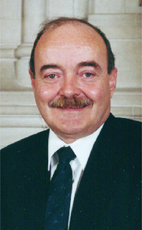
House of Commons photo

Crucial Fact

  • His favourite word was quebec.

Last in Parliament May 2004, as Independent MP for Chambly (Québec)

Won his last election, in 2000, with 50% of the vote.

Statements in the House

Government Contracts May 9th, 2001

Mr. Speaker, the minister of public works explained that the $615,000 contract was awarded to Groupaction to evaluate the sponsorship system across the country. The Globe and Mail says the opposite, contending that for $615,000, the minister only received a 20 page list of companies interested in getting sponsorships.

Does the minister confirm that all he got for $615,000 was a list of companies? It is a lot of money for each page.

Canada Information Office May 8th, 2001

Mr. Speaker, after the ministerial tours in Quebec paid for with public funds, we are now learning that the government is using the financial resources of the Canada Information Office, the CIO, to conduct a poll for political purposes, this for a mere $193,000.

Will the minister of public works admit that this further evidence that the government is using the CIO's resources for partisan purposes and that it confuses the interest of its party with that of the public?

Supply May 8th, 2001

Madam Speaker, I wish to congratulate the hon. member for Toronto—Danforth for his recent conversion to the virtues of fully complying with the constitution. This is a great novelty, and I do hope it reflects a new Liberal tendency.

As we are dealing today with drinking water, the Liberals are suddenly determined to fully respect the areas of provincial jurisdiction.

Is the hon. member giving us a scoop and telling us that the government is now dropping the infamous millennium scholarship program so vigorously condemned, particularly by Quebec but also by other provinces, as interfering in provincial responsibility for education? Is he announcing, for the Prime Minister, that the Romanow commission on health care is a thing of the past, that it is over and done with, that the government will not interfere with Quebec's health care sector? Should we now conclude from the member's speech that these are the new tendencies of the Liberal Party, the party in power?

I would like the member to explain his position. Members will agree with me that it is surprising to hear the member for Toronto—Danforth repudiate the federal government's interference and its centralizing power in areas under provincial jurisdiction.

Supply May 1st, 2001

Mr. Speaker, I listened with great interest to the speech made by the member opposite. I share the opinion of my colleague, the member for Mercier, who was telling the minister a few moments ago that what troubles her—and it is troubling, even if the minister does not like it when we say that he did a complete about-face—is the fact that he changed his position dramatically with regard to chapter 11.

If it makes him happy, let us say that he did not do an about-face, but rather that he failed to give us an explanation and that, like the member who just spoke, he does not seem to be aware of the deadly political implications of chapter 11. Once adopted, chapter 11 could prove disastrous to future generations.

Governments can make mistakes and they have. I saw maybe 35 finance ministers table 35 budgets year after year, and they all said their budget was the best that had ever been prepared and presented to the people. Nevertheless, we ended up with a huge debt.

If the member takes for granted that governments do not make mistakes, would it not be fair, in case they make one some day, to discuss with the opposition in order to find mechanisms that could, should there be a threat, allow parliament to express its opinion on the matter? I am not sure the Liberals have a monopoly on the truth.

Canada Elections Act April 5th, 2001

Mr. Speaker, I am pleased to take part in this debate to support the amendment moved by the member for Lévis-et-Chutes-de-la-Chaudière. Under the proposed electoral reform, the Senate, that group of wise individuals who represent the financial interests of Canada's economic elite more than they represent the Canadian people, is to be consulted.

I think that these people, who are not elected, should not impose their view of how members of this chamber should be elected. This would give them a power and authority that they do not legitimately have because they are not elected.

Nor can I let pass without comment the views of the Canadian Alliance member who is all for what was described in the Charlottetown accord as a triple-e Senate: elected, effective, and I forget what the third e stands for.

I would like the member to give this some thought. The Bloc Quebecois is saying that the Senate should be abolished; it no longer has a role to play. The Senate had a purpose in the time of Caesar in ancient Rome. But I ask the member who is waxing on about the beauty and grandeur of an elected Senate what happens when an elected Senate opposes a policy of the governing party.

We have experience of this in Quebec. At one point there was an independence party in power in Quebec and 75 federalist MPs representing Quebec in Ottawa. The federalist MPs said “We represent the views of Quebecers just as well as MNAs do”. What happens when an elected Senate tells the elected representatives of this House “We represent the Albertans who elected us just as well as the Canadian Alliance, 23 of whose 26 candidates were elected. We are just as legitimate as the Alliance”?

This is where things get tough and complicated when a second elected House wants to have its authority recognized and sometimes claims to have greater authority than the elected members of this House. Instead of solving the problem we are inviting squabbles between elected members in both houses.

We used to have that situation in Quebec. This is nothing new. Until 1965 when it was abolished, we had a second chamber called the executive council. Nobody in Quebec has ever asked for the reinstatement of this provincial institution. It has never been said in print or elsewhere that this was a great loss for democracy or for the Quebec people. For all intents and purposes, this assembly of unelected members did not represent in any way the day to day interests of the public.

Now that my distinguished colleague of the Alliance who spoke so highly of the triple-e Senate has finished his discussion with his colleague, I would ask him to think this over. He said that in Alberta his party won 23 seats out of 26. If we had an elected Senate, senators elected in Alberta would be able to work against the elected Alliance members of Alberta. We would end up with the same kind of situation we had with Trudeau. He was a member from Quebec in Ottawa and he said that he represented Quebecers as well as the Quebec government did. He even said we were a tribe and many other things besides.

Members can see the dichotomy this created within the population of Quebec between the federalists and the sovereignists. At this point there would be a similar split between the Alliance partisans and the Senate partisans, if we can put it that way.

The position of the Bloc Quebecois is to abolish this outmoded institution which dates, as I said, from ancient Rome before the time of Caesar. It is very costly, adds little and defends little or rather does not represent the day to day interests of the public. These are people who are, more often than not, being compensated for services rendered.

I agree with the member who said that in the United States a person has to be elected to become a senator. In Canada, a person has to be defeated. A person must have run in a riding during an election, lost or been rejected or revoked by the public. This is the way to become a senator. This is the history of the Senate in Canada.

Most of those who sit in the Senate are being thanked. It is a way of recognizing service which, at times, has nothing to do with the administration of a country. It is pure and simple recognition for support, a hand up, a kind word with respect to the Prime Minister during an election, for example, or an attempt to influence the public during a vote which is compensated by an appointment to the Senate.

For example, there are appointments in other areas. I learned that my adversary in 1993, the person running against me in Chambly, is now the president of the Canada Post Corporation. I am delighted at his appointment as, he is a competent individual. This is perhaps not the usual way to get this sort of job, but luck arranges many things. The current president of the Canada Mortgage and Housing Corporation is, in my opinion, a competent individual, and I am delighted at his appointment.

However, I know lots of others who had absolutely not one ounce of administrative ability or anything else. As a reward for running or for getting absolutely slaughtered in the polls—because they knew in advance that there was no hope of victory in a given riding—they were told “Run, and you will get your reward”. Depending, I presume, on people's qualifications, they ended up at various levels of government bodies or agencies or crown corporations. Some of them are here on the Hill in ministers' offices when their only qualifications are to have been a defeated candidate.

We are saying that this change to the Elections Act, is necessary. The chief electoral officer, a neutral citizen, must be given authority. Until now his neutrality in performing his duties has never been questioned. The Elections Act contains many shortcomings.

All members here are elected. As the hon. member for Beauport—Montmorency—Côte-de-Beaupré—Île-d'Orléans has said, no one has ever been elected to this place after campaigning at gun point in his or her riding. We are all representatives of the people, democratically elected and entitled to hold a seat in this place, even if this does not always suit those who are seated on the opposite side of the floor. The opposition has a right to be here under our parliamentary system and it plays an important role.

In my opinion, there are many things that need changing. Surely electronic voting will be one of those changes. The bill permits electronic voting to be used, but there are some other points that are questionable. For instance, for the owner of a nursing home to be able to vote for all his residents is somewhat undemocratic, in my opinion.

Thought should perhaps be given to having a voter's card because there is too much of this kind of substitution. There are people who vote eight, ten, twelve, fifteen times on the same voting day. Unfortunately the legislation governing the last election was new as well. It had been substantially amended and instead of improving matters it made them worse.

In the future, I hope that electronic voting or some other process will bring about an improvement instead of the opposite.

Supply April 3rd, 2001

Madam Speaker, I do not know whether the hon. member across the way has managed to convince himself, but he has certainly not convinced me.

I have been involved in transactions for twenty years, and I have sold shares like this. When there is a sale of shares that involves an unpaid balance of $300,000, normally guarantees are set out. Normally, such a contract would be a minimum of 20 pages.

However, if the member opposite claims to know the whole truth of the Prime Minister's saga, perhaps he could explain how the Prime Minister's company, a numbered company, bought from Consolidated Bathurst, at one point, nearly half the riding of Shawinigan for one dollar and other fair and reasonable considerations? Could he explain what these considerations were, he who claims to know every aspect of the Prime Minister's personal transactions?

I put this question to him, he who alleges difficulties in the case of certain members of other parties. This involves a contract worth $300,000 with a $300,000 balance of the selling price. It is true that the parties' intent is capital. It is true that it could be written on the corner of a napkin, as he says, except that generally there are guarantees.

If the member's logic holds, how is it that the Prime Minister intervened in the second sale in 1999, this time to support burdens more onerous than those contained in the first agreement of sale, which was an absolute sale, apparently in 1993?

If he no longer had them in 1993, how could he be party to the sale in 1999? This would be enough, if he is of good faith, to raise questions, and good ones, and try to come up with a response.

Division No. 36 March 26th, 2001

Mr. Speaker, I congratulate my colleague for this most interesting speech. She was just telling us that some people within the justice system were opposed to the introduction of this bill, whatever the member opposite may say.

I would like her to tell us who are these serious stakeholders who have spoken out against the bill. I would be interested in knowing if the Barreau du Québec, the professional body of which the member opposite who is shouting so loud is a member, has expressed its views on this issue. I would like the member to tell us.

Supply March 15th, 2001

Mr. Speaker, I have a question for the minister.

I would like him to explain how it can be that in the United States when there is a dispute, when an appeal is won, and I presume the decision must be executed as in a regular court, it does not work that way for the Americans. Even if they lose, they try a kind of blackmail on us and we end up forced to negotiate what is coming to us as a result of the decision by the trade tribunal. I am not laying any blame whatsoever on anyone.

I would just like him to explain how, even if we win out, they will not comply unconditionally but come after us with other agreements on milk, eggs, yoghurt, margarine or mayonnaise. Do the Americans only use free trade when it suits them? That is what I would like explained.

Supply February 20th, 2001

Mr. Speaker, it is always very interesting when new ideas such as these are advanced. The danger, however, comes when they are taken to extremes. A politically correct attitude can go too far.

I worked in a party that talked about proportional representation. One thing led to another and suddenly all sorts of minorities—visible and invisible minorities, women, sexual dissidents—wanted to be represented in parliament. The result would be that one person could have four votes: one by virtue of his citizenship and three more by virtue of his other attributes. Is this not a danger?

Supply February 15th, 2001

Mr. Speaker, I listened with great interest to the comments of our colleague from the New Democratic Party.

Unfortunately, like her and like most of the members here, I know very little about these negotiations. Everything is secret. The discussions are kept incommunicado and we do not know what the talks are all about.

Besides all the concerns expressed earlier by my colleagues on this side of the House, one issue worries me especially. Maybe it is no longer the case, but the member made a brief reference to that situation earlier. I wonder what a country like Canada will gain from such negotiations, when we know what is going on in some countries which, out of courtesy, I will not name.

For example, a few years ago, in the copper mines of a certain South American country, children, young girls, worked in water and mud up to their waist, carrying pails of the clay soil from which copper is extracted. These six, seven or eight year old children suffer from arthritis just like old people.

I wonder if my colleague worries about that. Why should we negotiate a free trade agreement with countries where citizens are treated that way?