
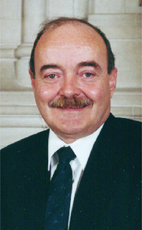
House of Commons photo

Crucial Fact

  • His favourite word was quebec.

Last in Parliament May 2004, as Independent MP for Chambly (Québec)

Won his last election, in 2000, with 50% of the vote.

Statements in the House

Employment Insurance Act February 13th, 2001

Mr. Speaker, I have followed the debates that have gone on since this morning with considerable interest, especially since the party in government invoked closure, with the aim of preventing us from speaking more and perhaps from looking more closely at the whole employment insurance system governing workers and work in Canada and Quebec.

Employment insurance, it must be understood, is a sort of mutual insurance, a kind of insurance frequently found in Quebec, although less and less so now, because what was mutual is being demutualized.

The federal government's approach and concept of the employment insurance plan was to guarantee real mutual insurance. Thus, workers fearful about one day losing their job decided to contribute an amount of money in order to create a fund for themselves that would help them, in darker days, to continue their day to day existence, meet their obligations, the first of which is to eat. That was the aim of employment insurance.

Unfortunately, this government is incapable of revealing its true objectives to the people of Canada. It is incapable of telling it like it is and incapable of saying that to eliminate the almost immeasurable accumulated debt of $680 billion, sales taxes or gasoline taxes, already fairly high, or income taxes had to be increased.

The government would rather get its hands on the surplus that was generated to benefit the taxpayers, not to let the government use it to pay back the debt, the deficits that have accumulated over the years. The government's only concern is to show that federalism is profitable and that everything is fine, that the government is rolling over in clover. That is not true. The government is using money it should never have been allowed to grab. The auditor general recently said so.

The previous speaker pointed out that since the government has been in office the premiums of the employees have dropped from $3 to around $2. This is a significant amount of money to pour back in the economy. However, for some five years now, we could have maintained the current EI system without charging a penny more to the workers, because with the surplus we would have been able to meet the needs of all the EI contributors.

Unfortunately, the government lacked the political will to increase the taxes in order to reduce the accumulated deficits. Instead, it chose to ignore the problem. Employment insurance rules have been changed; only 42% of people qualify for it. Yet, 100% of them pay premiums the minute they start working, but the government says nothing about this.

It is as if someone were to take out property insurance and the insurer were to say “If your property goes up in flames, you have four chances out of ten of getting paid, but you must pay 100% of your premiums and pray God that your property will not go up in flames”. This is somewhat the same thing.

The auditor general recently came here and supported the opposition's arguments. There is no basis, no calculation to scientifically establish the workers' contribution rate for employment insurance. It is pulled out of a hat. Things are not so bad. Since much of our debt is owed to foreigners, with the fluctuation of interest rates on the international market, contributions to employment insurance are reduced or maintained at the same level for a while, without any kind of ability to objectively and correctly assess the needs of the plan.

Certainly, if we constantly draw on the employment insurance fund to pay for the accumulated national debt of almost $600 billion, we will never be able to contribute enough to pay off such a debt. Was this the true objective of the employment insurance plan when it was created? Let us not forget that it results from a federal-provincial agreement, from a constitutional amendment made in 1943, I believe, that transferred the whole employment insurance sector from provincial to federal authorities.

People put their confidence in the federal government. We now see the results. In Quebec, we are now used to this, and we no longer have any illusions about these people. That is why members on this side of the House would rather take off with what little they have left now, because in a few years we will have nothing left.

As for the health system, the federal government used to contribute 50% of the costs in the provinces. Now it is barely paying 15%, but it sets the standards. This is like inviting someone to a restaurant and footing the bill while the person decides on the menu. It takes some nerve to act like this. Such is the story of the party opposite.

Let us talk about women's issues, including parental leave, as they relate to this bill. There are studies—and the Liberals know them as well as I do—which show that women are paid less than men. This is not from me. Women are certainly aware of that situation, because they went all the way to the Federal Court of Appeal to defend the principle of pay equity. The government was paying women less than men. It was told so by a number of courts and administrative tribunals. The government threatened until the last minute to take the issue to the Supreme Court of Canada, to challenge the principle that equal work should mean equal pay for women.

It is the same thing with employment insurance. The same old principles that have been governing the Liberals for eons are resurfacing. A pregnant worker is not entitled to benefits unless she has accumulated 600 hours of work. There is no exception to this rule. There are pregnant women who, because of the very nature of their work, because they are exposed to certain risks such as computers, radioactive rays and so on must, on the recommendation of their doctor, stop working before having accumulated 600 hours.

The bill does not provide exceptions for such cases. No, the rules are very strict. It is always black and white for the party in office. That is the law and that is it. They make it and they impose it.

The Liberals are really not exercising the wisdom of Solomon. The hon. member for Hochelaga—Maisonneuve is studying law in his spare time, but it is not a waste of time.

Even though he is doing it in his spare time, it is not a waste of time. He has become a legal expert who can be pretty convincing. He will tell members the same thing I am telling them now. We could have done away with EI contributions for several years, as the auditor general told us. The government would have been able to maintain the program. Now it is going to take $30 billion from those who work hard to earn a living and use that money to pay off the debt Canada has accumulated over the years to cover this government's wild spending.

We are talking here about $2.8 billion. I see you nodding in agreement, Mr. Speaker. The embassy in Tokyo cost $2.8 billion. Five thousand dollars does not even cover the value and the surface area of the embassy grounds. Such lavishness is just incredible. Yet, young women with young children who are unfortunate enough to lose their jobs are condemned to live in misery by this government. It has no qualms about letting these people starve. That is poverty.

When we talk about poverty, that is the kind of poverty we are talking about, and not the poverty of the billionaire friend of the government who made only $250 million instead of $500 billion on a government transaction involving a 40 year lease. He is not the one who is poor. The one who is poor is the woman who arrives at work one morning and is told that there is no job for her any more. It is the woman who is told by her physician that she must stop working because she is pregnant and unable to go on. That woman does a lot for society. I know my friends opposite are totally insensitive to this kind of misery.

Supply February 8th, 2001

Mr. Speaker, I listened with great interest to the comments by the member for Arthabaska, and I have a question for him.

I have read all the editorials, especially in Quebec. Members will forgive me for reading the French ones in particular, but I assume the English language newspapers are saying pretty much the same thing. Throughout this whole business of handing out contracts and favours, the Prime Minister has been saying that he is an ordinary MP and that he is doing his job as an MP.

The editorial writers are saying that this is not true; he is not an ordinary MP. Democracy imposes him on us every three years and four months, or thereabouts, but once elected our Prime Minister is a dictator. He has the discretionary, decisional power to hand out money without being accountable to anyone. Can he claim to be an ordinary MP like I and all the other MPs on this side of the House? Is he not something more? That is the first part of my question.

The second part is this. In a divorce proceeding would it be considered normal for the mother of one of the parties seeking divorce to also serve as the judge and award child support, assign fault, and determine access? It seems to me that one could say that this is not transparent, even if the mother-in-law in question were mine—she is very fair—and if she perhaps had a tendency to favour me, which I am not in any doubt about. One might wonder whether her ruling was an impartial one.

During the election campaign did the ethics counsellor not come up with his decision a bit too quickly, before he had all the facts? Does this not leave him open to criticism for the simple reason that he was appointed by his friend, that he is acting for his friend, and that his decisions favour his friend? I would like to hear what the member for Arthabaska has to say about this.

Supply February 8th, 2001

Not a one.

Supply February 8th, 2001

Mr. Speaker, I have been listening to this debate for a while and I want to warn the Chair that the proposal by the party currently in power will literally change the nature of opposition days in the House.

What we call an opposition day, unfortunately for the government, is not generally a day of praise. What the House leader of the party in office has said will turn opposition days to the advantage of the party in power.

To remedy that there will be a vote this evening, or a deferred vote, if the party in power does not agree with the proposal and the amendment by the opposition parties. It can always catch up, with its parliamentary majority, in the vote at the end of the day.

I therefore ask that the Chair pay careful attention to avoid creating a dangerous precedent for the opposition, which is in the minority in the House, as we all know.

Petitions February 8th, 2001

Mr. Speaker, I am the spokesperson for some 50 people in my riding who are calling upon the government to pass legislation requiring the identification of genetically modified products.

I have just heard it said out in the lobby that it was important for this to be done because people with allergies to certain products are at risk of a major reaction if they do not know the contents of what they are eating.

I recently read an article that said there is a plan to cross tomatoes with spiders. When the tomatoes start climbing the walls, it will be a bit too late to pass any legislation. One may well wonder why such crosses would be done, unless it is to avoid shipping costs and have the tomatoes take themselves to consumers.

Economic Policy October 19th, 2000

Mr. Speaker, I do not have much time, but I do find that the hon. member for Ancaster—Dundas—Flamborough—Aldershot has a colossal nerve.

He says that there were even some deaths in Walkerton because of bad drinking water treatment. Could he at least have the courage to admit that in Quebec and elsewhere in Canada it is in part, perhaps in large part, the federal cuts that have made it impossible for the provinces to respond to their people's needs in the health field?

Let him at least have the honesty to admit that.

Youth Criminal Justice Act September 25th, 2000

Mr. Speaker, I have not had the chance to speak to this bill before, and the many parliamentary duties I have to perform almost prevented me from studying it closely.

It is not as a legal expert or as a person who is knowledgeable in this field that I want to take part in this debate today, but as a father of five. It is not easy to know what goes on in a young person's head, particularly if that person has suffered from socio-affective problems, maternal deprivation or other problems of that kind.

I would like to tell a little story. One day, I went hunting with my four year old son and we had a flat tire. For those who know a little bit about cars, I took the bolts from the wheel and put them in the hubcap, which I left on the road. While I was removing the wheel, my son took the hubcap containing the bolts and threw it as hard as he could into the woods. What was he thinking? I was not very happy, but it is hard to predict what a child will do.

As our colleagues from the Alliance, we are all appalled when we hear about a criminal act or a brutal assault like the one that happened in England a few years ago when two boys aged 10 or 11 killed a two year old boy. Of course we were all appalled. We see these kinds of things once in a while.

However, is revenge society's right? Rather, should it not act to protect itself and individuals, especially when they are as pretty as my party's assistant whip? Kidding aside, society must protect itself. But should it bear a grudge? Should it punish, and vengefully so? I believe we are heading in the wrong direction when we claim society should exact some kind of vengeance on individuals, in particular young people, since they are at issue today.

I did not read or see the statistics, but I heard them and they tell me, and all the experts and those versed in this area, that in Quebec youth crime has really dropped. Earlier the member for Portneuf very convincingly said that youth crime fell by about 23 p. 100. This is worth noticing, and I believe we should stay the course.

I had the opportunity to work with someone who made a mistake when he was young, he killed someone. Fortunately it happened in the early 50s. He spent several years in prison, and when he came to work with us in Sept-Îles, on the North Shore, he kept it a secret, he talked to no one about it. Unfortunately, it became known, eventually, which was a real heartbreak for this man who was sincerely sorry for what he had done in the past and wanted to keep it a secret. He claimed he had paid his debt to society, and I believe he had. He behaved in an exemplary manner, was a hard worker, but had made a mistake when he was young, and he was the first one to be sorry about it.

We are living at a time of rapid communications, when we can fax a photograph. Some 20 years ago, the RCMP and the QPF had bought a publicity slot during Hockey Night in Canada to show what was the ancestor of the modern fax machine. They wanted to show how it was possible, with the methods of communication then available, to send the picture of someone wanted in Halifax to Vancouver in record time.

With the amazing speed of all these methods of communication, imagine what will happen if the name of a young person who has made a mistake and often regrets it immediately is released to the public. How will he escape the condemnation of the community if the facts of an affair are made public by the media? Only one avenue remains. If he wishes to rebuild his life, he could perhaps leave the country.

Society protects itself and I am not against it being able or wanting to do so. But this bill goes further than protection. We have not asked that heinous and highly reprehensible crimes be allowed to go unpunished. That is not what the Bloc Quebecois is calling for. It is simply asking that all the chances be put on the side of those young people who can be rehabilitated.

What I find surprising is that Canadian Alliance members, whom I respect, are asking elected representatives to lower costs, taxes, just about everything. Now that they have an opportunity to take up the call for less, they are calling for more.

It is expensive to keep young people in prison, and experience has shown that those who end up there are more hardened criminals than those who were spared. Spending 10, 12 or 15 years of one's life drinking coffee, playing billiards and being bored does not do anything for one's compassion. Prison is the best school for crime. We all know that. I am not saying anything new to the members opposite.

We want to keep our youth out of there as much as possible, in order to save those who can be saved. I believe this will be better for society. The role of justice is not to take reprisals, to play the role of avenger and to substitute itself to victims. Justice must administer matters in the best interests of the public.

I am surprised, and all the more so when I see the government House leader attack us in the newspaper by saying that the Bloc Quebecois has chosen a path which will cost the House of Commons a lot and that he would not have done that.

I would simply remind him that the cancellation of the privatization contract of the Pearson airport was supposed to cost $225 million. I believe this is what it has cost for Air Canada alone. The last time we checked, I believe the amount had already reached $700 to $800 million. I also remind him of the cancellation of the famous helicopters, which the government now plans to buy once more. How much did that cost?

The government House leader says nothing about those issues. He blames the opposition because it does its work, because its opposes a measure which will be totally unjust and harmful to our youth. The present system already works well in Quebec, where the government administers justice in accordance with the established constitutional order. Why not let the government administer the system the way it does, since it does it so well?

I support my colleagues from the Bloc Quebecois. Even if I am not very familiar with this kind of legislation—we each have our qualities and weaknesses—being more skilled in economic matters.

I support them on this issue. We should never allow ourselves to be guided by grudges or by vengeance, which are bad advisers.

Youth Criminal Justice Act September 25th, 2000

He is a sorry figure.

Species At Risk Act September 19th, 2000

My hon. friend from Hochelaga—Maisonneuve, who has been studying law at night, really seems to know his stuff. He is using Latin words now. He said they went about it ultra petita .

We asked the federal government to get involved and, as usual and as was pointed out by the brilliant member for Hochelaga—Maisonneuve, who will get a score in his law courses that will put the Minister of Justice to shame, the federal government went overboard and used its prerogative to interfere in the protection of endangered species.

It is unfortunate. There will be overlap and duplication, with double the costs, double the number of departments involved and all the bureaucracies around them. The Bloc Quebecois cannot support such a process, which is why we will be voting against this bill.

Species At Risk Act September 19th, 2000

Mr. Speaker, it gives me pleasure to speak to Bill C-33 on endangered species.

I see that the federal government is very concerned about endangered animal species. Unfortunately, it is not as concerned about French Canadians, a species which has been assimilated for the past 150 years, with the result that it has now dropped from 50% of the Canadian population to approximately 25%.

I know that for certain members across the way who are recent arrivals to Canada, this means very little. But I can tell the lady who is gazing charmingly and wide-eyed in my direction that, in case she was unaware, at the time of Confederation there were as many francophones as anglophones in Canada.

Unfortunately, we see the federal government wishing to intervene so that endangered species will have the opportunity to grow, multiply and survive, something, I repeat, that it has always refused Quebecers, whether my colleague likes it or not.

I think that the intention behind the bill is good, except that what we have here is duplication and overlap. What was needed—even the preamble to the bill points this out—is for the bill to pave the way for consultation with the provinces precisely so that this duplication can be avoided.

Six Canadian provinces, namely Quebec, Ontario, Alberta, New Brunswick, Nova Scotia and Saskatchewan have legislation on this, and a list compiled by scientists and their governments establishing which species are endangered or at risk in the province.

The federal government is going to encroach in a heavy-handed way on an area of exclusive provincial jurisdiction. I know that, for the member who earlier was yelling like someone caught in a barbed wire fence, this kind of debate on respecting legislative jurisdiction we have on a regular basis is plain gibberish and makes no sense at all.

To say in the House of Commons, in this very parliament, that constitutional law and the constitution are nothing, when in the mind of members of the Bloc Quebecois the constitution is the basic law which governs the relationship among provinces and among private citizens, is to show contempt to a degree that would not have been thought possible on the part of today's politicians.

The constitution is the law of the land. The Fathers of Confederation decided to balance powers. The federal government was to have authority over international relations, the post office, national defence and the telegraph, which transmitted communications from one province to the next.

However, precedent after precedent, change after change, including legal rulings and mainly the abolition of referrals to the Privy Council in London, have turned it into the quintessential joke.

The Supreme Court of Canada, which has always leaned to the same side, has started to set out principles of constitutional law and the related rules of interpretation, and as a result our constitution has more or less lost all meaning.

I will give you a few examples. We had sections 91 and 92, which gave effect to the powers of the federal government and to those of the provincial governments respectively. The Supreme Court of Canada came up with all kinds of wild theories, such as that of unoccupied fields in estate law.

For a long time, the federal government said “The province is not exercising its right to collect taxes on inheritances in estate law”. It is the unoccupied field theory, which means that the federal government can interfere as long as the provincial government is not exercising its jurisdiction in that field. But it so happens that it is a province's prerogative not to exercise its jurisdiction in a particular area.

Look at what is happening. Recently, a decision was handed down regarding federal interference in areas under provincial jurisdiction, such as property and civil law, including estate law, with the reference on the gun control legislation. The Supreme Court of Canada invented yet another theory by saying “Yes, the federal government can still interfere in areas under provincial jurisdictions in matters of public safety for instance”.

The construction of high-rise buildings also has an impact on public safety. Transportation, be it by tractor trailers, trucks, ships or just plain surface transportation, can have an impact on public safety. One thing leading to the other, the provinces are losing all the jurisdictions they kept for themselves when the Confederation agreement was negotiated in Charlottetown starting in 1864.

Today, we have this bill on endangered species. The habitat of species that are endangered and on the way to becoming extinct, be it a seabed or wetlands, often comes under provincial jurisdiction.

Bill C-33 says that harmonization between provincial and federal scientists is desirable. Unfortunately, clauses in the bill indicate that the federal government is grabbing almost manu militari , proprio motu , the right to oversee the whole thing and is asserting its primacy in the field of endangered species protection.

This is unfortunate, because more confrontation is looming. The hon. member opposite, who is a champion of confrontation, will certainly be involved. Quebec is being told that it cannot look after its own resources and the habitat of endangered species.

I think that moderation and conciliation are preferable. The federal government should have provided in its bill that, following consultations with the provinces, a list of endangered species could be drawn up in co-operation with the provinces.