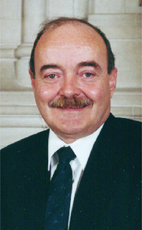
House of Commons photo

Crucial Fact

  • His favourite word was quebec.

Last in Parliament May 2004, as Independent MP for Chambly (Québec)

Won his last election, in 2000, with 50% of the vote.

Statements in the House

Leader Of The Government In The House Of Commons September 19th, 2000

Mr. Speaker, the government House leader thinks we oppose his coming to Quebec because he is a Franco-Ontarian.

I would remind the leader that the Bloc Quebecois opposes visits by all federal ministers touring Quebec at the expense of the Canada Information Office, the famous CIO, in tours organized by the good friend of the Minister of Public Works, Michèle Tremblay, and a former Liberal candidate, Serge Paquette, to whom the Liberals have paid out over $4.2 million since 1997.

Why are the visits to Quebec only? Why the heck are these visits organized by the CIO and not by the various ministers' offices? Why are the contracts for the organization of these visits being given to friends of the Liberal Party of Canada?

The government leader would be better advised to rise in defence of his minority, which has been rather mishandled these days.

Financial Consumer Agency Of Canada Act September 18th, 2000

Mr. Speaker, I listened carefully to the brilliant speech by my colleague, the member for Hochelaga—Maisonneuve.

I have just learned something and I thank the member for it. With regard to community reinvestment—I am sorry but that is what I had in mind—I thought the obligation to give money to a particular sector or a particular activity was automatic. I see this is not the case.

My colleague seems to have a good knowledge of all the aspects of the American banking system. In the United States, where they have community reinvestment legislation, have banks or bankers been exempted from paying taxes elsewhere in compensation for these investments in the community?

I am wondering if such compensation exists. Has the member studied this side of the issue? I agree with the kind of reinvestment he is proposing, namely a reduction of service fees for low income users. In the United States, has the government found a way to compensate the banks by taking less money from them?

The member will understand why I am asking this question. When the current Minister of Finance brought down his 1999 budget, the Bloc Quebecois spoke out against the fact that the minister was being very generous to the richest, namely the banks, and that they should be paying a lot more taxes than they had been up to that point. Despite a slight tax increase in that sector, it clearly was not enough to create social justice as well as tax fairness.

I want to ask my colleague from Hochelaga—Maisonneuve if the Americans do the same kinds of favours as our good finance minister does to his banker friends.

Petitions September 18th, 2000

Mr. Speaker, I am pleased to table in this House a petition signed by 115 people who want to be informed about the food they eat, especially with regard to genetically modified organisms.

Canadians have the right to know exactly what they eat. Genetically modified foods can be cause for concern in many respects.

Therefore, these 115 petitioners are asking the government to make labelling of genetically modified products mandatory.

Quebecers' Fête Nationale June 15th, 2000

Mr. Speaker,

Our love runs deep, in colours bold And flowers are its language proud In many forms we let them say What often is not said aloud The fleur-de-lys, our flag, flies high Accomplishments are taking shape, And as our special day draws nigh, Ourselves we should congratulate Bonne fête nationale, Quebecers.

.CAPS. Jewish Community

Supply June 8th, 2000

Mr. Speaker, I listened very carefully to the comments by my hon. colleague across the way, who no doubt managed to convince herself of what she just said. This had to be a speech that was contracted out by the CIO to someone who wrote it and was probably paid handsomely to do so.

The hon. member said that the CIO was the Canada Information Office, and that Canadians wanted to be informed. I do not deny a government must keep its citizens informed about its policies. But why is that, after the CIO was set up, the first decision that was made was a ministerial order exempting the office from the application of a number of provisions in the Public Service Employment Act and its regulations, especially with regard to hiring?

The office did not want to go through the normal public service channels to do its hiring. It wanted to hire people who espoused its doctrine, who were able to do its dirty work, and shamelessly compromise themselves, people like the infamous Serge Paquette and Richard Bélisle, who were both former Liberal candidates, one in the 1988 general election, the other in a provincial election. One of them was a political attaché to a Liberal MP.

I want to ask the hon. member, who is so concerned about keeping Canadians informed, if she informs them when she is invited to a ribbon-cutting ceremony with the minister in charge of the CIO? Does she inform the taxpayers present at the event that, when Mr. Paquette and Mr. Bélisle attend such events, they are paid $2,500 each, plus 38 cents a kilometre for travelling expenses? Does the Canada Information Office inform taxpayers about these things?

Could she tell us why the CIO does not abide by the public service hiring regulations?

Supply June 8th, 2000

Mr. Speaker, the famous CIO the member for Repentigny is talking about is probably the acronym for cronyism and influence office, or something of the sort.

Is this agency accountable to the public? Do we have details on this? Are those things secret? Did the Auditor General of Canada examine the management and the administration of this agency? In his recent reports, did the auditor general mention certain points that brought about the question the Bloc is asking today? Are there some sources of mismanagement or undue influence or are we talking purely and simply about patronage and cronyism? Really, we should call the agency the cronyism and influence office.

I would like the member for Repentigny to elaborate a bit on the contracts that were awarded without going to tender. To whom were these contracts awarded and why? It could be interesting for the House and particularly for the Speaker who is listening closely.

Supply June 8th, 2000

Mr. Speaker, I listened with great interest to the speech of the hon. member for Regina—Qu'Appelle. I cannot help but find some incredible contradictions between what the member says and who he is.

The hon. member waxes nostalgic when he talks about the Meech Lake accord. But is he not the one who, while at the Privy Council Office, between 1993 and 1997—when his voters apparently sent him to purgatory for a while—worked very closely with the real killers of the Meech Lake agreement on developing the current plan B? That is one contradiction.

There is a second contradiction. The member talks about democracy. Democracy is the backdrop for today's opposition motion. This motion is about democracy. When the government slashes the CBC's budgets, it does more than just that; it interferes in the day to day management of the CBC's activities. The Lester affair is the most recent example, but there were many others before. The government is beginning to control the information.

Since 1960, we have gone from tailored to ready-to-wear clothing and from restaurant to ready-to-eat, fast food. Now, they are working on the ready-to-think, and the member is involved in the process.

The government is trying to manipulate the information in Canada. They talk about the greatest country in the world, about the greatest democracy; that is another contradiction in what the member for Regina—Qu'Appelle says. How should we interpret the member's position on Bill C-20? He talks about democracy, but this legislation will create an imbalance and arbitrarily set a majority for a future referendum.

Is the member aware that, when Ukraine decided to separate, the Russian government voted a law similar to Bill C-20 to prevent it from doing so?

I would like the member, who had the opportunity to work in the Privy Council Office and who is familiar with plan B, to tell us if he worked on that plan. I would like to hear him on this.

Supply June 8th, 2000

Madam Speaker, it seemed to me that my colleague from the Canadian Alliance near the end of his remarks said that this instrument of electoral organization, the CIO, operated only in Quebec.

Is he not afraid, though, that one fine morning—at the moment we have a minister for electoral organization from the Liberal Party of Canada in Quebec, he is using the CIO in Quebec— but is it unimaginable that a Liberal Party of Canada organizer in Alberta, British Columbia or Saskatchewan might one day also use the CIO to unseat Alliance members in their ridings where they live? Canadian unity is not an issue there and yet this is what the CIO does. For the time being, it is doing it in Quebec—and this does not distress the member particularly—but the day it starts its activities in his riding is the day my colleague will perhaps change his tune.

Finally, my question is as follows: is he not worried that the government will use its information for purely partisan purposes? And when a party is mentioned, it is not necessarily the member's party. I would like to know how he sees things.

Supply June 8th, 2000

Madam speaker, after that great speech, I am tempted to ask the minister how much that speech cost us and who wrote it?

The Canada Information Office does not do anything itself. Everything is contracted out. I would not be surprised if the speech that the minister just read cost us $25,000 or $27,500—this is the scale involved.

If the drafting of his speech was contracted out, could the minister table the contract in the House and assure us that it was awarded through a bidding process?

If, as the minister admits, the Canada Information Office is a tool to promote Canadian unity, why is it managed by the Department of Public Works and not by the Department of Intergovernmental Affairs?

Is it because out of all the jobs the Prime Minister has given him, the minister omitted a very important one? Is it because he is the chief organizer of the Liberal Party of Canada in Quebec that the CIO had to be at his service, so that he could do his job as the organizer in Quebec for his party? That is the real issue.

Why is the CIO not under the authority of the Minister of Intergovernmental Affairs, if promoting Canadian unity is its only responsibility?

Supply June 8th, 2000

—or with agencies. The government finds all sorts of schemes to make its friends get rich. This is what the minister never managed to stop. On the contrary, he blindly got on board and was never able to justify his decisions.

He should be brought back to reality so as to recognize, like everyone else here, that such spending to help his friends and ensure his re-election must be stopped.

The government is all over the place. It spends a fortune on the drafting of press releases when it has public servants who could do a very good job at that, believe me. When will the minister stop boasting and bragging with taxpayers' money? He wastes and spends but it is not his money. It is everyone's money, including yours, Madam Speaker.

That is the purpose of today's opposition motion, to say that enough is enough. The government must stop making fun of the public. It must stop taking advantage of taxpayers, making them work so hard and taxing them to the gills, while wasting public money inconsiderately, through extravagant spending, gargantuan dinners and so on.