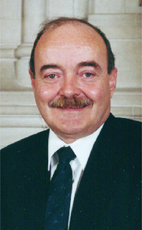
House of Commons photo

Crucial Fact

  • His favourite word was quebec.

Last in Parliament May 2004, as Independent MP for Chambly (Québec)

Won his last election, in 2000, with 50% of the vote.

Statements in the House

Points Of Order February 24th, 2000

It was the only one he had and it got lonely. So he decided to write it up in Le Nouvelliste , where he discussed a co-managed federalism.

I am sure that this article from Le Nouvelliste would inspire my friends across the way if they allowed me to table it. As the hon. member for Chicoutimi said, they would realize that their constitutional obsession prevents them from seeing what it is like in the field and, most of all, from realizing that for once the provincial Liberal leader had an idea.

Points Of Order February 24th, 2000

Madam Speaker, this past weekend, at the young liberals seminar, the leader of the Liberal Party of Quebec had an idea.

Canada Post Corporation Act February 23rd, 2000

Madam Speaker, I am pleased to rise for the second time within half an hour, this time on Bill C-229.

I have great difficulty understanding the attitude of my Reform colleague. This bill originates with a member from across the floor who is most certainly close to the elderly and other more vulnerable members of society. The hon. member obviously wants to defend these people with her bill. CThis is something to be proud of, and I congratulate her for her initiative.

Some people in our society may be rather easily misled. If they are approached with false representations, fake brands, fake images or other devious means, this is a reprehensible act. It may not be legally wrong under the Competition Act, but it is morally wrong.

I believe we need to support Bill C-229. Its objective is to assist and protect those members of our society most in need of protection. I have great difficulty, and always will have great difficulty, understanding the attitude of my friends in the Reform Party. This is not the first time either. The same thing has happened a number of times.

During the last parliament, the member for Portneuf introduced an amendment to the Bankruptcy Act, so that when assets were being distributed in a bankruptcy, employees would have precedence over the banks, and the wealthy. To my great surprise, Reform Party members voted unanimously against that proposal.

I remember another instance. We wanted to limit the penalty imposed for getting out of a mortgage to three months interest. Nowadays, things go so fast that the mortgage lender who is paid back before the end of the term of a mortgage hardly suffers any prejudice, since capital funds are so mobile.

Yours truly had proposed that the penalty that can be imposed by a financial institution be limited to three months interest. Again, contrary to all expectations—I did not understand then and I still do not understand now, three or four years later—the Reform Party voted against that proposal. It is as though the western Canadians, whom they represent, were all very rich and happy to pay penalties when they pay back a loan for farm machinery, or the mortgage on a silo, a house or a barn.

It is this far right attitude that makes these people difficult to understand. We have a duty to protect the most disadvantaged, those who are most likely to be affected by illegal marketing, ploys and schemes. Again, I find it hard to understand the Reform Party's attitude.

Reformers seem to think “It is a free for all. If someone succeeds in fooling an elderly person, so be it. These are the rules of the game, the rules of commercial competition”. But what about ethics?

I think that they are forgetting something important, commercial ethics. It is a question of what is right. It is not my intention to say that the Reform Party members lack moral standards, although they seem shy about expressing them here. Yet this is the perfect place.

We must congratulate the member who introduced this bill on her initiative. I hope that she will be able to introduce others in future for our consideration. If they are like this one, it augurs well.

There are parliamentarians on both sides of the House who respect their fellow citizens and are concerned about their well-being and who introduce bills that reflect this. It is not easy to get a private member's bill this far. Sometimes, it takes the signatures of 100 other parliamentarians for a bill to be debatable and votable here.

Often political life throws us into various committees. They are not the best place to make friends and it takes a lot of courage and nerve to go through the hoops anyway and approach people with whom one has sometimes had run-ins or “coltaillés” as we say in French. The member for Matapédia—Matane will know what I mean by “coltaillé” as will the member for Stormont—Dundas—Charlottenburgh, who is also a francophone and knows our colourful expressions.

It takes courage to approach members individually for their signature and sometimes to get them to set aside their petty grudges. But when members succeed at this, that shows respect for democracy and for their fellow human beings. When one makes it through the procedure that the member embarked on and a bill gets this far, it is no longer the time to tear it apart and toss it into the wastebasket. It is the time to debate it. It is the time to recognize its merit. It is the time to take the necessary action.

I will not go on, but I congratulate the member. She can count on my personal support and that of the Bloc Quebecois members, because her bill shows respect for the individual.

Municipal Grants Act February 23rd, 2000

The hon. member for Chicoutimi tells me that the government took $50 billion through all sorts of schemes.

We have reasons to be concerned about Bill C-10, considering the exorbitant discretionary powers that the minister wants.

My party knows that municipalities have needs, and the Liberal Party knows that too. The Liberals are putting the pressure on us. They are asking for the unanimous consent of the House to pass this bill by 1.30 p.m. on Friday. They want this bill to be deemed to have been passed without any debate, because municipalities have been asking for this legislation. They are holding the municipalities by the throat. They introduced this bill in mid-October. They fooled around a bit with it in committee. Then, at the last minute, they say “Hurry, the municipalities want this bill. You must adopt it without any discussion”.

If I were member of a municipal government, I would worry because there is absolutely no guarantee that everybody will get their due when discretionary powers are used.

I can no longer trust Liberal ministers anymore because, they act just like the highwaymen of the last century.

The Bloc Quebecois made suggestions and proposed amendments. If I remember well, we introduced more than 50 amendments. They were all rejected by the liberals because they had just defined the discretionary power they wanted to be able to help themselves to other people's money. That is what we wanted to avoid, but they rejected all our suggestions, and I understand why.

Of course, the Bloc is disappointed and I assume that my colleagues from the Conservative Party are also. We demand more transparency in the management of the public's business, but the more we ask, the less we get. Everyday during question period we hear real horror stories like the shifting of funds from Rosemont to Saint-Maurice. If I were the former minister responsible I would not laugh like the hon. member opposite is doing right now. It is no laughing matter; it is rather sad.

I remember that when we asked this individual, during Oral Question Period, to explain what was going on, he answered that 42% of workers who contribute to EI are entitled to EI benefits. He was the link between the officials of his department and parliament.

He never monitored anything, and went down the wrong way on a one way street, as they say. In the meantime, he got it in the teeth because his officials were doing things behind his back. Maybe, as he was here trying to defend his department and good management, the Prime Minister was plotting behind his back. If I were him, I would not be bragging today. The same thing is going to happen to the minister in charge now.

Canadians want more transparency, they want to limit discretionary powers as much as possible, they want them to be monitored and checked. But it is not in the bill. The bill says “The Minister may”, “If the Minister is of the opinion that”, “in the opinion of the Minister”. When a minister is made to think, it gets very expensive for those who never asked him to think in the first place.

It is dangerous. When a minister thinks, he often spends money too. And who gets to foot the bill? The unemployed workers once again, because there is only one continuous source of money, namely the EI fund. Therefore, it is the working poor—who do not have the time to watch the debates, who watch the news once in a while, and see the scandals that are happening, the poor people who are working hard to eke out a living and pay their taxes—who will foot the bill.

In the meantime, the Prime Minister and the minister are rolling in it like piglets in the trough, because it is somebody else's money. It is sad but true.

We are therefore going to support this bill so as not to penalize the municipalities. They are entitled to the respect of the opposition and of all parties. We on this side of the House, the combined opposition parties, are almost alone in respecting organizations or people. Members opposite have no respect for anything.

We respect the municipalities and will support the bill before us, but not with any enthusiasm. We will support it because the government members have the municipalities by the throat and are threatening not to give them one red cent until the opposition agrees to pass the bill. So we are giving our approval, but reluctantly, not because it is a good bill that would be to the credit of the government opposite. It is a bad bill that the municipalities are forced to go along with and that the opposition parties are forced to support so as not to penalize the municipalities.

Municipal Grants Act February 23rd, 2000

My colleague from Matapédia—Matane tells me that the only thing left to tax is shrimp and I am pretty sure they are going to do that too.

At some point in one's life, however, there has to be a minimum of scruples. It is all very well to attack widows, orphans and the poor. Unemployment has never been attacked. The unemployed have been attacked instead. The poor people have been attacked instead. That is the history of this government.

Now it is gloating over billions of dollars. In a few days, on Monday, February 28, the Minister of Finance will bring down his budget. He will be wearing his new shoes and a flower on his lapel, and he will tell us that things are going great, when in fact he got his surpluses by literally robbing taxpayers, by taxing them indirectly under the cover of employment insurance contributions and other things. The minister did not have the courage to tax directly, as the previous government did, and I recognize that.

When it came to taxes, the previous government knew where to collect them and it called them taxes. This government dips into the employment insurance fund. It takes out as much as it possibly can, to the tune of $24 billion or $25 billion annually. It reduces transfers to the provinces. Things are not going well in hospitals, both in Quebec and elsewhere, because of the federal government.

Municipal Grants Act February 23rd, 2000

And the people of Quebec, naturally.

Champlain had gone as far as Lake Champlain, one of the great lakes, which is now in the United States, unfortunately. The irony of it is the fact that Hudson, who had started from the other end, nearly met Champlain in the same period. They missed each other by 60 kilometres. Some were discovering from the south, Champlain was doing his discovering from north to south, and they almost met on Lake Champlain. I know that not many of those opposite are aware of this, but for us in the Bloc Quebecois, this is a fact of history everyone knows.

Not only do these people not know the history of Quebec, they also do not know the problems of the municipalities, which are having to cope with all sorts of economic imperatives and are sweating blood trying to make ends meet.

The federal government has laid hands on the employment insurance fund, and has managed without any scruples to get billions of dollars away from poor folk. I am thinking of the fishers in the maritimes and Quebec, the people of my native Gaspé.

They are in dire straits because of the decision by those in charge of Human Resources Development Canada, under the leadership of this heartless government, to make use of the employment insurance fund for its own purposes. They decided to use all the billions of dollars the fund generates to carry out partisan politics and to do my colleague, the honourable member for Rosemont, out of a considerable sum, in favour of the Prime Minister of Canada who represents the riding of Saint-Maurice.

I know. Madam Speaker, that my statements may be disturbing to you, but you also realize they are the truth.

Municipal Grants Act February 23rd, 2000

Mr. Speaker, you are a man of your words. Indeed, last Friday, when 1.30 p.m. came around, you told me I still had 25 minutes and 54 seconds. I will not argue about the 54 seconds.

At that time, I was in the process of telling my Liberal friends opposite that the infamous discretionary powers have always caused the downfall of ministers. Most of those ministers who were caught red-handed, as I said, fell prey to some discretionary power. Never anything else. I had also shown how, when it comes to justice, the current government often applies a double standard.

I had then talked about the current scandals at HRDC. I was not, however, aware of the one my colleague, the hon. member for Rosemont, announced today when he questioned the minister.

The minister was unable to give an answer, once again and as usual. She could not tell the hon. member for Rosemont that his name, his good faith, his position as an MP, had been made use of to divert funds that would normally have been allocated to his riding. The people of Rosemont were penalized, and theirs is not a wealthy riding. There are many unemployed people, many young people, many single parents, in fact poverty may well be somewhat more visible there than elsewhere. Funding for that riding got diverted to the riding of Saint-Maurice. That is purely and simply criminal.

I notice that the government House leader is seated on this side of the House. Probably so as to distance himself from what the people in his party are doing; I am pretty sure of that. It is sad. He probably realizes it, and that is why he is sitting on this side right now.

The bill before us, Bill C-10, is well intentioned, as always. I think everybody here wants to do the right thing. The bill stems from good intentions. We are always prepared to help others, our fellow citizens and, in this case, the municipalities. What bothers me, however, is the discretionary power the minister is taking upon himself.

Now there is another member crossing over, I think because members opposite are realizing they are in the wrong party. They are probably doing a wrong to the municipalities too. If this keeps up, sides will need to be changed, Mr. Speaker. I wonder if they are going to have a quorum over there, and if we will be able to keep sitting today.

This is a sad event. I personally was opposed to that and said that we must restrict this discretionary power that the minister is giving himself. For example, when the time comes to pay his taxes, the minister thinks “Here is a mayor in a small municipality where there is a federal property. He is not a supporter of our party, the great Liberal Party of Canada. Perhaps he is a sympathizer of the mean Quebec sovereignists”. Or it could be somewhere else in Canada. Perhaps the mayor of a given town is a friend of the Reform Party or of another party.

In such a case, the minister may be less inclined to meet his obligations and pay what he owes in lieu of taxes to the municipality. An opposition party must fight tooth and nail against this kind of initiative, because this always leads to injustice, and prejudice. Sometimes, when we realize that it is the case, it is very late to correct the situation.

This bill comes at a time when we are debating the clarity act. Our friends opposite claim to be the protectors of clarity, the champions of clarity in Canada. For them, nothing is ever clear, except what they do themselves. This time, experience obviously did not serve them well.

Take the definition of “federal property” at subsection (3) for instance. Even the Jesuits, who are famous for knowing everything, would have a hard time understanding this legislation. Incidentally, I must say that I have great respect for the Jesuits. The reverend who is protesting on the other side is a Jesuit, and I have a great deal of respect for him. I may not necessarily share his views, but he is a Jesuit and I respect him greatly.

Take a close look at the definition of “federal property”. It might be necessary to call in the Minister of Intergovernmental Affairs, who understands everything even though he is not a Jesuit, because he is Jesus Himself.

Subsection (3) reads as follows:

(3) For the purposes of the definition “federal property” in subsection (1), federal property does not include a ) any structure or work, unless it is

(i) a building designed primarily for the shelter of people, living things, fixtures, personal property or movable property,

(ii) an outdoor swimming pool,

(iii) a golf course improvement,

(iv) a driveway for a single-family dwelling,

(v) paving or other improvements associated with employee parking, or

(vi) and outdoor theatre; b ) any structure, work, machinery or equipment that is included in Schedule II:

Unfortunately for those who are not familiar with how this works, schedule II is not included. One must go to the library to get it, and even a member of parliament cannot get it for free. The government has decided to save money. For some time now, we have had to pay to get the schedules of an act or the model law, the original act.

Ever on the lookout for savings, the Minister of Finance has now arranged it so that parliamentarians who want to do their jobs and research must now pay for the bills they have to debate, unless they get lucky and the act is revamped. Then the bills would appear on our desks.

Those wondering about schedule II will have to make a trip to the library. Maybe they will have it and maybe they will no longer have it. I cannot say. I continue with my quote: c ) any real property or immovable developed and used as a park and situated within an area defined as “urban” by Statistics Canada—

Talk about clarity.

—as of the most recent census of the population of Canada taken by Statistics Canada, other than national parks, national historic sites, national historic parks, national battlefields, heritage canals or national marine conservation areas;

So much for clarity.

Not all municipalities in Canada are able to call on a legal department to explain the difference between a taxable and a non-taxable federal property. Do those obsessed with clarity know whether or not the port of Montreal is a taxable federal property? I could not find out from the authorities who presented this to the committee.

Right now, when services are brought into our municipalities, when pipes, cables, gas lines and so forth are put in, generally both sides of the street are asked to pay half. But when it is the federal government across the street, it does not pay its share. So any owner across the street from the federal government is stuck, and has to foot the whole bill.

We know that government buildings or structures are rarely small 24 by 40 bungalows or one and a half story houses on a 60 by 100 lot. They are huge. National parks, for example, are immensely huge. Imagine the cost for the people of Quebec City or Montreal who have to pay when pipes are laid, streets are paved and sidewalks are laid in front of a federal building. They cannot say at the moment whether the Plains of Abraham in Quebec City, the port of Montreal or the airports in Sept-Îles, Goose Bay, Newfoundland or elsewhere are also included, and whether the government will pay taxes for them.

There is beautiful Fort Chambly built in my riding under French rule. For my friends opposite, who insist on clarity, I will be clear. In 1601, Champlain had been up what was called at the time Rivière aux Iroquois and is now called Rivière Richelieu, the Richelieu River, and had slept at Chambly. He had a premonition. He must surely have known that one fine day there would be a member of parliament for Chambly who would defend the people of Chambly.

Point Of Order February 23rd, 2000

Mr. Speaker, following the introduction by the Minister of Intergovernmental Affairs of a bill denying Quebecers their fundamental rights, I ask for the unanimous consent of the House to table a document that will enlighten it.

What we have here is an article published on February 21, the day before yesterday, in the newspaper Le Quotidien and entitled “Co-Management Federalism”. What a great expression. Let me read part of it: “The constitutional program of the Quebec Liberal Party is taking form. A Liberal government under the leadership of Jean Charest would try to sign administrative agreements with Ottawa on environment, telecommunications and the international role of Quebec among other things.

A Charest government would like to reinstate the federal transfers to the provinces at the levels they were in 1994 and get its tax points back. The goal would be to recover permanently a portion of the taxes paid by Quebecers to Ottawa up to $8 billion.”

Mr. Charest is finally beginning to open his eyes and to understand that, from now on, federalism must be based on co-management. He is asking for less to obtain—

Point Of Order February 22nd, 2000

Mr. Speaker, following the announcement by the Prime Minister, who introduced a bill denying the most basic rights of Quebecers, I ask for the unanimous consent of the House to table a document that will enlighten the House.

This is a study on social union done by André Binette for the Secrétariat québécois aux Affaires gouvernementales. In this study, Mr. Binette concludes “With the signature of the social union agreement, a historical step was taken. Ottawa will no longer even pretend to respect Quebec's autonomy or its traditional interpretation of the Constitution”.

Modernization Of Benefits And Obligations Act February 21st, 2000

Madam Speaker, I listened with great interest to the comments by the Reform member who just spoke, and I believe he is right. If we were to follow the logic of the people across the way, why elect a parliament, why elect 301 members to this House? It would be a lot less expensive, a lot less costly to elect the nine supreme court justices and to ask them, as they have the monopoly of truth, to legislate as they see fit, which might not always be how the people really want it.

I think it runs contrary to reality to claim, as the member across the way—for whom I have the greatest respect by the way—is doing, that the House must listen to the dictates of the courts, be they high courts, medium courts or low courts. I believe we must give back to parliament its full authority, including defining a couple.

If we define a legal marriage through legal means, in the near future—I guess this is my question to the member for Kelowna—are we not going to create legal children? Or are we going to come up with legal creations which are not anchored in reality? This is the danger. We know people who are living together, who are not in a sexual relationship, but who are economically dependent on each other.

In my riding, there is a brother, of very sound mind, who will have to support his younger brother who is mentally deficient. I had breakfast with him on Saturday and he told me “Why would it not apply to me when I die? I am single, I will never marry, I will never have children, I have only my brother to support. Why could I not see to it that he is looked after, just as they are going to do for same sex couples?” This is why I have great difficulty with this bill.