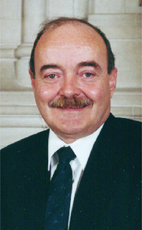
House of Commons photo

Crucial Fact

  • His favourite word was quebec.

Last in Parliament May 2004, as Independent MP for Chambly (Québec)

Won his last election, in 2000, with 50% of the vote.

Statements in the House

Municipal Grants Act February 18th, 2000

A widow came to see me after her husband died. The Department of Revenue had begun to bug him for some paltry amount, a pittance. They went after her husband right to his grave. He was dead, and the letters kept coming.

I am saying that it is not normal when you look into the system, and the Prime Minister wants us to believe there was only about $251 in fraud at the Department of Human Resources Development. It is totally criminal to change and alter truth like that: $251.50. Are we a pack of lunatics here? Tie up parliament for $251.50.

My colleague, the member for Rivière-des-Mille-Îles calculated it on a pro rata basis, the rule of three. The figure involved is $2.8 billion or more exactly $2,750,754—

Municipal Grants Act February 18th, 2000

To give it to whom? To give it to Wal-Mart, to Bombardier, to Pratt & Whitney, to Vidéotron or other such companies under the transitional jobs fund. Do you not think that is disgusting?

Municipal Grants Act February 18th, 2000

Mr. Speaker, it is not up to the member opposite to decide what I will say in my speeches. I know he did not understand anything.

I am showing you the meaning of the abuse of discretionary powers and where it can lead. For those who are not friends of the government, who are not members of the Liberal Party of Canada, it becomes dangerous.

So, my mover muddles his weeks. He did not intend to do anything wrong and there is no benefit for him in doing so. He says he did not work two days he worked, but he says he worked two days the next week he did not work. It amounts to the same thing. He was fined $800. The cheque was recovered, interest was charged and the man was threatened with a charge of fraud. This is how the management of the Department of Human Resources Development dealt with him.

Municipal Grants Act February 18th, 2000

These people have quotas to meet, probably like the minister responsible for administering this act. Perhaps he will be more generous with his friends than with his enemies. When the mayor of a nice town is a potential Liberal candidate in the next election, as was the case with some members now sitting in the House, then the minister can be more generous. That is what discretionary powers are all about, and that is what is dangerous in our system.

At second reading, and in committee, I recall that we asked for the discretionary powers given to the minister in this bill to be delineated. My colleague, also on the committee, went to speak to the Chair, no doubt to ask him to intervene, because they do not like to hear people say such things, to hear about abuse of discretionary powers.

I will give another example. In my riding there is a man who has worked on an on-call basis for many years. He is a mover. When a strong pair of arms are needed, they call him up, because he is a pretty strong, pretty sturdy individual. Sometimes he works a day or two, sometimes not at all. Every two weeks he fills out his employment insurance card.

He made a mistake. For one week, he marked that he had not worked Monday and Tuesday, and for the second week that he did work Monday and Tuesday, when he had not worked that week. He simply reversed the two weeks—

Municipal Grants Act February 18th, 2000

The current minister's predecessor is a sorry figure. He is the true culprit in this whole affair, but the minister is trying to cover up for him. As my father used to say “The one who is holding the bag is just as guilty as the one who is filling it up”.

If discretionary powers do not offend these people any more than that, I will give them a few examples.

A young nurse worked night shifts at the hospital, and when she did, she got a 35 or 45 cent an hour premium for an eight hour shift. She became unemployed, but she did not refuse any calls. From time to time, she got a call to come to work, and the young woman, who had just graduated from nursing school and who wanted to gain experience and eventually find a full time job, said yes. Whether it was a day shift, an evening shift or a night shift, she went to work.

When she filled out her employment insurance card, she reported working on that particular day. Her hourly wage at that time was, say, $15 an hour. She wrote on the card that on that particular day she worked an eight hour shift and earned eight times $15, or $120. Human Resources Development Canada realized that it was not true, that she did not earn $120 but $122 because she had a premium for working the night shift.

She received notices and was given fines. She had a public servant after her for six months and had to pay penalties. She was not given any chance even though the mistake was made in good faith and her hourly wage was indeed, say, $15, as it is generally the case for nurses.

Municipal Grants Act February 18th, 2000

Mr. Speaker, I am extremely delighted today to have the opportunity to speak to Bill C-10, an act to amend the Municipal Grants Act.

We do not want to mislead the population. We talk about grants, but my colleague from Saint-Jean asked last week why we called it grants since they are basically payments of property taxes. As we used to say in law, and my colleagues who have studied in that field have heard it often enough “The King can do no wrong”. That is what is taught to law students on the very first lesson of their very first day in school. Then I could add to that saying that the King does not pay property taxes either.

That is the reason why there is a little subterfuge and the act talks about grants instead of taxes. However, if we look at it more closely, it could very well be real grants. Usually, when we talk about grants, we talk about the discretionary power of a minister. The minister can decide to give or to refuse a grant. In this case, the title Municipal Grants Act is not misleading since the discretionary power of the minister is mentioned in clause 3 of the bill.

There is nothing more scary than the discretionary power of a minister. Seldom do we see a minister having discretionary power who does not end up dirtying his or her hands. We really do not see it often. We have a very good example right now with all the mess at HRDC involving two ministers, one who was there earlier but has left since then and the other one who was not there earlier but is in the middle of things right now. This shows what discretionary power can do.

At the discretion of the Minister of Human Resources Development, $500,000 was given to Wal-Mart. Poor Wal-Mart. It is sad how little money they have. And they are not alone.

The Minister of Human Resources Development and her officials do have discretionary power, and I see the member opposite shaking her head, but it is really a discretionary power even if, under the legislation, the minister has the authority to give grants or to fund programs, there is a highly discretionary component to all these things.

Here is an example. I know I am not a minister and I have no such pretension, but here is an example. Officials at Human Resources Development Canada divided my riding, the beautiful riding of Chambly—and I take this opportunity to say hello to the people of Chambly—into areas, such as area 37 or 38. For these areas to be eligible for the transitional jobs fund, their unemployment rate had to be over 12%.

The county town of Marieville is located in my riding, in the middle of a vast countryside, a largely agricultural area, where of course there is practically no unemployment. You may have a father, a mother and even a son working on a farm, so no one is unemployed.

The unemployed move to the county seat, the city of Marieville, which has high unemployment, in excess of 12%. For a year now, we have been asking the minister to transfer Marieville to the adjacent area, Chambly, so that it could qualify for grants under the transitional jobs fund, thus allowing people living in Marieville to benefit from this program.

This request was made a year ago. It was made not only by myself, but also by the municipal authorities, by Sylvain Lapointe, the mayor of Marieville, whom I take this opportunity to salute and who does an excellent job as a mayor, by the chamber of commerce and by the MNA.

Every stakeholder told the minister that it made no sense to include Marieville in a rural area, while this city which has between 5,000 and 6,000 residents and has high unemployment, but cannot benefit from the transitional jobs fund.

I learned, during oral question period, that the minister have given grants in her riding, where unemployment is clearly lower than 12%. It is not always true that the shoemaker's children are the worst shod, the minister's riding being proof of that. The minister gave transitional jobs fund grants, even though her riding does not seem to qualify for them.

To this she says “Yes, but in my riding, there are some pockets where unemployment is higher than 12%”. The law does not give her that authority. The law says that if in a particular area, which is clearly defined, the unemployment rate is below 12%, that is 11.99%, it does not qualify for transitory job fund grants.

The same applies to the riding of the Prime Minister, who used the same argument during oral question period last week or at the beginning of this week. He says that in his riding there are places—a street, a neighbourhood, a corner—where unemployment is over 12%. But this is not what the law says. It says that in the area as a whole unemployment must be 12% and above.

So members can see what discretionary power is. These people will stop at nothing to meet their ends. Fortunately, once in a while, they get caught, as it happened to the minister.

Do not ask me to show any pity, because what management at the Department of Human Resources Development did is really dishonest. I could give many examples and my friend, the member for Trois-Rivières, has just as many of his own.

Points Of Order February 18th, 2000

Mr. Speaker, I ask for the unanimous consent of the House to table a document which will be of great interest to my friends across the way regarding the passage—

Points Of Order February 18th, 2000

Mr. Speaker, I rise on a point of order. Earlier, we went around and it was my turn to ask for unanimous consent. That is when you stood up. When you did—the rule in this place is that we sit down when the Speaker stands up—I took my seat. But once you had stood up, you said that the member for Chambly was seated and had not asked for the floor, when all I was doing was complying with the standing orders.

I wish to know whether I am entitled to request unanimous consent to table something.

Points Of Order February 18th, 2000

Mr. Speaker, again on a point of order. I was listening to my colleague very carefully, but I do not know which member he was referring to. Could you tell us, Mr. Speaker?

Points Of Order February 18th, 2000

Mr. Speaker, my colleague, the member for Lotbinière had nearly finished his remarks. I was hanging on to his every word. He has only a couple of words left to say, so could you—